


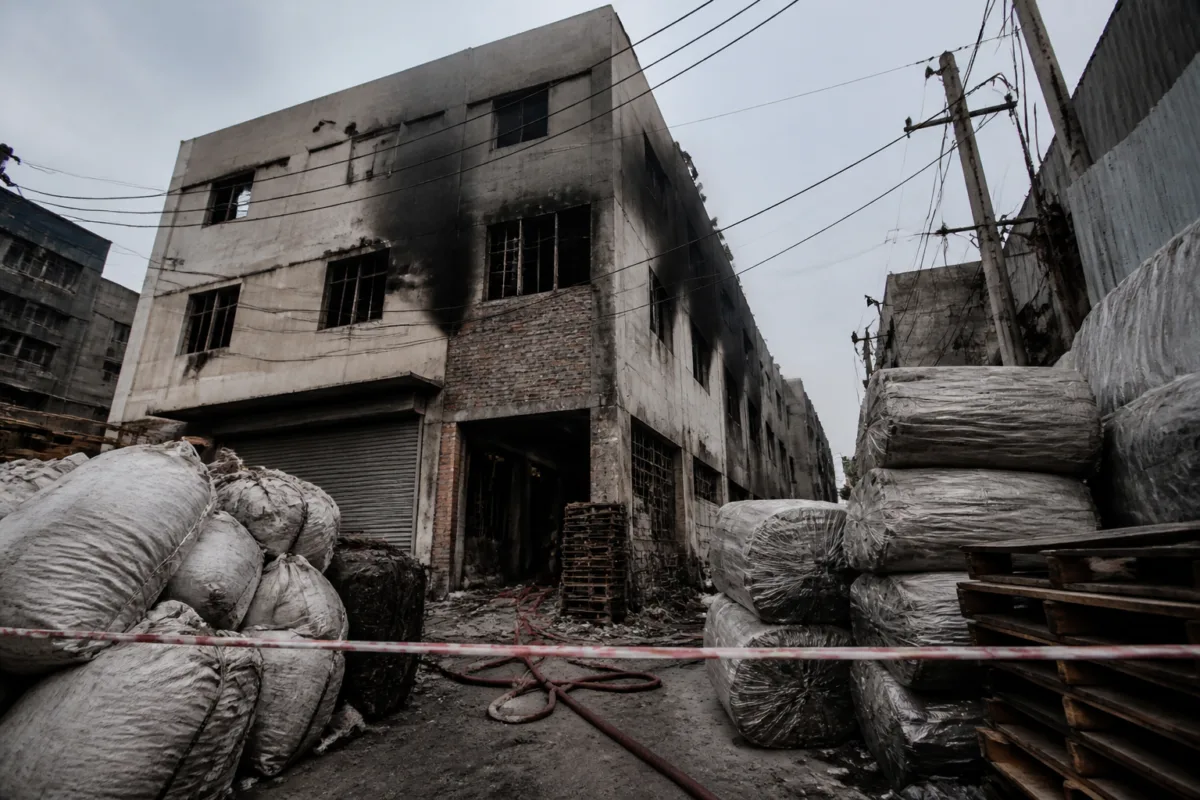
The latest action in the Mangolpuri factory fire case has shifted attention from the immediate tragedy to the chain of decisions that allegedly left workers trapped inside a four-storey industrial building. Police have issued lookout notices against two suspects, including the reported owner of the shoe-manufacturing unit, after the October 30 fire in northwest Delhi’s Mangolpuri Industrial Area Phase-I killed four workers and injured two others. The case now raises a wider urban question: how can a workplace continue operating when its only escape route is reportedly obstructed, its windows are sealed and workers’ concerns allegedly produce no corrective action?
The notices against Mukesh Bansal and Rohit Goyal were issued a few weeks after the fire, according to police sources cited by the Times of India. The notices are intended to prevent the two from leaving the country. Police are also expected to seek non-bailable warrants and may initiate proceedings to declare them proclaimed offenders. These are investigative and procedural steps, not findings of guilt. The police are still scrutinising documents to establish ownership of the factory and the respective roles of the individuals named in the case.
The distinction over ownership is important because industrial fires often expose a gap between the person who controls a premises, the person who runs the business and the person who is formally recorded as its owner. In this case, the injured worker Vikas told police that Bansal owned the factory and that Goyal was his associate. The same account identified Ashok Kumar as the factory contractor and Suresh Chand as the supervisor who frequently visited the premises. Chand and Kumar have been arrested, while the police continue examining documents and alleged responsibilities.
That uncertainty is not a minor administrative detail. Establishing who owned, occupied, supervised or contracted work at the premises is central to determining who was responsible for maintaining safe access and evacuation arrangements. The available report does not establish the final legal position of any of the accused. It does, however, show that the investigation is examining the factory not simply as a site where a fire occurred, but as a workplace whose management structure and physical conditions may have influenced the consequences of the incident.
Vikas’s account describes a four-storey building, including a basement, with only one staircase for entry and exit. Sacks of raw materials were allegedly stored along that staircase, obstructing movement between floors. Workers had reportedly raised concerns about the obstruction with the owners and supervisor, but no corrective action was taken, according to his statement to police. The report also quotes Vikas as saying that workers were told to continue with their work because such conditions were treated as normal.
The alleged arrangement created a single point of failure. Once smoke began moving upwards from the lower floors, workers on the upper levels had limited options. A staircase that was both the only route in and out and a storage area could not function as a reliable evacuation path. The account also says the windows were sealed with glass panes, ventilation was inadequate and there was no alternative escape route. These conditions are presented in the injured worker’s statement and remain part of the investigation rather than an adjudicated finding.
The timeline described by Vikas shows how quickly a routine shift became a fatal entrapment. He and his cousin Ashok had finished their regular shift at about 8pm. After dinner, they returned to the second floor for the night shift with four other workers: Lal Babu, Harender, Prem Chand and Harihar. Around 9pm, black smoke began spreading from the lower floors. As the workers tried to breathe and escape, they allegedly found the staircase blocked by raw materials. Ashok, Harihar, Lal Babu and Prem Chand died, while Vikas and Harender survived.
The incident therefore illustrates the difference between nominal access and usable access. A building may have a staircase in physical terms, but that does not mean workers can use it during a fire. Escape routes must remain clear under ordinary operating conditions, particularly in premises where raw materials are stored and workers occupy multiple floors. The supplied report does not provide the building’s sanctioned plan, occupancy approval, fire-safety certificate or inspection history, so it cannot establish whether the premises complied with any specific regulatory requirement. Those missing documents are nevertheless central to understanding how the factory was permitted to function and whether warnings or inspections were acted upon.
The case also shows why worker testimony matters in investigations of industrial accidents. Vikas’s statement does more than describe the final moments of the fire. It identifies the everyday conditions that allegedly preceded it: material stored along a staircase, sealed windows, poor ventilation and repeated worker concerns. Such details can help investigators examine whether the disaster resulted only from the ignition event or whether the severity of the deaths was increased by preventable conditions inside the building.
At the same time, the available evidence cannot answer several important questions. It does not state what caused the fire, whether the factory had valid approvals, which authority was responsible for inspection, whether previous notices had been issued, or whether the building was being used in accordance with its approved purpose. It also does not identify the nature of the raw materials or explain the condition of electrical, fire-detection and firefighting systems. These gaps matter because accountability in an industrial fire depends on more than identifying people who may have fled. It also depends on reconstructing the regulatory and operational history of the premises.
The ownership investigation is consequently linked to the city’s administrative system. Industrial areas contain multiple layers of responsibility involving property owners, tenants, contractors, supervisors, workers and public agencies. When records are unclear or responsibilities are divided informally, enforcement can become difficult. The police statement that documents are being scrutinised suggests that the case has not yet resolved who held which role. Until that is established, it is not possible to assign final responsibility for the alleged safety failures.
The report also does not establish what action, if any, has been taken across other units in Mangolpuri Industrial Area Phase-I. Nor does it say whether authorities have conducted a wider inspection of buildings with similar layouts or storage practices. That absence should not be treated as proof that no inspection occurred. It does indicate, however, that the immediate case and the broader industrial-area response are separate questions. A criminal investigation can identify suspects and collect evidence, while preventive enforcement requires authorities to identify comparable risks before another emergency occurs.
The physical description of the premises provides a clear measure of the urban risk involved. A multi-storey factory with a basement, a single staircase and workers undertaking a night shift is not an isolated residential setting. It is part of Delhi’s working city, where production, storage and labour are often concentrated in industrial pockets close to dense neighbourhoods. The story is therefore not only about one building or one fire. It is also about how industrial land is occupied, how workplaces are monitored and how workers’ safety is treated in buildings designed or adapted for production.
The most significant evidence in the case is not simply that a fire caused four deaths. It is that the reported escape conditions may have converted a fire into a mass-fatality event. The alleged obstruction of the staircase, lack of an alternative exit and sealed windows are all questions that can be tested through site inspection, building records, witness statements and forensic evidence. The police’s next procedural steps, including applications for non-bailable warrants and possible proceedings against absconding accused, will address the legal process. They will not by themselves answer whether the wider system detected or ignored the physical risks before the fire.
For now, the case confirms three facts: four workers died and two were injured in the Mangolpuri factory fire; police have issued lookout notices against Bansal and Goyal; and investigators are examining ownership, supervision and working conditions at the premises. What remains to be established includes the final cause of the fire, the building’s approval and safety status, the precise responsibilities of each person named, and whether the alleged warnings were recorded or acted upon. Those findings will determine whether the incident is understood as a failure by individuals, a failure of a workplace, or a wider failure of industrial safety enforcement in the city.

