


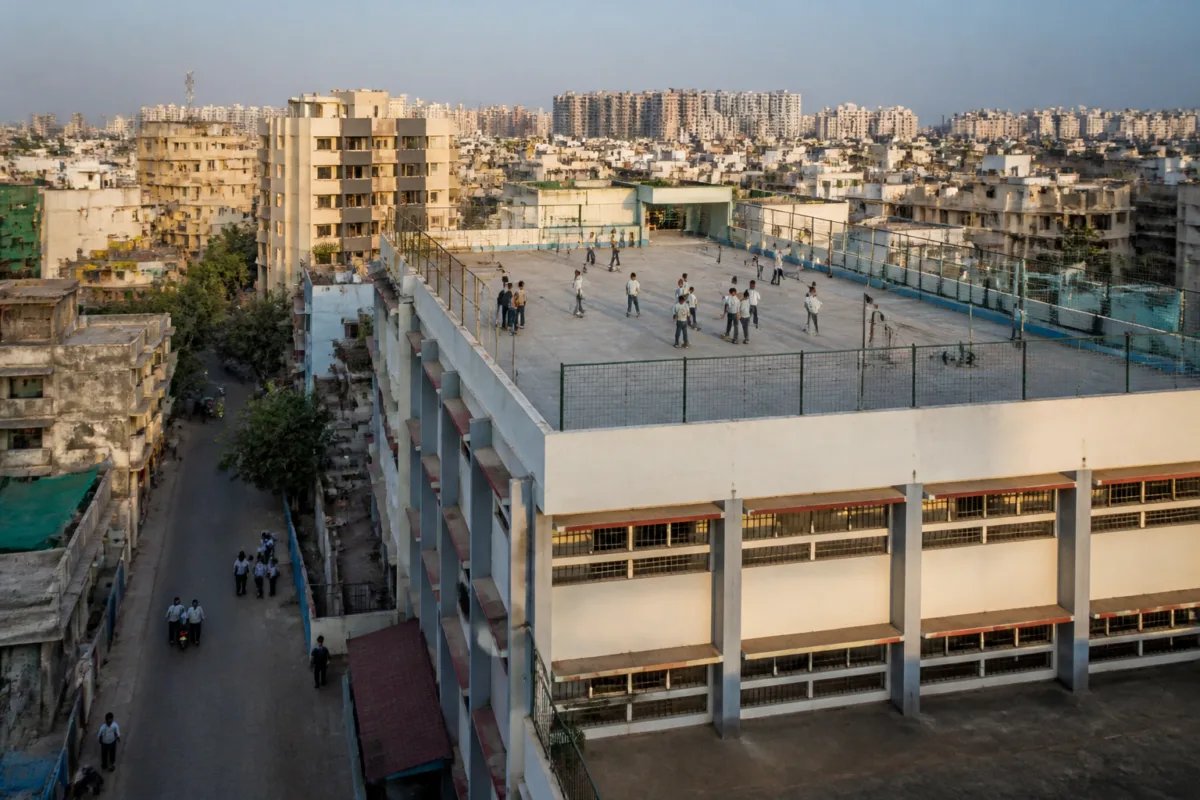
Gujarat’s reported changes to school approval rules have triggered opposition from the Gujarat School Management Association, which says easier permissions for new secondary and higher secondary schools, along with recognition of rooftops as playgrounds, could weaken grant-in-aid schools and reduce access for economically weaker students.
The association’s objection centres on changes to provisions under the state’s secondary education law. According to its president, Bhaskar Patel, the earlier framework restricted permission for another grant-in-aid, government or self-financed school when an existing school was located within a five-kilometre radius. The amended rules will allow a new school to receive approval even when its building is directly opposite an existing school, he said.
Patel said the change could increase competition between schools in densely built cities, where land is expensive and large playgrounds are increasingly difficult for institutions to retain. The association has also objected to the reported decision to treat a school rooftop as a playground under the revised approval framework.
The dispute places two urban pressures at the centre of the policy change: the shortage and rising cost of land in major cities, and the need to maintain adequate open space for students. Patel said that land in large cities is available at extremely high prices, leaving schools with limited space for outdoor facilities. The association argues that counting rooftops as playgrounds could weaken physical education infrastructure rather than resolve the land constraint.
The association has warned that easier approvals could lead to schools opening in close proximity to one another, which it described as a risk to the survival of grant-in-aid institutions. These schools, it said, are run by community groups that have collectively formed management bodies. If new schools draw away students, the association fears that existing grant-in-aid schools could become financially unsustainable.
The concern also involves affordability and access. Patel said that if grant-in-aid schools close, economically weaker children could find it more difficult to continue their education. The source report does not provide enrolment figures, financial details of the affected schools or the text of the amended government provisions, so the scale of the potential impact is not established in the available material.
Patel also referred to an earlier permission process in which existing schools could raise objections when a new school was proposed. He said such objections were considered and that some earlier approval orders included conditions preventing the new institution from taking students from the existing school, failing which its permission could be cancelled. The association says the revised framework removes an important layer of protection for existing schools.
The reported changes have therefore opened a wider administrative question over how Gujarat balances school expansion with neighbourhood-level capacity, land availability and minimum facility standards. The next steps will depend on the detailed wording of the amended rules and the state government’s response to the association’s objections.

