


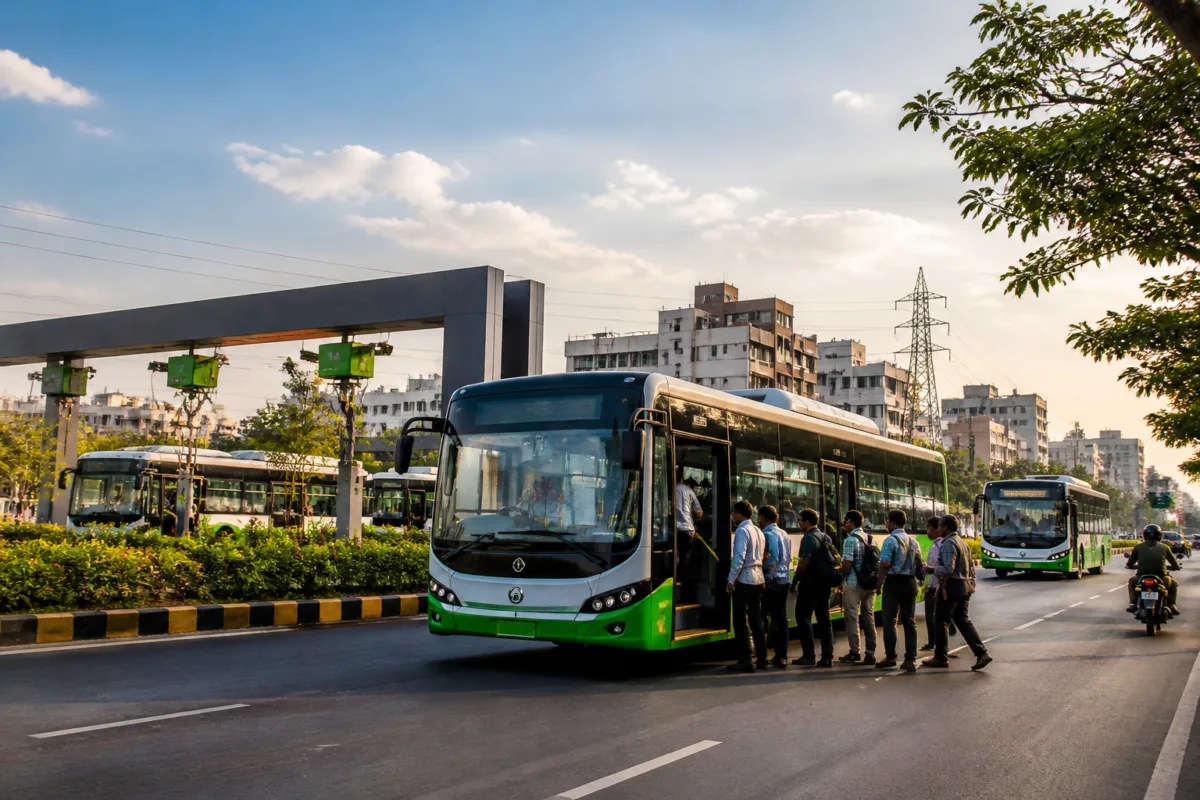
Hyderabad’s plan to introduce around 2,800 electric buses is more than a fleet replacement exercise. It is a test of whether the city’s public transport system can align vehicle procurement with charging infrastructure, depot capacity, electricity supply and financially sustainable operations.
The Telangana State Road Transport Corporation (TGSRTC) plans to induct the buses in phases and replace diesel vehicles operating within the Outer Ring Road limits. The expansion includes 2,200 additional electric buses under the Centre’s PM E-DRIVE scheme, along with the conversion of some existing diesel buses through retrofitting. Chief Minister A Revanth Reddy has set December 9 as the target for making city bus operations entirely electric, although the available information does not establish whether that deadline can be met.
The scale of the proposed transition is significant. TGSRTC’s August 2026 fleet statistics showed that 1,037 electric buses were already operating across its network in Telangana. In Hyderabad, around 500 electric buses were reported to be in service by May 2026. The planned addition would therefore represent a substantial increase in the city’s electric-bus presence, while also requiring changes to the systems that keep buses moving between depots and routes.
That distinction matters because electrification is not achieved simply by purchasing buses. Electric buses require charging facilities, upgraded depots, high-tension electricity connections and operating arrangements that can accommodate charging time and energy demand. TGSRTC has estimated that charging facilities, depot upgrades and high-tension connections will require around Rs 392 crore.
This infrastructure requirement changes the financial calculation. The headline benefit of electric buses is often expressed through lower running costs, but the transition also creates new capital and operating obligations. Electricity expenses, battery replacement and charging infrastructure will remain important cost components. The financial outcome will depend on electricity tariffs, operating conditions and the contractual arrangements used for procuring and running the buses.
The projections supplied by TGSRTC indicate a potentially large operating-cost advantage. At an estimated daily operation of 200 km per bus, 2,800 buses would cover nearly 5.6 lakh km every day. A diesel bus fleet travelling that distance, with average mileage of 2.7 to 3.4 km per litre and diesel priced at around Rs 104 per litre, could incur annual diesel expenditure of approximately Rs 624 crore to Rs 786 crore.
However, the projected saving is not the entire diesel bill. After accounting for electricity costs, the indicative operating-cost advantage is estimated at around Rs 245 crore annually, based on previously reported running costs of Rs 20 per km for diesel buses and Rs 8 per km for electric buses. These numbers are projections rather than guaranteed savings. Actual results will depend on how often buses operate, the routes assigned to them, electricity prices, charging efficiency, maintenance requirements and the terms of the contracts.
The figures also show why fleet electrification must be assessed over the full operating system rather than through vehicle price alone. A bus that has a lower running cost may still create pressure on depots if charging capacity is insufficient. Similarly, a city may secure buses under a central scheme but face delays if electricity connections, civil works or procurement contracts do not progress at the same pace.
TGSRTC’s retrofitting programme illustrates another route to electrification. The corporation is converting 240 existing buses at its Uppal workshop. Sai Green Mobility will retrofit 200 buses, while Kalyani Powertrain Limited will handle the remaining 40. Retrofitting allows an existing asset base to be used differently, but its effectiveness will depend on the performance, reliability and operating life of the converted vehicles. The supplied report does not provide performance results from the programme.
The environmental case is also based on the scale of daily operations. Based on estimated diesel consumption, electrification could prevent around 1.6 lakh to 2 lakh tonnes of direct tailpipe carbon dioxide emissions annually. Electric buses would also eliminate tailpipe emissions of nitrogen oxides and particulate matter along the routes on which they operate. For passengers and residents living near busy roads, the local air-quality effect depends on how many diesel buses are actually removed, where electric buses are deployed and whether the proposed fleet operates consistently.
This makes route allocation an important but unresolved part of the plan. Replacing diesel buses within the ORR limits defines the geographic scope of the transition, but the available information does not specify the route-by-route deployment schedule, depot-wise charging capacity or the number of diesel buses that would be withdrawn at each stage. Without those details, the environmental and service benefits remain city-level projections rather than measurable route-level outcomes.
The PM E-DRIVE component adds a national policy dimension. The scheme is expected to support the introduction of 2,200 additional electric buses, linking Hyderabad’s fleet transition to a broader public-transport electrification framework. The central scheme can help reduce the initial procurement burden, but it does not remove the need for state-level operational planning. TGSRTC must still coordinate vehicle deployment, depot upgrades, power connections, charging operations and maintenance.
The institutional challenge is therefore one of sequencing. Buses, chargers and electricity connections must become available together. If buses arrive before depots are ready, they may not be fully used. If charging infrastructure is installed without adequate fleet deployment, public investment may remain underutilised. If contracts do not clearly allocate responsibility for batteries, maintenance and energy costs, projected savings may not translate into stable operating finances.
The December 9 target puts this sequencing challenge under a fixed deadline. A target date can focus administrative action, but the information currently available does not confirm the procurement, retrofit, depot and charging milestones needed to meet it. Nor does it establish whether all city-bus operations will be covered by electric buses by that date. The target is therefore best understood as an implementation objective rather than an accomplished transition.
Hyderabad’s case also highlights the difference between a clean-vehicle announcement and a clean public-transport system. The latter depends on dependable service, sufficient fleet availability and infrastructure that works during daily operations. Electric buses can reduce direct emissions and diesel dependence, but the public benefit is realised only when they run reliably on routes used by commuters.
The evidence confirms that TGSRTC is pursuing a large-scale electric-bus transition with an indicative annual operating-cost advantage of around Rs 245 crore, potential direct tailpipe carbon dioxide reductions of 1.6 lakh to 2 lakh tonnes, and an estimated Rs 392 crore requirement for supporting infrastructure. What remains uncertain is the pace of deployment, the operational performance of retrofitted buses, the financing and contractual structure, and whether the December 9 target can be achieved. The next milestones to watch are the arrival of the additional buses, progress at depots and charging sites, the Uppal retrofit programme and the corporation’s confirmation of its implementation schedule.

