


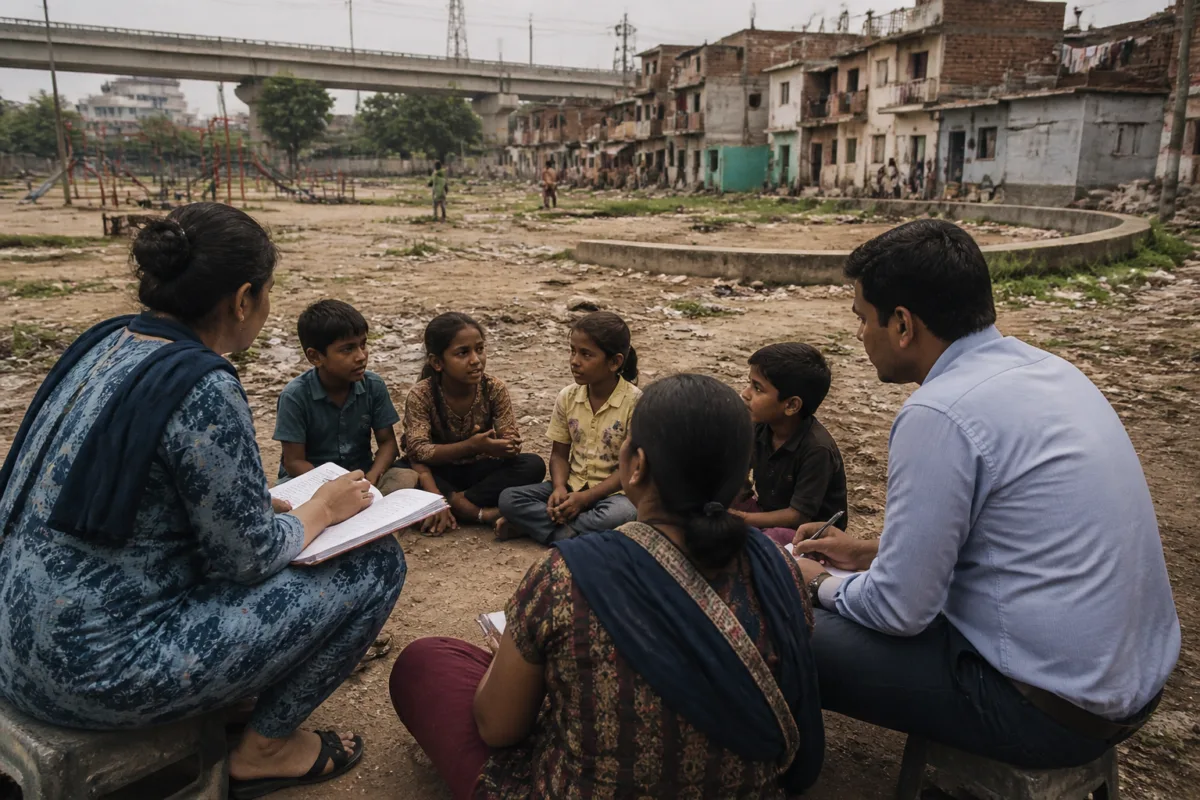
Delhi children’s rights came into sharp focus when 48 children told representatives of the Delhi Commission for Protection of Child Rights (DCPCR) about the conditions shaping their daily lives, from child labour and unsafe parks to inadequate sanitation, school barriers and neighbourhood drug use. The session, organised by the NGO CHETNA, was not simply a forum for complaints. It offered a street-level account of how failures across homes, schools, public spaces and government systems overlap in the lives of children living in some of the city’s most vulnerable settlements.
The children, aged between 11 and 16 and mostly living in shanties across Delhi, came from 22 institutions. Their accounts showed that the problems affecting them do not sit within a single administrative department. A 12-year-old identified as Akash, whose name was changed, said he picked rags to support his mother and younger brother and help repay family debts. He began working after his father died in 2025 and asked whether his elder brother could be helped to find employment so that he could stop working.
That account places household income and child protection in the same frame. The child’s request was not for a specialised programme but for an adult in the family to secure work. The testimony suggests how quickly the loss of a parent can push a child into informal labour when families have debts and limited alternatives. The supplied report does not establish the extent of child labour among the participating children, but it does show how economic insecurity can directly interrupt childhood and education.
Education-related concerns were also closely connected to household conditions and gender restrictions. A 16-year-old identified as Anisha said reaching Class X took her further in school than anyone else in her family. She also told the panel that many girls wanted to study but were not allowed to continue. Another child asked where help could be found for frequent quarrels between her parents. These accounts show that school participation is influenced not only by what happens inside classrooms, but also by family conflict, social expectations and the support available around a child.
The children’s testimonies further connected education to the condition of housing and neighbourhood infrastructure. A Class VIII student said teachers were rude to him after he lost his books and clothes when his home in Tughlakabad was demolished. The report does not identify the agency responsible for the demolition or state whether rehabilitation was provided. It does, however, record a direct consequence of housing disruption: the loss of basic educational belongings and a changed relationship between the child and the school.
Public space emerged as another part of the child-protection system. A 14-year-old from Mangolpuri said he and his friends avoided their local park because people gambled and used drugs there, and because fights involved threats to stab others. A separate 14-year-old from Nizamuddin alleged that a woman sold drugs to children in the neighbourhood and said some users were as young as eight. He also claimed that police were present but did not act. These claims were presented by the children during the session; the supplied report does not provide an independent police response or establish the allegations as verified facts.
The significance of these accounts lies in what they reveal about access to public space. A park is formally a civic amenity, but its practical value depends on whether children can use it without exposure to violence, gambling or substance abuse. When children avoid a park because it feels unsafe, the issue is not limited to policing. It also concerns how public spaces are monitored, who is accountable for their everyday management and whether neighbourhood-level institutions respond to visible risks.
The same question applies to Bhalswa canal. One teenager recalled that someone went to bathe there and never returned. He asked the panel to consider basic warning signage because, according to his account, there was no sign indicating that the location was dangerous. The report does not state whether the canal is under the responsibility of a particular agency or whether any safety assessment has been carried out. Still, the testimony identifies a basic infrastructure gap: where a hazardous site is known to local residents, the absence of visible warnings can leave people without even the simplest information needed to avoid danger.
Sanitation was described as an everyday cost for children living under a flyover in Nizamuddin. The child said there were no community toilets or bathing facilities, and that residents had to pay Rs 10 to use a toilet and Rs 30 to bathe. These figures are specific to the testimony reported from the session and do not establish citywide sanitation costs. They do show how the absence of public facilities converts a basic service into a recurring expense for households already living in insecure conditions.
The account also raises a built-environment question about children who live in spaces not served by standard neighbourhood infrastructure. A family under a flyover may fall between the responsibilities of agencies managing transport infrastructure, municipal services, sanitation provision and child welfare. Unless these systems coordinate, the child may be visible as a problem during an enforcement action but invisible when toilets, bathing facilities, schooling support or protection services are planned.
Menstrual hygiene, teaching practices and private tuition were among the other issues raised. A 14-year-old asked for sanitary pads to be made available at school. A 13-year-old questioned why students still needed private tuition after attending classes. These questions point to the difference between nominal access to education and the conditions required to participate fully. The report does not provide information about the schools involved, their facilities or the availability of government support, so it cannot establish whether the concerns reflect a broader pattern. It does show that children understand gaps in the services intended for them and are able to identify them in concrete terms.
The DCPCR representatives placed responsibility on adults and institutions. Chairperson Dr Om Prakash Vyas said that when adults do not perform their duties, they may violate the rights of others. Commission member Kundan Kanskar said people in children’s immediate and wider circles needed to remain vigilant because gaps in support could expose children to harm. Member Swati Gupta responded to a 14-year-old’s question about crimes against women and girls by saying the problem would end when boys stopped committing such acts.
These responses identify the institutional challenge without resolving it. The children described problems spanning family income, safety, policing, education, housing disruption, sanitation and gender-based harm. The DCPCR can hear concerns and discuss measures, but the practical response would involve multiple actors. The report does not specify which recommendations were formally adopted, which department would implement them or what deadlines were set after the session.
CHETNA director Sanjay Gupta said children should have a say in decisions affecting their lives. That principle is particularly relevant to urban planning and municipal administration because children experience neighbourhoods at a different scale from official maps. They know which park is avoided, where a canal becomes dangerous, how much a toilet costs and what happens when belongings are lost during demolition. Their testimony can therefore function as a form of local knowledge, even when it still requires administrative verification and follow-up.
The evidence from the session does not support a claim that every Delhi child faces the same conditions. Nor does it establish the individual allegations about drug sales, police inaction or dangers at specific locations beyond the children’s accounts. What it confirms is that a single group of children described interconnected failures across several urban systems. Their experiences show how weak support in one area can intensify vulnerability in another: a death in the family can lead to child labour, a demolition can disrupt schooling, an unsafe park can remove access to recreation, and absent sanitation can impose daily costs.
The next test is whether the session produces traceable action. That would require the concerns to be assigned to responsible institutions, followed up with the children and translated into measures that can be checked, such as safer public spaces, access to sanitation, education support, protection from labour and assistance for families facing crisis. The DCPCR’s discussion has brought the accounts into the institutional record; the report does not yet establish what happens after that point.

