


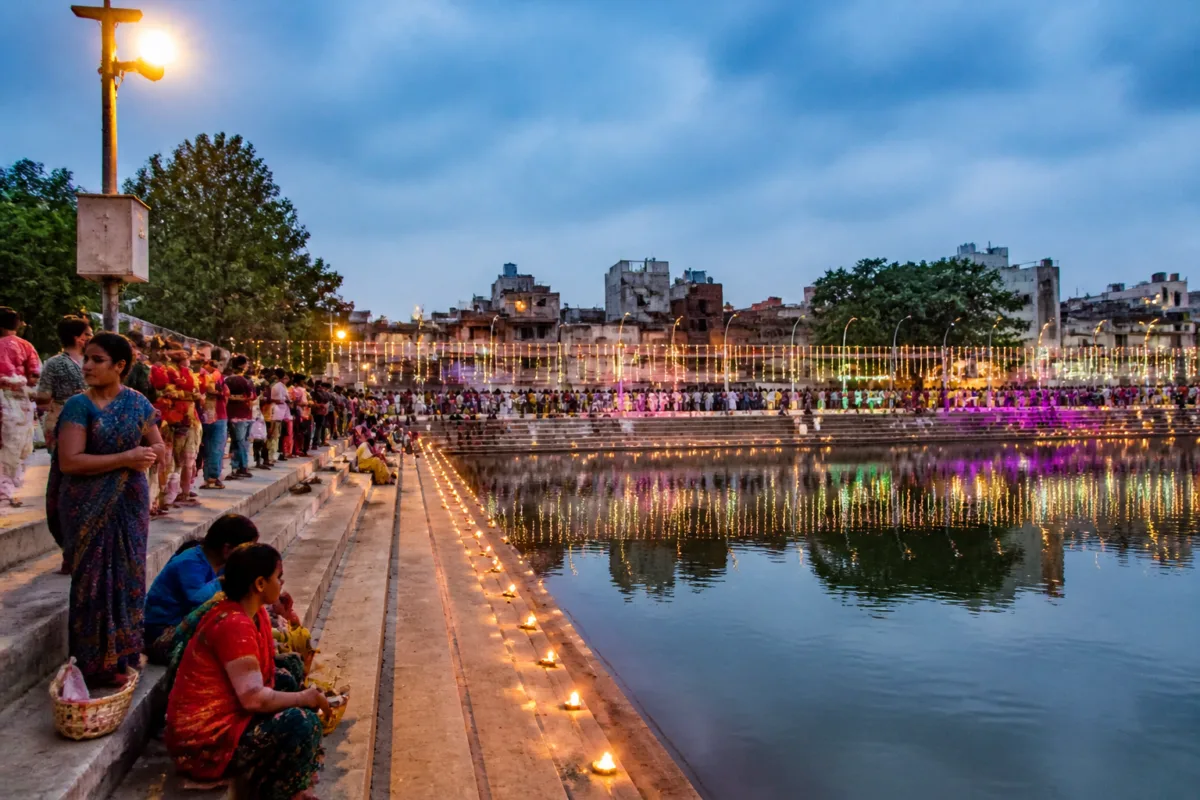
Delhi’s Chhath ghats are combining expanded crowd facilities with religious and cultural programming this year, as organisers at Mangolpuri’s Bapu Park and Narela’s Ajuba Ghat prepare for thousands of devotees. The arrangements include permanent water bodies, lighting, CCTV surveillance, musical fountains, laser shows and coupon-based access at one of the city’s busiest पूजा venues.
At Bapu Park in Mangolpuri, the Sacred Chhath Development Committee has organised the festival at a permanent ghat equipped with modern facilities. The programme will include a musical fountain, laser show, cultural performances and a devotional music evening. The committee has installed 24 CCTV cameras across the site and arranged 150 lights for the venue.
Committee president Shrikant Singh Vidyarthi said more than 10,000 devotees observing the fast are expected to reach the Mangolpuri ghat during the celebrations. The report also states that more than 5,000 devotees come to the site to offer arghya, indicating the scale of demand on the permanent facility during the festival period.
The arrangements reflect how Delhi’s Chhath venues have evolved from temporary neighbourhood sites into organised public gathering spaces. At Bapu Park, the organisers have combined religious facilities with crowd infrastructure and entertainment programming. The site’s lighting and surveillance arrangements are intended to support movement and safety across the premises during peak hours.
Narela’s Ajuba Ghat has a longer institutional history. Vinay Kumar, founder and general secretary of the Janhit Purvanchal Society, said the society has conducted Chhath Puja at the site for the past 24 years. According to his account, worship began there in 2002, when Chhath Puja was not widely known in the area. He said he started the event at the age of 22.
Kumar said former Delhi chief minister Sheila Dikshit recognised the site as a government ghat in 2005, after which a pond was built and arrangements for tents, lighting and sanitation were provided at the government level. The report says devotees now queue for about three hours to obtain coupons for पूजा at the venue, making controlled access a defining feature of the Ajuba Ghat experience.
The developments at the two sites show the different ways Delhi’s public religious spaces are being managed: Mangolpuri’s Bapu Park is emphasising permanent facilities, surveillance and programmed attractions, while Narela’s Ajuba Ghat relies on an established access system to manage demand. The source does not provide details of traffic diversions, emergency medical arrangements or municipal agencies responsible for operations.
The reported arrangements will remain focused on the current Chhath celebrations, with cultural programmes, devotional performances, musical fountains and laser shows scheduled as attractions at the participating ghats.

