


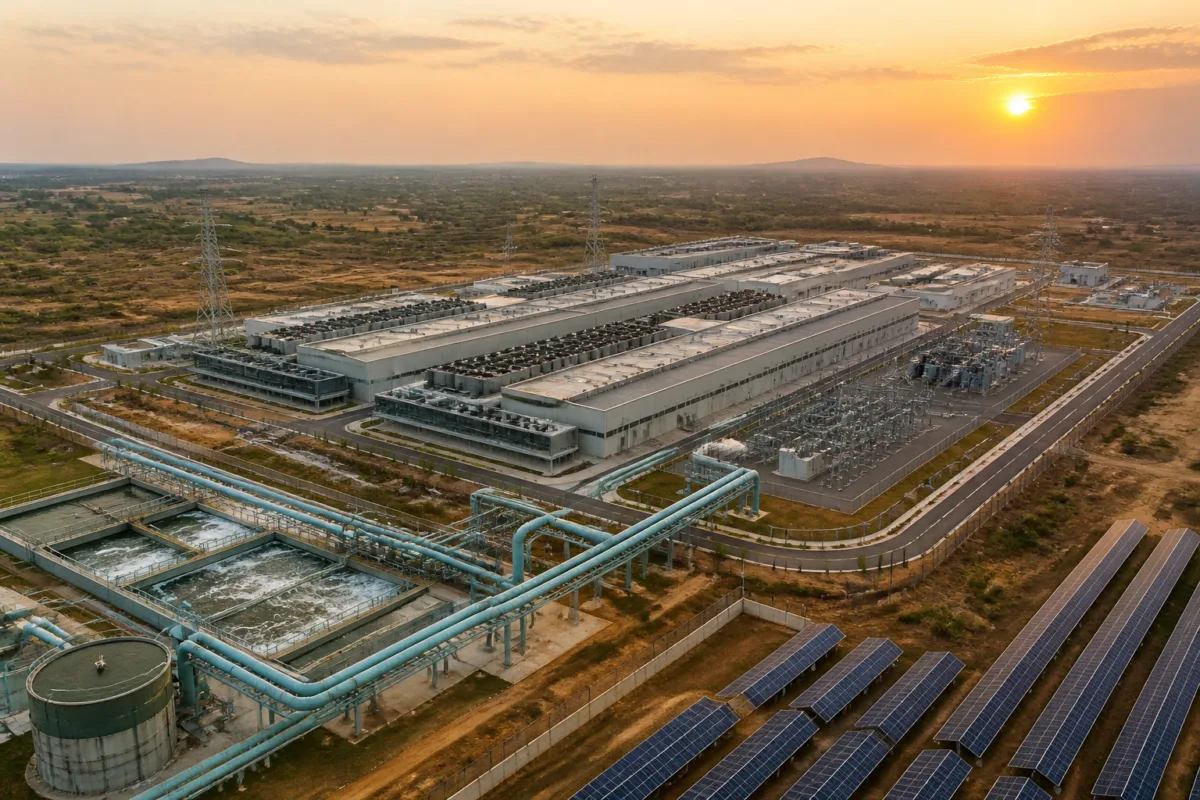
AirTrunk’s proposed Andhra Pradesh data centres would turn the state’s digital-infrastructure ambition into a test of how India plans power- and water-intensive growth. The Blackstone-backed operator has submitted detailed project reports for two hyperscale campuses that could involve about Rs 1.03 lakh crore, or $11 billion, in investment, with combined capacity of as much as 1.8 gigawatts. The proposal is still under consideration by state authorities.
The scale matters because a data centre is not simply a technology facility. It is a large physical installation that requires land, reliable electricity, cooling systems, water arrangements, network connectivity and administrative clearances. In Andhra Pradesh, the proposed campuses are being advanced as the state seeks to establish itself as a major data-centre hub. That ambition is unfolding alongside a resource question: how much additional power and water can the state support while keeping industrial expansion compatible with local infrastructure capacity?
AirTrunk said in an emailed statement that it had submitted the detailed project report for the two campuses. The company said the facilities would use low-water, air-cooled technology and industrial water supplies rather than municipal sources. Those details are central to understanding the proposal. They indicate that the company is presenting cooling demand and municipal-water pressure as infrastructure issues to be managed through technology and source selection, rather than as secondary operational matters.
The proposal remains under consideration by Andhra Pradesh authorities. That means the investment figure and capacity are proposed, not an approved or operational project. The state’s eventual decision will determine how the campuses fit into its wider industrial and infrastructure planning. The supplied information does not establish a final location, construction timetable, approval schedule, power-procurement arrangement or commissioning date.
The project’s proposed capacity is as much as 1.8 gigawatts across two campuses. That number is a useful indicator of the physical scale of the plan, but it is not the same as the amount of electricity that would necessarily be consumed at every moment. The source material does not provide an operating-load profile, a connection plan or a breakdown of the expected power requirement. It does, however, make clear that electricity availability is part of the state’s strategy for attracting data-centre investment.
Chief Minister N. Chandrababu Naidu said this week that the government was expanding renewable-energy capacity and strengthening water supplies to support the buildout. The statement places the AirTrunk proposal within a broader public infrastructure effort. It also shows that the state is treating data centres as a development category requiring advance planning for utilities, rather than as conventional office or industrial projects that can rely on existing networks without major augmentation.
The renewable-energy reference is significant in institutional terms. A hyperscale campus depends on continuous and reliable power, while the state is also signalling an effort to expand renewable capacity. The supplied material does not specify whether the proposed campuses would be directly powered by new renewable projects, connected through the grid, or supported by a combination of arrangements. It therefore confirms the policy direction but not the final delivery model.
Water is the other major planning issue. Data centres use water mainly in relation to cooling, although the precise demand varies by facility design and operating conditions. AirTrunk’s stated use of low-water, air-cooled technology is therefore a project-specific response to the concern over water requirements. The company also said it would use industrial water supplies instead of municipal sources. The source does not identify the proposed industrial-water provider, the volume required, the treatment process or the safeguards that would apply during periods of scarcity.
That missing information is important because the distinction between municipal and industrial water is an administrative and infrastructure distinction, not a guarantee that there will be no public impact. Industrial water still requires a source, treatment, transmission and an allocation framework. The supplied report does not say how the state will balance the needs of the proposed campuses with those of existing industries, households or agriculture. It only records the company’s stated operating approach and the government’s broader position on strengthening water supplies.
Andhra Pradesh’s data-centre strategy is also developing alongside another large technology proposal. Alphabet’s Google is separately developing a $15 billion artificial-intelligence hub in the state, according to the report. The material does not provide details of that project’s land, power or water requirements, nor does it establish whether the two proposals would share infrastructure. The parallel announcements nevertheless show why state-level planning will matter: multiple large digital projects can create cumulative demands even when each project is assessed separately.
The combined investment value attached to AirTrunk’s proposal is about Rs 1.03 lakh crore. In headline terms, that makes it one of the country’s biggest proposed digital-infrastructure projects. But the value of the proposal alone does not reveal its public or economic outcome. The source does not state how much employment would be created, how many construction workers would be engaged, what local procurement would be possible, or how much revenue the state expects. Nor does it say whether the investment would be deployed in a single phase or over several stages.
Those omissions do not reduce the significance of the announcement; they define the questions that arise before approval. A data-centre campus is long-lived infrastructure. Its economic value depends not only on the capital committed to construction, but also on the quality and reliability of the systems around it. Power transmission, water networks, access roads, digital connectivity and regulatory coordination can determine whether a large facility operates efficiently and whether surrounding urban and industrial areas experience pressure on shared systems.
The proposal also raises a question about how states measure infrastructure readiness. At one level, attracting a hyperscale operator signals that Andhra Pradesh is seeking a larger role in the digital economy. At another, the state must demonstrate that the land and utility systems required by such projects can be provided without weakening essential services. The current material confirms the state’s stated plans for renewable energy and water supplies, but it does not provide performance data showing existing capacity, current demand or the margin available for new campuses.
This is why the proposal should be read as an infrastructure decision as much as an investment announcement. The central issue is not simply whether AirTrunk will build two campuses. It is whether the approval process can connect the project’s capital scale and technical design to transparent decisions about utilities, resource allocation and public infrastructure. The company has addressed part of the water question through its proposed cooling technology and industrial-water sourcing. The authorities’ role is to establish how those arrangements will work in practice and how they will be monitored.
The project’s status makes the next stage particularly important. AirTrunk has submitted detailed project reports, but the proposal remains under consideration. The supplied report does not identify the approving departments, the stage of environmental or utility assessment, or any public consultation process. It also does not state whether the two campuses would receive separate approvals or be assessed as a combined development. These are not established facts in the available material and should not be assumed.
What is established is the direction of travel. Andhra Pradesh is positioning renewable-energy expansion and stronger water supplies as part of the foundation for major data-centre investment. AirTrunk is proposing two campuses with up to 1.8 gigawatts of combined capacity and about Rs 1.03 lakh crore in potential investment. The company says its design will reduce water use and avoid municipal supplies. Google’s separate AI-hub proposal adds to the state’s emerging technology-infrastructure profile.
The larger urban question is whether digital infrastructure can be planned as part of the regional utility system rather than treated as an isolated private development. For Andhra Pradesh, the answer will depend on what state authorities disclose and require as the AirTrunk proposal moves through consideration. The key developments to monitor are approval decisions, the final campus locations, utility arrangements, construction timelines and evidence that renewable power and industrial water systems can support the proposed buildout.

