


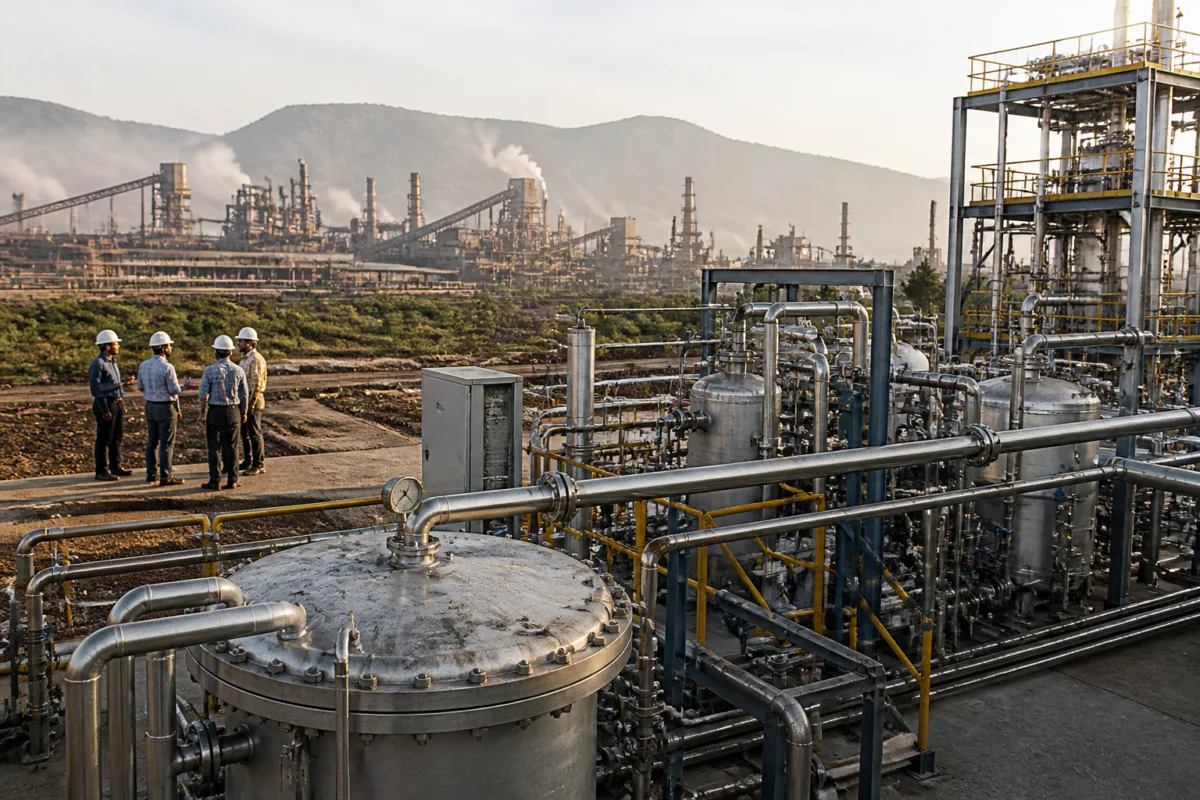
Nalco will commission India’s first pilot gallium recovery plant this month at its alumina refinery in Damanjodi, Koraput, Odisha, marking a new attempt to recover the strategic metal from industrial process waste. The facility is being developed jointly with the Bhabha Atomic Research Centre (BARC) and the Heavy Water Board.
Nalco chairman and managing director Brijendra Pratap Singh said on Friday that the plant was almost ready after a delay of one to two months. The delay was caused by the late arrival of specialised imported equipment, spares and consumables, he said at a news conference in Bhubaneswar.
“This plant is coming up for the first time in India. Certain spares and consumables had to come from outside, which delayed it by one or two months. The plant is now almost ready and we are going to start it this month itself,” Singh said.
Gallium is a strategic high-tech metal because gallium compounds are used as semiconductor materials. According to sources cited in the report, the pilot facility will recover gallium from spent process liquor generated at Nalco’s alumina refinery in Damanjodi. The company has not disclosed the plant’s proposed recovery capacity in the supplied information.
The project links India’s critical-mineral ambitions with the waste streams of the aluminium industry. Instead of treating spent process liquor only as a refinery residue, the pilot will test whether it can serve as a domestic source of a material used in high-technology manufacturing. The facility’s performance will determine the practical potential of scaling up the recovery process.
Singh also outlined Nalco’s plans to expand its aluminium capacity and increase its production of value-added products. He said demand for aluminium wire rods remained strong, particularly because of growth in the power sector, electricity infrastructure, renewable energy and data centres.
For its future expansion, the company is examining special-grade rolled products for aerospace, defence, cans and other specialised applications. Nalco’s consultant is preparing a detailed project report that will assess existing imports and present and future domestic demand. Singh said the company would focus on products “which are currently not made in the country”.
Nalco remains committed to its 2030 commissioning target for its larger expansion programme, although Singh acknowledged that individual milestones could be delayed by a month or two. The detailed project report is expected to be completed around February or March, after which the company plans to begin ordering project packages. Groundwork would follow, with implementation planned over three years.
The announcement also places the gallium facility within Nalco’s wider effort to move beyond primary aluminium production. The company is a public sector undertaking and Singh ruled out privatisation, saying there was “no question of privatisation”. He cited Nalco’s profitability, strong margins and dividend payments to the government, adding that the government’s mandate was for the company to expand.
Nalco is separately involved in lithium exploration in Argentina through KABIL, a joint venture in which it holds a 40% stake. Singh said non-invasive exploration had established the presence of lithium, while drilling and further exploration would be used to determine the lithium grade, processing technology and commercial viability of producing lithium carbonate for supply to India.
The immediate milestone for the gallium initiative is the commissioning of the Damanjodi pilot plant this month. Its operation will provide the next evidence on the feasibility of recovering the metal from Nalco’s refinery process liquor.

