


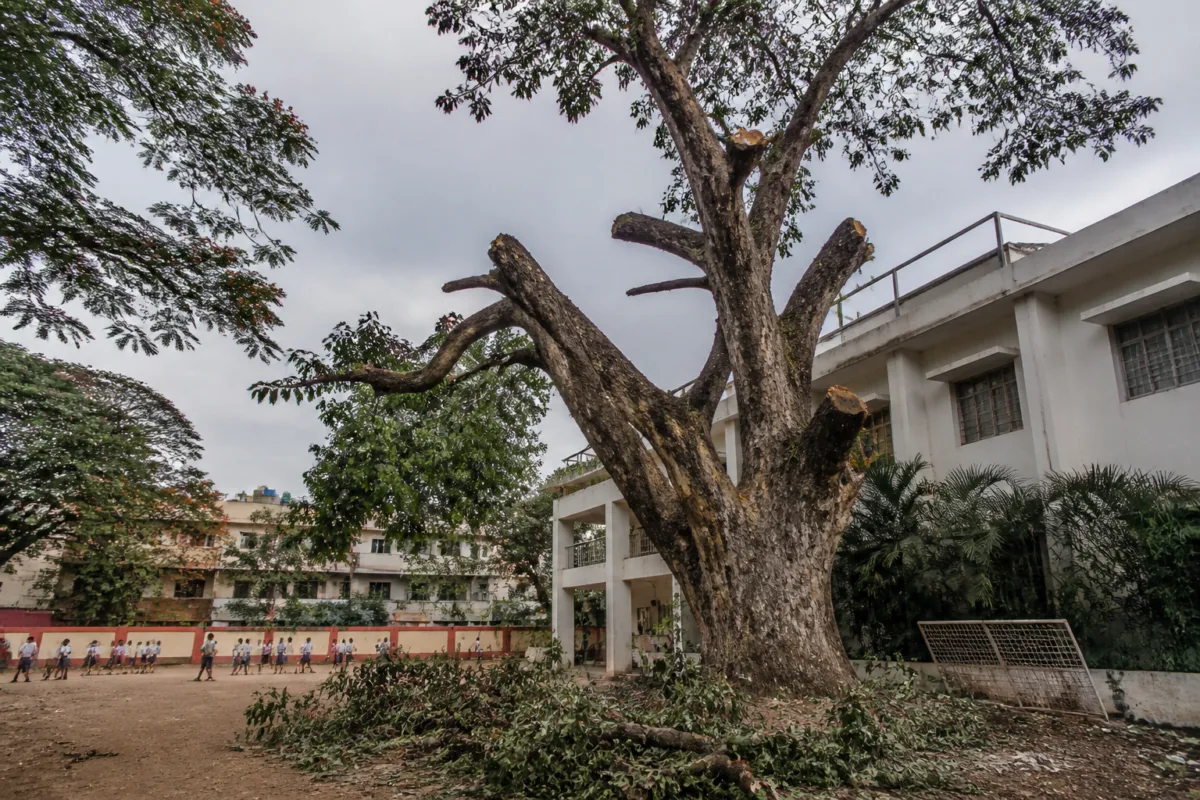
The case against Auro Mirra International School in Ulsoor over the cutting of 12 branches from two trees is more than a dispute about pruning. It places a recurring urban governance problem in sharp focus: how should institutions respond when trees appear to pose an immediate safety risk, while still complying with laws intended to protect the city’s declining green cover?
The Greater Bengaluru Authority’s forest department registered an FIR against a person associated with the school after finding that branches of a peepal tree and a gulmohar tree had been cut without prior permission. The case was registered under the Karnataka Preservation of Trees Act, 1976. The matter was subsequently taken to the additional chief judicial magistrate’s court, which authorised the forest department to investigate the alleged non-cognisable offence and submit a final report.
The school has defended the pruning as a safety measure. A representative said a large gulmohar branch had fallen while children were lining up for a school assembly, narrowly avoiding an accident. The school also said the removed branches were leaning towards its building and terrace. The forest department, however, said prior approval had not been obtained before branches of the two trees were cut.
That conflict captures the difficulty of managing mature trees inside Bengaluru’s increasingly dense institutional and residential landscape. A tree can be an ecological asset, a safety concern, a structural risk and a regulated public resource at the same time. The available account does not establish whether the branches were assessed by an arborist or whether an emergency exception was available. It does establish that the school proceeded without the permission the forest department says was required.
The central issue is therefore not simply whether the branches were dangerous. It is whether the city’s system provides a clear, fast and accountable way to deal with dangerous branches before residents or institutions take action themselves. When the response mechanism is slow, unclear or difficult to access, property managers may treat pruning as routine maintenance. When unauthorised cutting is treated as a serious offence, the same action becomes a matter for investigation and possible prosecution.
### A safety decision becomes a statutory case
The school’s explanation is grounded in an immediate physical risk. A falling branch near children creates a situation in which administrators are likely to prioritise prevention over procedure. The representative also said that some branches were leaning towards the building, suggesting that the concern was not limited to one isolated incident.
But the forest department’s position introduces a second obligation. Mature trees cannot be altered solely on the basis of a private property manager’s assessment if the law requires prior approval. The permission process exists to ensure that tree-related decisions are reviewed by the competent authority rather than made only by the owner or occupier of the premises.
The case now has two distinct factual questions. The first is whether the branches presented the level of risk described by the school. The second is whether the cutting complied with the statutory process. The first question concerns safety and evidence about the condition of the trees. The second concerns administrative authorisation. Establishing one does not automatically resolve the other.
The forest department’s investigation will determine the next stage. According to the range forest officer cited in the report, the school could either pay the prescribed penalty after the investigation or approach the court for further proceedings. The report does not specify the penalty amount or indicate when the investigation will be completed.
### Bengaluru’s trees are also governance infrastructure
Urban trees are often discussed as environmental features, but their management is also an administrative function. They occupy land that is otherwise used for buildings, roads, footpaths and utilities. Their branches interact with roofs, electric lines, school courtyards, parking areas and pedestrian movement. Decisions about them require coordination between property managers, civic authorities, forest officials and, in some cases, courts.
The Ulsoor case shows how that coordination can break down at the point where responsibility is most immediate. The school says it had a safety concern. The forest department says permission was not obtained. Residents are asking for stringent action because they believe unauthorised pruning of mature trees can affect Bengaluru’s urban bird population. Each position reflects a different public interest: protection from physical harm, compliance with the law and preservation of urban habitat.
The source report states that the school has trees nearly 200 years old and that it considers the campus to be built around them. If accurate, that description makes the site particularly important from a management perspective, but it does not settle the legal question. Older trees may require more careful assessment precisely because the consequences of poor pruning can extend beyond the immediate removal of branches.
The reported involvement of residents is significant because tree decisions on private premises can still have neighbourhood-level effects. Mature trees contribute to the character and ecological functioning of streets and campuses beyond their property boundaries. Residents’ concern about birds indicates that the dispute is being viewed not only as a private safety decision but also as an intervention affecting shared urban conditions.
At the same time, the available evidence does not establish the extent of ecological damage caused by the pruning, whether the trees remain healthy or whether bird populations at the site have changed. Those questions would require an assessment beyond the claims currently recorded in the report.
### The missing link is a documented response pathway
The case points to the importance of documentation in urban tree management. A robust process would need to record the reported hazard, the condition of the tree, the nature of the proposed pruning, the authority responsible for approving it and the action taken. The supplied material does not say whether such an assessment was requested or whether the school attempted to contact the department before cutting the branches.
That absence matters because disputes after pruning are difficult to resolve without evidence of the tree’s earlier condition. Photographs, inspection notes, arboricultural opinions and permission records can help distinguish emergency intervention from unauthorised alteration. Without them, the inquiry is left to reconstruct events after the branches have already been removed.
The court’s authorisation for the forest department to investigate the alleged non-cognisable offence gives the case a formal route. It also means that the immediate media account should not be treated as a final finding against the school. The department is still investigating, and the school has presented a different account of the circumstances.
For civic administration, the broader test is whether residents, schools, hospitals, housing societies and commercial properties know how to report a dangerous tree or branch and receive a timely decision. The report does not provide evidence on how accessible or rapid that process is in Bengaluru. It does, however, show the consequences when action is taken before permission is secured.
### What the case reveals about urban tree protection
The Karnataka Preservation of Trees Act, 1976, is the legal framework under which the case has been registered. Its presence indicates that tree cutting and related interventions are not treated as ordinary property-maintenance decisions. Yet a law can protect trees only when its requirements are understood, enforceable and compatible with urgent safety needs.
The Ulsoor dispute therefore raises a design question for governance: can the permission system distinguish between routine pruning, hazardous branches and immediate emergencies without weakening oversight? The supplied report does not describe the Act’s detailed procedures or any specific emergency provision, so no conclusion can be drawn about whether the existing framework answers that question.
The case also highlights the need for clear institutional accountability within large campuses. The school representative said the campus manager was on leave and unavailable to explain why permission had not been sought. That detail suggests a decision may have been made in the absence of the person who normally handles the matter, although the report does not establish who ordered or carried out the pruning.
For residents, the issue is equally practical. They need protection from falling branches, but they also depend on mature trees for shade, habitat and the environmental quality of neighbourhoods. A system that treats safety and conservation as opposing choices may encourage either avoidable risk or avoidable tree damage. A system that records the condition of trees and provides a transparent route for urgent action can address both concerns more effectively, though the source material does not establish whether such a system is currently available or being used.
The facts presently confirmed are limited but important: 12 branches from a peepal and a gulmohar tree were cut at the school; the forest department says this happened without prior approval; an FIR was registered under the 1976 Act; the court authorised an investigation; and the school says the work was undertaken to protect children and buildings. The final determination will depend on the investigation and any subsequent proceedings. Until then, the case remains a sharp illustration of how Bengaluru’s urban tree policy is tested not in broad declarations, but during the minutes when a property manager must decide whether a branch is a danger, a protected part of a mature tree, or both.

