


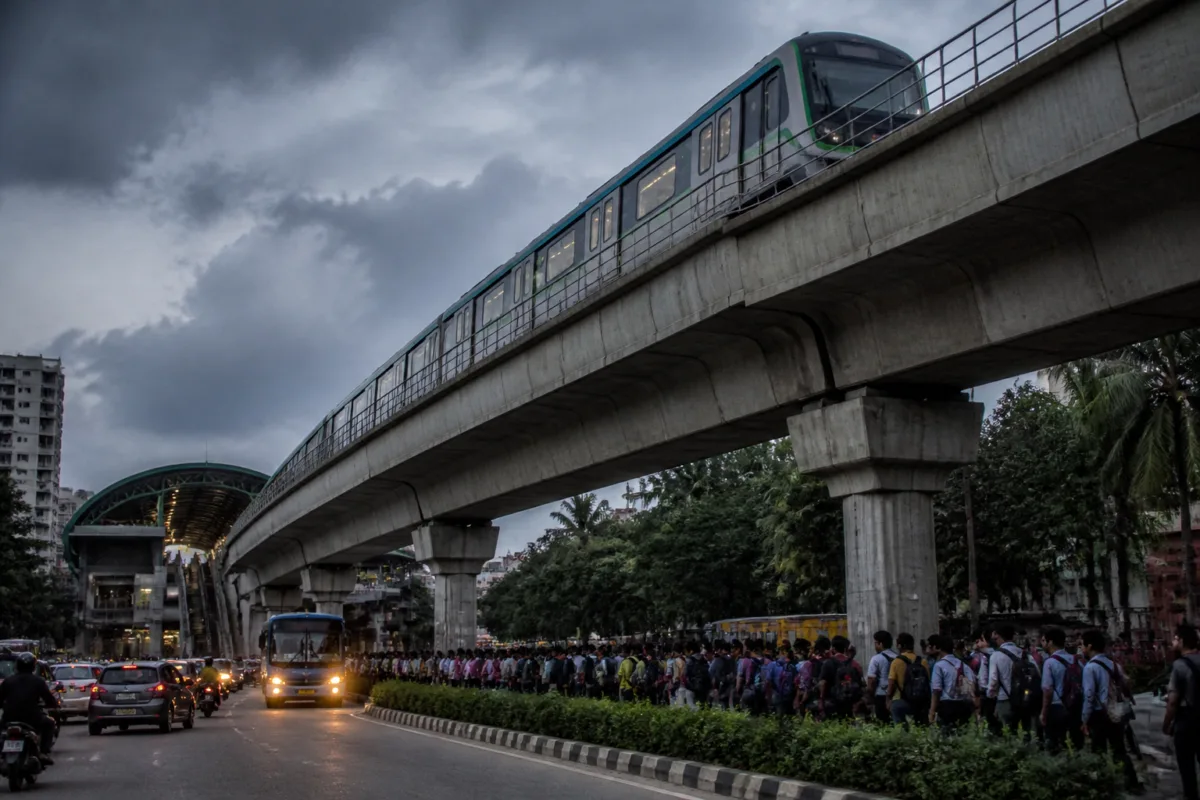
Karnataka Chief Minister D.K. Shivakumar has challenged the Centre’s stated 50:50 funding model for Bangalore Metro, saying the state bears additional costs related to land acquisition, foreign-exchange fluctuations, taxes and operating losses. He made the remarks at a programme held at the Indian Institute of Management Bangalore after the inauguration of the Metro’s Pink Line on Friday.
The dispute emerged after BJP MP Tejasvi Surya credited Prime Minister Narendra Modi and the Union government with prioritising Bengaluru’s Metro expansion. Surya said the city’s Metro network had grown from 17 km in 2014 to 103 km, and said Modi would be invited for the inauguration of the proposed Blue Line to Kempegowda International Airport and the suburban rail project.
Responding to the remarks, Shivakumar said political competition should not prevent cooperation on development projects. He said the Centre’s responsibilities included supporting the implementation of state projects, providing necessary approvals and offering financial assistance. According to him, the financial burden of Metro projects should be shared equally by the Centre and the state in practice, not only in the stated project formula.
Shivakumar said the state carries the cost of land acquisition, foreign-exchange-related increases in repayments for overseas loans, taxes imposed by both levels of government and the losses of Bangalore Metro Rail Corporation Ltd. He said these costs meant that the actual burden was not being divided in a 50:50 ratio.
He specifically sought a funding arrangement under which the Centre would share the additional cost caused by fluctuations in foreign-exchange rates on overseas loans taken for Bangalore Metro. Shivakumar said the Union government bears such exchange-rate variation for the Delhi Metro and urged that comparable assistance be extended to Bengaluru.
The chief minister also called for nationalised banks to provide Metro projects with loans at lower interest rates. He said lending in rupees, rather than in foreign currency, could prevent additional liabilities arising from exchange-rate movements. He asked the prime minister to examine the proposal.
Shivakumar further argued that the Centre should share half of the operational losses incurred by Metro systems. He said the state government currently bears these losses, while they are not counted as part of the project cost when central assistance is assessed.
He also proposed establishing a single national technical institution for Metro projects across India. The institution, he said, could prepare a list of approved technologies and systems, allowing cities to select suitable options on the basis of technical committee recommendations. Such a framework could standardise approvals, encourage indigenous technology and support passenger safety, he said.
The chief minister said approval for Bengaluru Metro’s Red Line had been pending for two years and called for delays in project clearances to be reduced. He also said project costs should be assessed according to different regional zones because land acquisition and construction expenses vary between cities, while the current cost framework is applied uniformly across the country.
The remarks place the financing structure of Bengaluru’s next Metro expansions at the centre of a wider debate over how India’s urban transport projects account for costs beyond construction. The immediate next steps will depend on the Centre’s response to the requests concerning foreign-exchange losses, operational deficits, lending and project approvals.

