


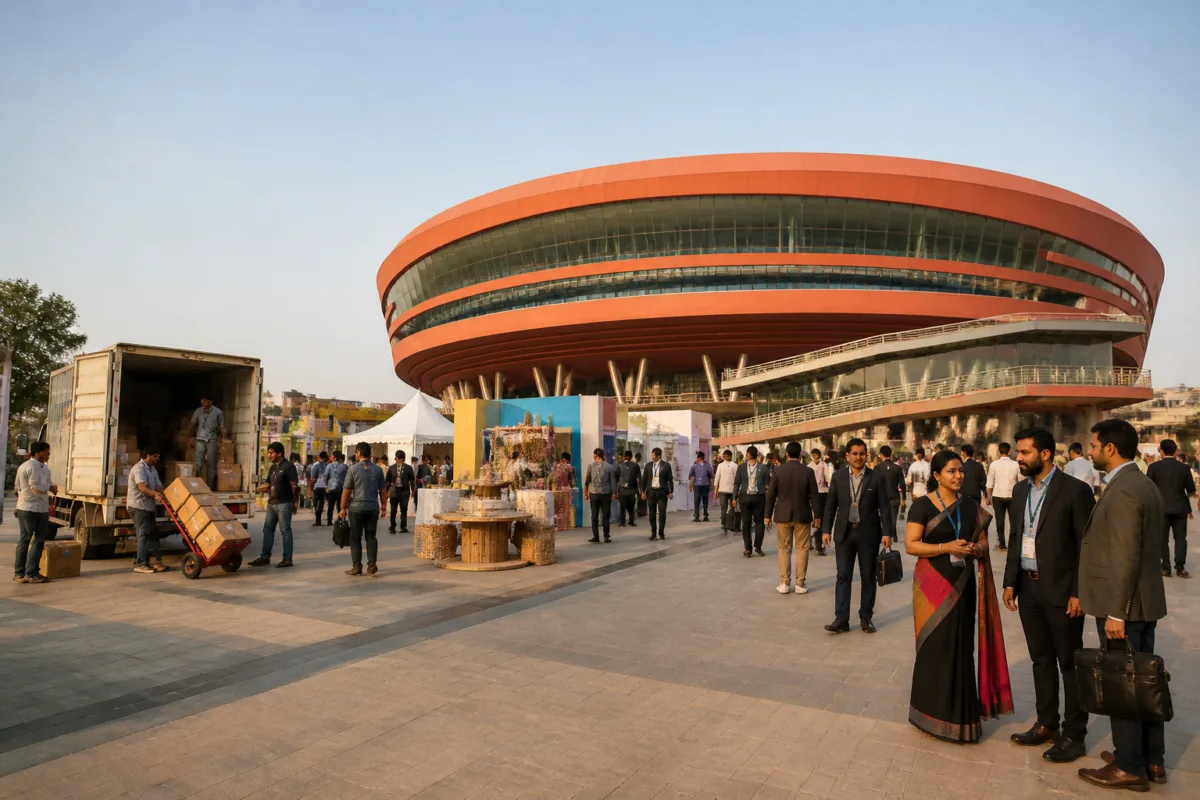
India’s export ambition is increasingly being expressed through physical infrastructure. At the inauguration of the 45th India International Trade Fair at Bharat Mandapam in New Delhi, Commerce Minister Piyush Goyal said the country was well on track to reach a USD 1 trillion export target in the financial year ending March, even as he announced the next phase of expansion of the exhibition complex.
The two developments are connected. A larger export economy requires more than factories, ports, logistics networks and trade agreements. It also requires places where producers, states, startups, artisans, buyers and institutions can meet. Goyal’s remarks at IITF placed Bharat Mandapam and future international fairs within that wider system. The announcement therefore offers a useful view of how India is attempting to turn exhibition infrastructure into an instrument of export promotion.
According to the minister, India recorded nearly USD 90 billion in exports in October 2026. The figure comprised approximately USD 50 billion in merchandise exports and USD 40 billion in services exports. Exports during the first seven months of the financial year, up to October, reached USD 570 billion, which Goyal described as an unprecedented achievement. He said India was well on track to achieve the USD 1 trillion target for the year.
The minister also expressed confidence that international trade would grow by 15-16 per cent during the current year. He made the assessment despite what he described as two ongoing wars, geopolitical volatility, uncertainty and subdued global trade growth, which he said was expected to remain around 3.5 per cent. These figures and projections were presented as evidence of the resilience of Indian exporters and the wider economy.
The immediate setting for those claims was a trade fair designed to bring a large number of economic actors into one built environment. More than 30 states and Union Territories were showcasing their strengths at IITF, alongside over 3,500 exhibitors and participants from 11 countries. The fair’s scale, according to Goyal, means visitors would need two to three days to explore the entire exhibition at Bharat Mandapam.
That scale matters because trade fairs perform a function that is difficult to replicate through a policy announcement alone. They make dispersed production visible. A product from a district, an innovation from a startup, a service offered by a small enterprise and a state’s industrial capability can be presented to buyers within the same institutional setting. For producers that do not yet have established international networks, visibility and direct interaction can be an important part of entering new markets.
The One District, One Product Pavilion at this year’s fair is intended to show products from different parts of the country, including arts, handicrafts, handloom and food products. The Hall of Inspiration is showcasing 600 startups and their innovations. The fair’s mobile application is intended to help visitors navigate the exhibition and identify exhibitors of interest. These initiatives show an attempt to treat the exhibition not simply as a collection of stalls, but as a managed platform connecting products, visitors and opportunities.
However, the minister’s announcement that Bharat Mandapam requires another expansion also reveals a capacity problem. Goyal said the government would soon launch the next phase of expansion, which would almost double the available exhibition space for exhibitors. He said the success of recent exhibitions, including IITF, had demonstrated that even the significantly expanded facilities available today were no longer sufficient to meet growing demand.
This is a familiar infrastructure question: whether capacity should be built in anticipation of demand or only after existing facilities become constrained. In the case of Bharat Mandapam, the government’s position is that recent demand justifies further expansion. The statement does not provide the proposed project’s cost, construction timeline, procurement structure, additional floor area or implementation milestones. Those details will determine how quickly the announced capacity can become operational and how effectively it can serve exporters beyond major national events.
The institutional role of the India Trade Promotion Organisation is also being widened. Goyal said ITPO planned to take IITF across the world through several international fairs, including sector-specific and multi-dimensional events. These fairs are expected to give Indian goods, services and startups opportunities to present themselves in developed markets and other international markets, particularly those with which India has entered into Free Trade Agreements.
This proposed international expansion changes the meaning of the domestic exhibition complex. Bharat Mandapam is not being presented only as a Delhi venue. It is the base for a wider trade-promotion architecture in which domestic exhibitions identify producers and international fairs help them reach buyers. The model depends on coordination between ITPO, state governments, businesses, exporters, startups and the institutions responsible for implementing trade agreements.
The emphasis on states and districts is significant. The minister cited examples of kiwi exports from Arunachal Pradesh, where exports had earlier been negligible, and Sindhuri pomegranates from Kullu reaching Dubai. These examples were used to show how products associated with particular geographies could find international markets. They also point to the challenge of moving from an individual success story to a repeatable system: producers need quality standards, sustainable practices, market information, buyer access and the ability to meet demand consistently.
Goyal linked that challenge to the principles of “Zero Defect, Zero Effect”. He said Indian products must meet high standards while reducing environmental damage. He also called for sustainable practices, a circular economy, greater use of natural products and more biodegradable products. In this framing, export competitiveness is not separated from manufacturing quality or environmental performance. The requirements placed on exhibitors and producers are also requirements for the systems that support production, certification, packaging and distribution.
The minister’s remarks placed MSMEs, artisans, handloom and handicraft producers, farmers, fishermen, manufacturers and service providers within the same export conversation. That breadth reflects the structure of the fair, but it also creates an administrative challenge. Different producer groups do not face the same barriers, and a large exhibition platform cannot by itself resolve constraints in production, finance, standards or logistics. Its value depends on what happens after a buyer meets an exhibitor and whether that contact can become a sustained commercial relationship.
The domestic economy formed another part of Goyal’s argument. He referred to strong business activity during the recent festive season, including Diwali, Govardhan Puja, Bhai Dooj, Navratri, Dussehra and Dhanteras. He also said October GST collections had reached an all-time high for the month and expressed confidence that November would record strong collections as well. The report does not provide the collection figures, so the claim remains part of the minister’s broader description of economic strength rather than a detailed assessment of tax performance.
The same distinction is important for the export target. The reported USD 570 billion in exports over seven months provides the central progress figure cited by the minister. Reaching USD 1 trillion in the full financial year will depend on performance during the remaining months, but the supplied report does not provide a monthly breakdown, sectoral composition beyond October’s merchandise and services split, or details of the assumptions underlying the target. The evidence establishes the government’s confidence and the scale of exports reported through October; it does not independently establish the final outcome.
For urban infrastructure, the Bharat Mandapam announcement raises a broader question about the role of exhibition and convention spaces in the national economy. Such facilities are often treated as event venues, but the government is presenting this one as part of an export ecosystem. Its value is measured not only by the number of events it hosts, but also by the range of regions and businesses it can accommodate, the international connections it supports and the ability of its digital and physical systems to manage large-scale participation.
The proposed expansion will therefore need to be understood through more than additional exhibition area. The available information does not yet establish how the expansion will be financed, when construction will begin, how disruption to existing operations will be managed or how access will be distributed among large companies, state-led pavilions, startups and smaller producers. Those questions will become central once the government releases the next phase’s formal details.
For now, the IITF announcement confirms a clear policy direction. India is combining export targets, trade agreements, domestic exhibition infrastructure and international promotion into one strategy. Bharat Mandapam is being positioned as a physical hub for that strategy, while ITPO’s proposed overseas fairs are intended to extend its reach. The success of the approach will be visible not only in the size of the venues or the number of exhibitors, but in whether the infrastructure helps a wider range of Indian producers convert participation into durable access to global markets.

