


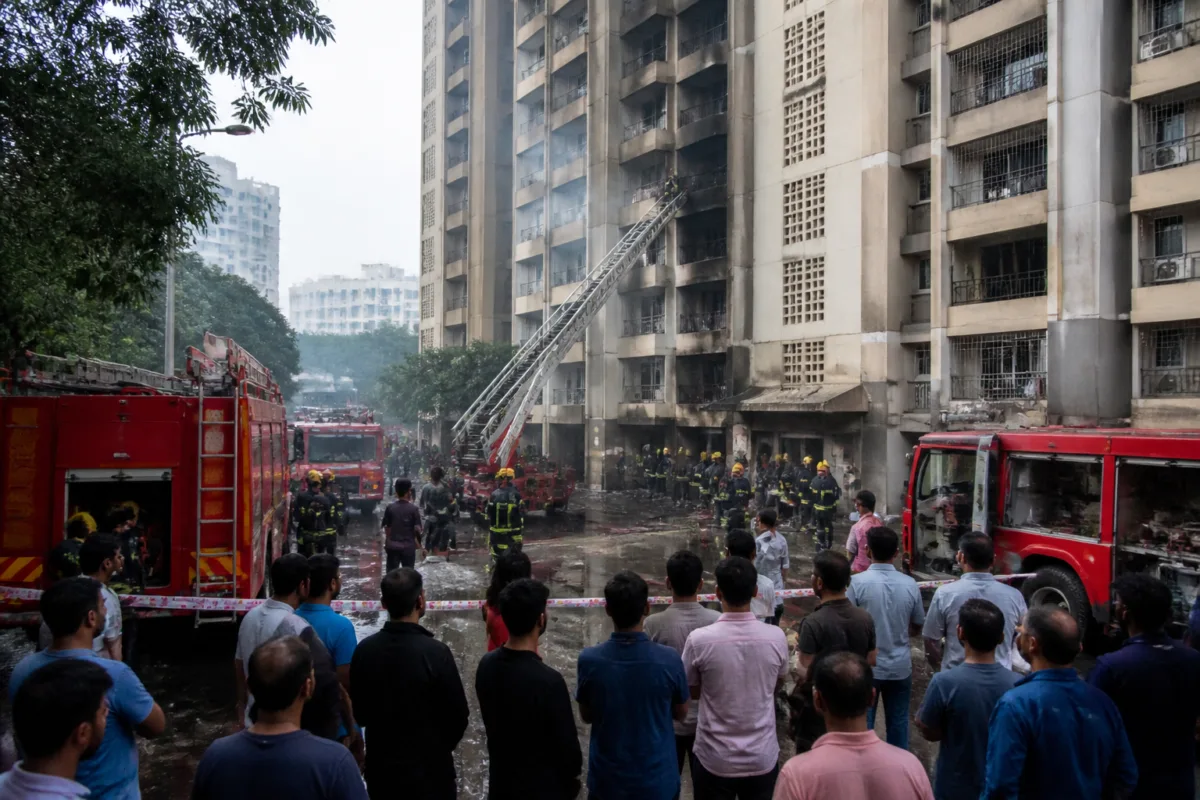
The November 8 fire at the Carlyle building in Thane’s Wagle Estate was contained without reported human casualties, but the rescue operation revealed the high-risk work expected of the city’s emergency personnel. Nearly 50 residents, including a senior citizen dependent on BiPAP oxygen support, and several pets were evacuated after flames and toxic smoke spread through a 17-storey residential tower.
The incident has now become the basis for a civic recognition demand. Shiv Sena MP Naresh Mhaske has urged the Thane Municipal Corporation to grant a salary hike to firefighters and disaster response personnel involved in the rescue. His request is not an announcement of an approved pay revision. It is a proposal addressed to the civic body, framed around the risks taken by personnel during the operation.
That distinction matters because the immediate emergency and the administrative response are two different processes. The fire brigade and the Thane Disaster Response Force were required to act within minutes during a rapidly changing incident. Any decision on pay, however, would have to move through the municipal corporation’s administrative and financial systems. The supplied report does not establish whether the TMC has accepted the demand, begun a review or set a timeline for a decision.
What the rescue operation shows is the complexity of firefighting in a high-rise residential building. The fire reportedly began in the building’s electrical duct and spread between the seventh and 14th floors. Smoke filled common corridors, trapping residents inside apartments. According to the account cited by Mid-Day, emergency teams used the building’s terrace and designated refuge areas to guide residents to safety.
The physical conditions made the operation more difficult than a conventional ground-level fire response. The common electrical duct and corridors were reportedly gutted, while doors, electrical wiring and the interiors of several apartments were charred. The report also says that the blaze was brought under control at about 2.30 am after a response that stretched into the following day.
The rescue involved more than one civic unit. Personnel from the TMC fire brigade and the Thane Disaster Response Force took part, while the civic corporation’s Regional Disaster Management Cell and specialised units from the Brihanmumbai Municipal Corporation were also involved. This combination points to the multi-agency nature of urban emergencies, particularly when a fire affects a large residential complex and continues for several hours.
The building itself was described as a 17-storey structure in the Raheja Gardens residential enclave, which houses more than 350 flats. That scale changes the character of a fire. A response team must not only locate the source of the blaze and prevent its spread, but also identify which residents remain inside, manage smoke-filled circulation spaces and assist people who cannot evacuate independently.
The account of the senior citizen on BiPAP support illustrates this dependence on specialised response. As smoke entered the apartment, firefighters and emergency responders reportedly carried the resident through smoke-filled stairwells. Paramedics then provided first aid on site. The incident also involved residents trapped in a lift after the power supply was cut, with smoke beginning to enter the cabin.
These details place the salary demand within a wider question of how cities value emergency capacity. Firefighters are often judged by the number of incidents they attend, but the operational burden is also shaped by the type of buildings they enter, the number of people at risk and the presence of residents who require assistance. In this case, the response included high-rise evacuation, smoke navigation, medical support and the evacuation of pets alongside their owners.
Mhaske’s letter, as quoted by PTI, described the contribution of the personnel as invaluable and said that a salary hike would recognise their performance and improve the morale of disaster management staff. The statement establishes the political and public argument for a pay revision, but it does not provide details on the proposed amount, the categories of personnel who would be covered or the municipal mechanism through which the increase could be implemented.
That missing administrative detail is central. A reward or salary hike could take different forms, including a permanent revision of pay, a one-time incentive, an allowance for specialised duties or a formal recognition programme. The report refers to a salary hike, but does not indicate which model the MP has proposed or whether the TMC has assessed the financial implications.
The incident also highlights how residential safety extends beyond the private apartment. The reported point of origin was a common electrical duct, while smoke travelled through shared corridors. The damage described in the report affected common building systems as well as individual homes. This means that the safety of residents depends partly on infrastructure and management arrangements that sit outside any one flat.
The supplied material does not establish the cause of the electrical failure, identify responsibility for the building’s maintenance or state whether any official inquiry has been ordered. It also does not provide findings on fire-safety compliance, the condition of the electrical duct, the functioning of emergency exits or the performance of fire-protection systems. Those questions remain separate from the recognition demand and cannot be answered by the rescue account alone.
For Thane’s municipal administration, the immediate operational lesson is that emergency response is distributed across institutions. The TMC fire brigade and disaster response teams handled the rescue, while BMC units were also called in. Such coordination can expand available capacity during a major incident, but it also makes roles, communication and accountability important parts of the response system. The report does not provide an assessment of how that coordination was managed.
The episode further shows why high-rise fires are not only fire-service events. They become tests of building access, evacuation behaviour, power systems, refuge spaces, lifts, medical preparedness and resident communication. In the Carlyle building, residents reportedly used or were guided towards the terrace and designated refuge areas, while others were trapped in a lift and a medically vulnerable person needed physical evacuation. Each of those situations required a different response.
The available evidence therefore supports two conclusions, while leaving a third unresolved. First, the November 8 operation placed substantial demands on Thane’s emergency personnel and involved the rescue of dozens of residents. Second, the operation required coordination between multiple civic and specialised units. The unresolved question is whether the civic administration will convert the political demand for recognition into a formal decision on pay or compensation.
That decision will indicate how the city treats emergency response as an institutional function rather than an exceptional act of bravery. For now, Mhaske’s request remains a proposal. The next verifiable development is whether the Thane Municipal Corporation responds to the letter, specifies the form of recognition and begins an administrative process for firefighters and disaster response personnel involved in the rescue.

