


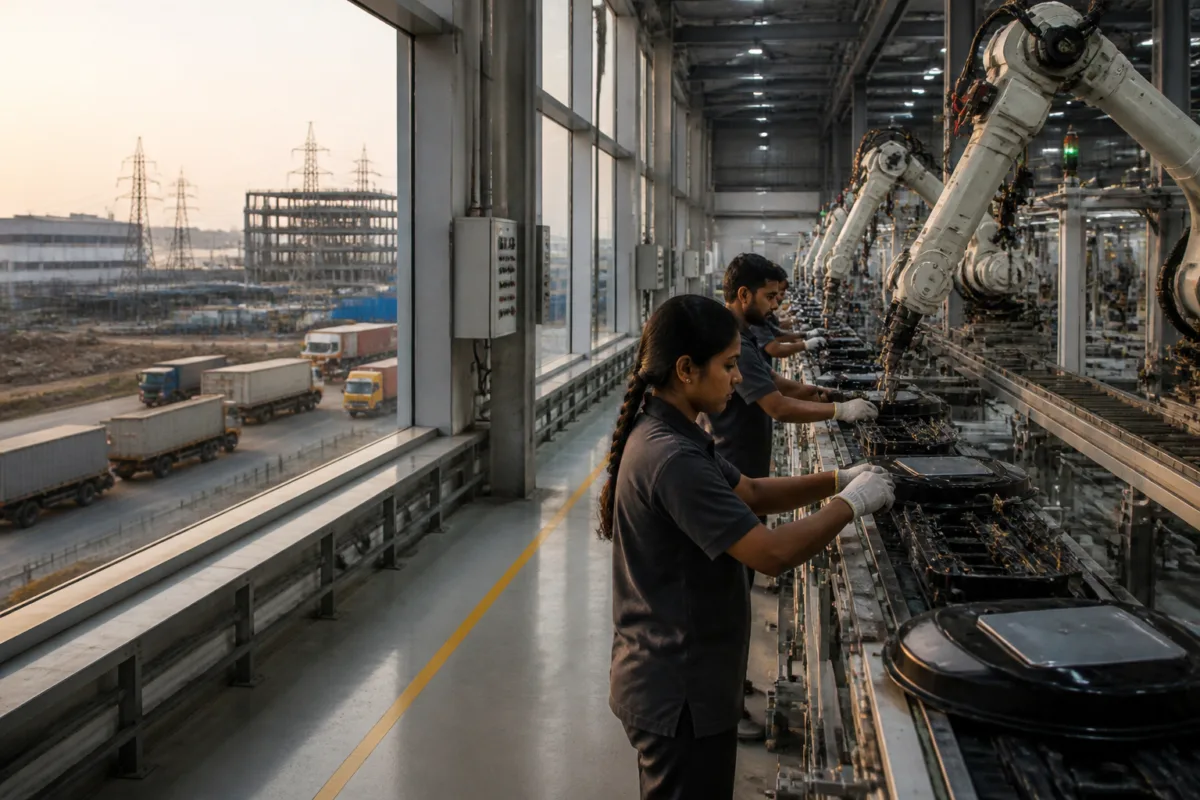
India’s production-linked incentive (PLI) schemes are attracting factories and increasing output, but the employment gains expected from the programme remain substantially behind schedule. An assessment by government think tank NITI Aayog found that the 14-sector programme has achieved 76% of its investment target and 64% of its production target, while creating only 28% of the jobs it had promised.
That gap is more than a performance statistic. It goes to the central question behind India’s manufacturing strategy: whether public money can convert industrial investment into sufficiently large employment opportunities for a young and expanding workforce. The PLI programme was designed not only to increase domestic production, but also to strengthen supply chains, attract global manufacturers and create jobs across sectors ranging from mobile phones and textiles to automobile components.
The assessment does not amount to a verdict that the programme has failed. NITI Aayog’s findings come roughly midway through the combined implementation period, with 42% of that period still remaining. The think tank has said that investment and production generally occur before large-scale hiring, and that employment could accelerate as facilities become fully operational. This qualification is important because the present figures measure progress before the schemes have reached their full implementation window.
Even with that time remaining, the difference between the three indicators is significant. Investment has reached more than three-fourths of its target, while production has crossed three-fifths. Employment, by contrast, is at just over one-fourth of its target. In percentage-point terms, the gap between investment achievement and employment achievement is 48 points. The pattern suggests that the early phase of the programme has been more successful at building capacity and increasing output than at producing jobs at the scale originally envisaged.
For cities and industrial regions, this distinction matters. A manufacturing investment can create demand for land, factories, logistics, power, transport and supplier networks without immediately producing a comparable expansion in direct employment. Industrial infrastructure may become more visible while the labour-market effect remains limited. The result can be a manufacturing footprint that grows faster than the number of stable livelihoods attached to it.
The PLI schemes have helped companies including Apple and Samsung expand manufacturing activity in India, according to the assessment reported by Economic Times. They have also contributed to a larger domestic manufacturing presence and increased exports. These are important outcomes for industrial capacity, but they do not automatically establish that the programme is meeting its employment objective. The employment target is a separate promise, and its progress has been considerably weaker than the investment and production numbers.
This distinction also changes how the programme should be evaluated. If investment is treated as the main measure of success, the 76% achievement appears strong. If production is the measure, the 64% figure indicates substantial progress. But if the policy is judged by its ability to absorb workers, especially younger workers, the 28% employment achievement presents a more difficult picture. The same programme can therefore look successful on industrial output and incomplete on employment generation.
The issue has wider significance because India’s manufacturing push is taking place alongside persistent concern over youth unemployment. Official data cited in the report put unemployment among people aged 15 to 29 at around 10% in 2025. Estimates from Azim Premji University cited in the same report indicate that nearly 40% of graduates aged 15 to 25 are unemployed, while the proportion is around one-fifth among those aged 25 to 29. These figures point to a jobs challenge that is not limited to the availability of factories. It also concerns the number, quality and suitability of jobs being generated for different sections of the workforce.
The education figures are particularly relevant to the manufacturing debate because industrial expansion does not create a single type of job. Factories may require production-line workers, technicians, supervisors, engineers and logistics employees, while the qualifications demanded for these roles can vary considerably. The supplied assessment does not establish whether the jobs created under the PLI schemes match the educational profile of unemployed young people. It does, however, show that the employment outcome is lagging behind the growth of investment and output, making the question of job composition as important as the headline number.
NITI Aayog has cautioned against treating the current employment gap as conclusive evidence of failure. Its argument is that hiring may increase once more plants become operational and the schemes move further into their implementation period. At the same time, the think tank has called for closer scrutiny of schemes that have achieved less than half of their respective targets. That creates a dual policy task: allow the programme time to mature, while examining whether weaker-performing sectors have structural problems that additional time alone will not resolve.
The institutional challenge is therefore one of measurement as much as implementation. The government has committed substantial incentives to attract manufacturers and develop domestic supply chains. To assess whether those incentives are delivering the intended public benefit, investment and production cannot be viewed in isolation from employment. The three indicators need to be tracked together, because strong performance in one can conceal weakness in another.
The current evidence does not show that PLI-supported manufacturing cannot create jobs. Nor does it establish that employment will automatically catch up during the remaining 42% of the implementation period. It shows that, so far, industrial capacity and output have advanced much faster than the employment target. The next phase of the programme will therefore be judged not only by new factories, production volumes or exports, but by whether those assets generate the scale of work that India’s manufacturing strategy was built to provide.

