

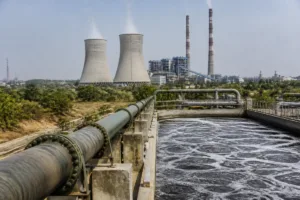
Nagpur’s Koradi and Khaperkheda thermal power stations are meeting 85-90% of their water requirements with treated sewage from the Nagpur Municipal Corporation’s Bhandewadi sewage treatment plant, reducing their dependence on fresh water from Pench dam. The arrangement has lowered the combined fresh-water reservation for the two plants from 67 million cubic metres (MCM) to 31.05 MCM.
Khaperkheda Thermal Power Station, which has an installed capacity of 1,340 MW, requires around 90 million litres of water daily. About 80 million litres per day (MLD) is supplied through tertiary-treated wastewater from Bhandewadi, while the remaining 10 MLD comes from Pench dam. Nearly 89% of the plant’s daily requirement is therefore met through recycled sewage water.
The treated water is used for condenser cooling and firefighting at Khaperkheda. Fresh water is retained for industrial and domestic requirements, including drinking water. Water from the Bhanegaon coal mine is also used for cooling and firefighting when required, according to the report.
Koradi TPS follows a similar operating model. The plant receives around 4,500 million litres of treated water every month from Bhandewadi and uses it to meet 85-90% of its water requirement. Fresh water from Pench is used for specific purposes, including boiler-related processes and drinking water.
Under the revised arrangement, Koradi has a fresh-water reservation of 26.05 MCM and Khaperkheda has a reservation of 5 MCM, taking the combined allocation to 31.05 MCM. Mahagenco has said that the available storage is sufficient to meet Khaperkheda TPS’s requirements.
The water data cited for November 12 placed Pench dam’s storage at 117.72 MCM, or 82.91% of its 141 MCM capacity. The water level at Navegaon Khairy dam was recorded at 323.86 metres against a maximum level of 325 metres.
Both power stations have also adopted Reduce, Reuse and Recycle practices and Zero Liquid Discharge systems. Their sewage and effluent treatment plants process wastewater for reuse in gardening, ash handling and other industrial operations. Water used for ash disposal is collected through recovery lines and recycled, further reducing freshwater consumption.
The arrangement places municipal sewage treatment within Nagpur’s industrial water-supply system, with treated wastewater serving a major use that would otherwise draw on reservoir stocks. The figures reported by Mahagenco and the municipal system show how separating potable and industrial water requirements can reduce pressure on freshwater allocations while maintaining operational needs at large power facilities.