


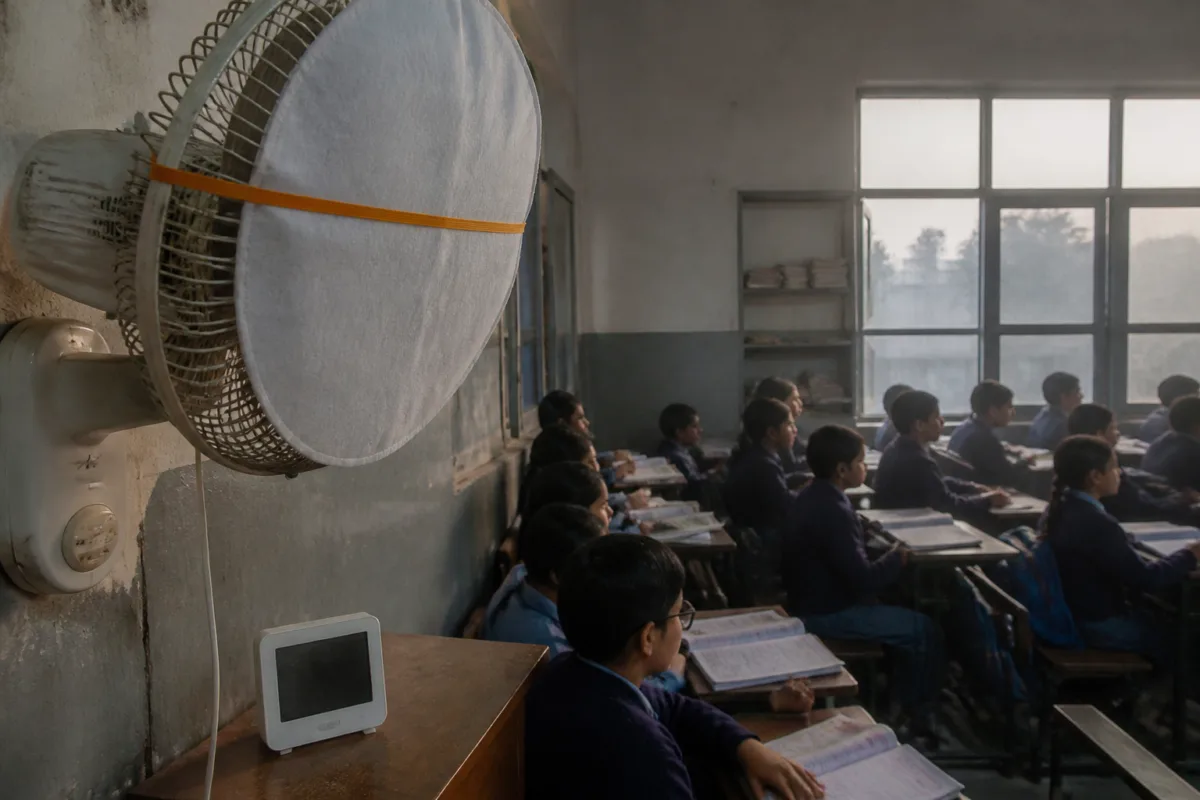
Project Vayu, a low-cost air-filtration initiative developed by two Delhi school students, has tested whether an ordinary classroom fan can become part of a practical response to fine-particle pollution. The model uses a Rs 140 filter attached to an existing table or wall fan, and has been piloted in 295 classrooms serving about 8,000 students. Its significance lies less in replacing a conventional air purifier than in addressing the affordability and scale problems that make indoor air protection difficult for many schools.
The project was started by Krish Aggarwal, a Class XII student at Sanskriti School, and Samarth Meattle, a Class XI student at Vasant Valley School. Their starting question was straightforward: what could classrooms that could not afford commercial air purifiers use instead? The answer was based on using equipment schools already possessed and adding a low-cost filtering layer.
The design is simple. An elastic band holds filter fabric over a fan. As the fan operates, air from the room is pushed through the material, which is intended to trap fine particles, including PM2.5. The filter fabric swells when the fan is switched on and can turn grey or black after several weeks, providing a visible indication that particles have accumulated on its surface.
The students said two major costs associated with air purifiers were the fan and the air-filtering material. By relying on existing classroom fans, Project Vayu avoided the need to purchase a separate appliance for every room. Hollingsworth & Vose supplied the filter material free of cost in large rolls. The rolls were cut to size and fitted with elastic at a factory, according to Aggarwal.
That approach shifts the question from whether a school can buy a commercial purifier to whether it can equip its existing classrooms with a basic filtration system. This distinction matters in a city where indoor spaces such as classrooms must operate through long teaching hours, while budgets remain limited. The project’s affordability claim is therefore central to its urban relevance: the proposed intervention is not a high-end device, but a retrofit to an existing piece of classroom infrastructure.
The pilot was conducted with the support of an NGO. The students said the initiative covered 295 classrooms and reached approximately 8,000 students. Classrooms were equipped with air-quality monitors, and schools were asked to record readings every hour. The monitoring component is important because the filter’s usefulness cannot be assessed only by its appearance or by whether a fan is running. It requires measurements of air quality before and after use.
According to Aggarwal, classrooms measuring approximately 600 to 700 square feet recorded a 50% to 55% reduction in PM2.5 levels during the first hour and about a 90% reduction after several hours of operation. In a 200-square-foot room, the team estimated a reduction of around 90% within an hour. These figures were presented by the students in the report and are not accompanied in the supplied material by an independent technical evaluation or a published testing protocol.
The project’s own account also identifies an important limitation. Classrooms are not sealed test chambers. Doors open and close during the day, students move in and out, and windows may remain open. Aggarwal said the reported results cannot be expected if windows are open. That caveat places the device within the broader problem of classroom ventilation: reducing the entry of outdoor pollution and filtering indoor air are related but different tasks.
A fan-mounted filter can circulate room air through filtering material, but its performance depends on the room’s size, the fan’s operation, the filter’s fit and condition, and the frequency with which outside air enters. The project’s reported difference between 600-700-square-foot classrooms and a 200-square-foot room also suggests that space and air volume are key variables. The available account does not establish a common performance level across all classrooms.
This is why Project Vayu is best understood as a test of an affordable retrofit model rather than as proof that every classroom fan can function as a standard air purifier. The students have reported promising pilot results, but the supplied material does not provide details on the type of filter used, the fan specifications, the baseline PM2.5 readings, the number of measurements, or the independent validation of the results. Those details would be necessary for schools or public agencies assessing whether the model can be adopted at scale.
The governance question is equally important. A classroom air-quality intervention involves more than supplying a filter. Schools would need a system for deciding when fans should operate, how indoor and outdoor conditions should be monitored, when filters should be replaced, and who would be responsible for checking equipment. The pilot’s use of hourly readings indicates that measurement was built into the exercise, but the available information does not say whether participating schools have continued monitoring after the pilot or how replacement costs are being handled.
The project also shows how the economics of urban environmental protection shape access. Conventional air purifiers combine a fan, filter housing, controls and a replacement cycle in one appliance. Project Vayu separates those components by using a fan already present in the room and adding filter material at a stated cost of Rs 140. This may reduce the initial expense, but the total operating cost would also depend on how often the filter must be changed, how much labour is needed for fitting and maintenance, and whether the material remains available without donation support.
That last point is significant for public-school deployment. Hollingsworth & Vose supplied the filter material free of cost for the project, helping keep the pilot affordable. The students now aim to reach 15,000 to 20,000 students across about 10 schools and are exploring testing in government schools. Any expansion would need to clarify whether the same material can be procured commercially, whether schools can maintain the system independently, and whether the claimed performance is consistent across different buildings and operating conditions.
Project Vayu’s planned expansion therefore creates a useful institutional test. Private schools, non-governmental organisations, suppliers and government schools may have different procurement processes, budgets and maintenance capacities. A model that works in a limited pilot may require additional administrative arrangements when deployed across a larger school network. The project’s next phase could provide evidence on whether a low-cost innovation can survive beyond its initial demonstration setting.
The initiative also places students at the centre of a problem usually managed through public-health advisories, school closures, building systems and household purchases. Aggarwal connected his interest in the project to personal experience of frequent nosebleeds while living in Delhi and said the problem improved after he began using an air purifier at home. That account explains the motivation behind the project, but it does not establish a medical relationship between the device and any particular health outcome for participating students.
What the supplied evidence does establish is narrower and still important. Two students identified the cost of air-purification equipment as a barrier, designed a fan-mounted filter, secured donated material, tested it in 295 classrooms and reported reductions in PM2.5 under specified conditions. They also acknowledged that open windows and classroom movement can affect results. These are the useful facts for policymakers: the intervention is inexpensive at the stated filter price, easy to understand, and potentially adaptable, but its performance depends on room conditions and requires monitoring.
The larger urban question is whether schools can protect children from polluted indoor air through isolated low-cost devices, or whether such interventions must be part of a wider system involving building design, ventilation management, air-quality measurement and recurring maintenance. Project Vayu does not answer that question yet. Its value is that it turns an abstract affordability problem into a measurable classroom experiment.
The next stage will determine how strong that evidence becomes. The students are seeking testing in government schools and plan to expand the initiative to 15,000-20,000 students across around 10 schools. The results to watch will include independent validation, filter replacement requirements, performance in occupied classrooms and the ability of schools to operate the system without exceptional donor support. Until those details are available, Project Vayu is a promising low-cost pilot, not a universal substitute for purpose-built air purifiers or better-controlled school ventilation.

