


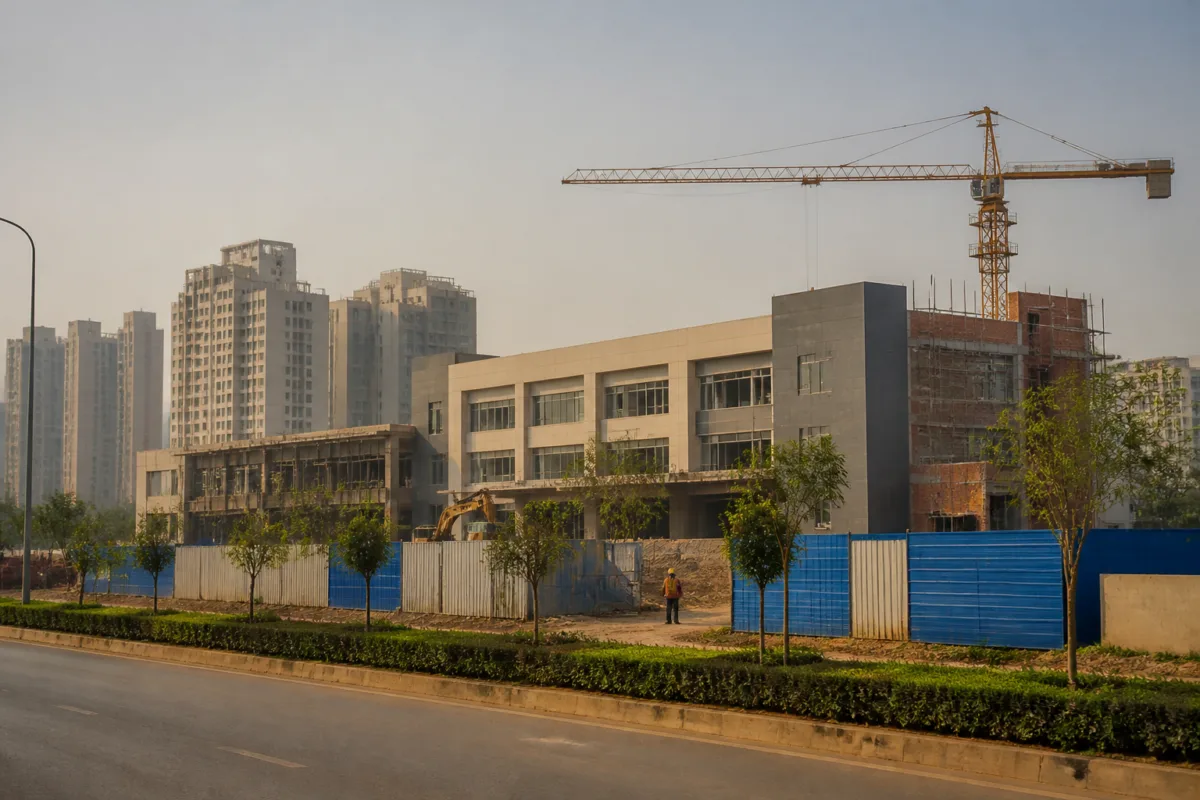
JP Schools’ acquisition of two land parcels from the DLF Foundation to build schools in Gurgaon is more than a property transaction. It signals how India’s urban education market is becoming part of a larger institutional investment story, with private equity-backed operators competing for land, brands and access to families seeking limited seats in high-quality schools.
The Blackstone-backed school operator has completed the sale deeds for the two parcels and plans to invest about ₹500 crore in developing the campuses, according to Ayush Periwal, chief executive of the Jayshree Periwal Group of Schools. The schools will operate under conditions agreed with the DLF Foundation, including quality standards for their functioning.
The transaction brings together three urban systems that are usually discussed separately: real estate, education infrastructure and corporate capital. The DLF Foundation is the corporate social responsibility arm of real estate developer DLF, while JP Schools is an established education operator with campuses and kindergartens in Jaipur. Gurgaon, meanwhile, is one of the National Capital Region’s fastest-growing employment and residential centres, where demand for schools has expanded alongside new housing and commercial development.
The available information does not specify the size of the land parcels, the exact locations, the number of seats planned or the construction timetable. Those details will determine how significantly the campuses add to local capacity. However, the agreement itself indicates that the land is not being treated as a standalone development opportunity. The buyer has accepted operating conditions linked to the DLF Foundation’s requirements, making the final school model as important as the land acquisition.
## Why Gurgaon is attracting school capital
The transaction comes at a time when private equity firms are seeking to build larger K-12 education platforms. Economic Times reported that high-quality private schools in major cities have limited seats and are unable to meet increasing demand for enrolment. This imbalance has made school operators attractive acquisition targets and has encouraged investors to create branded networks across multiple cities.
Gurgaon is particularly relevant to this shift because its urban growth has been driven by a combination of corporate employment, residential expansion and privately developed districts. In such locations, education infrastructure is not simply a social service located within the city. It is also a component of the residential ecosystem that influences where families live, how far children travel and how developers position new neighbourhoods.
The purchase of land from the DLF Foundation places the new schools within that broader relationship between urban development and institutional services. The source material does not establish whether the parcels were originally reserved for a specific category of educational use or whether the foundation will retain any role after the sale. It does establish that the schools will be built under agreed conditions and that quality norms formed part of the transaction.
That distinction matters. A school campus requires land, approvals, construction finance, teaching staff, operating systems and a long-term enrolment strategy. A large investment estimate may cover the physical development of the campuses, but it does not by itself indicate how quickly capacity will become available or whether the schools will serve the broader city or a narrower premium market.
## From individual schools to branded platforms
JP Schools’ Gurgaon entry follows a broader movement from individual school ownership towards organised education platforms. The group was founded by Jayshree Periwal and currently has three large campuses and five kindergartens in Jaipur. One of its campuses offers residential facilities and an international curriculum, with students from countries including China, Singapore, the United Kingdom, Japan, Italy, the Netherlands and Spain.
Blackstone invested in JP Schools in November 2025. The fund is aiming to deploy $700 million in education-related investments, according to earlier Economic Times reporting. The scale of that target places the Gurgaon project within a wider capital allocation strategy rather than treating it as an isolated campus expansion.
The competitive landscape is also changing. Rival private equity firm KKR backs Lighthouse Education, which operates K-12 schools and preschools under brands including Billabong High, Heritage Xperiential, Euro School, Centre Point and Pathways. KKR recently acquired Pathways School in Gurgaon for a reported value of ₹1,500 crore. The transaction illustrates the value investors are placing on established school brands, operating systems and existing urban demand.
Global operators are also entering the market. Nord Anglia, backed by Swedish private equity firm EQT, operates schools under the Oakridge brand in Hyderabad. The presence of domestic, private-equity-backed and global operators suggests that competition is increasingly organised around curriculum, reputation, scale and the ability to replicate a school model across cities.
This platform approach can provide operators with access to capital for new campuses and standardised systems for administration, admissions and academic delivery. But it also makes land and location decisions more consequential. A school brand can be expanded only where there is sufficient demand, suitable land, regulatory clearance and the ability to recruit and retain staff.
## The land question behind school expansion
In rapidly urbanising areas, the availability and allocation of land often determine whether social infrastructure keeps pace with housing growth. The Gurgaon project shows how private institutions can become important providers of education infrastructure, but it also raises questions about who sets the terms of that provision.
In this case, the DLF Foundation has attached conditions to the purchase, including quality norms. JP Schools’ chief executive said the operator had agreed to those requirements and described the family’s reputation as an additional standard. DLF Foundation and Blackstone did not respond to Economic Times queries, so the full terms of the agreement are not publicly available in the supplied material.
The absence of those details limits what can be concluded about affordability, admissions, fee structures, local access or any obligations to serve surrounding communities. The project’s public value will depend not only on the number of classrooms created but also on the type of capacity delivered and the families able to use it.
There is also an institutional question. When a corporate foundation transfers land to a private school operator under specified conditions, the arrangement can shape the character of a neighbourhood for decades. The school may become an anchor institution for nearby housing, but the public can assess that role only when the land-use permissions, campus plans, capacity and operating commitments are clear.
## What the investment trend reveals
The reported ₹500 crore project cost and the ₹1,500 crore reported value of the Pathways acquisition point to a market in which education assets are being evaluated as long-term urban platforms. Their value is connected to more than buildings. It includes established brands, existing campuses, student demand, curriculum offerings and the ability to expand into new catchments.
The trend also reflects a supply problem identified in the report: leading private schools in major cities have limited seats while enrolment demand continues to rise. New campuses can expand supply, but the effect will vary by location and price. A school built in a growing urban district may reduce travel distances for some families while remaining inaccessible to others because of fees or admissions policies.
For Gurgaon, the next evidence will therefore be operational rather than financial. The important milestones will include the campuses’ precise locations, approvals, construction progress, planned capacity, curriculum, fee structure and opening schedule. These details will show whether the transaction primarily adds premium educational capacity or contributes more broadly to the city’s infrastructure needs.
JP Schools’ entry confirms that Gurgaon remains a priority market for institutional education operators and investors. It also shows that the future of urban schooling is increasingly being shaped through land transactions, corporate foundations and private-equity-backed platforms. The central question is no longer only who is building a school, but how the city’s expanding education capacity is being planned, financed and made accessible.

