


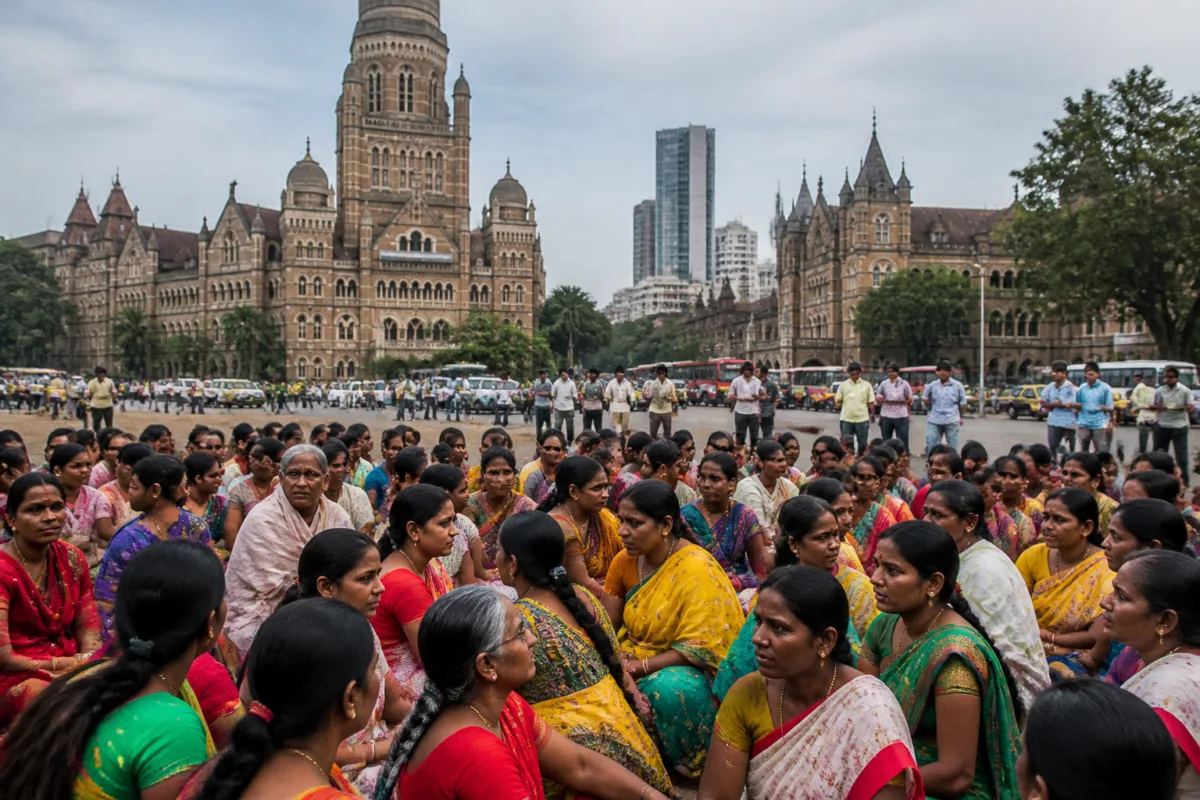
The protest by women from Maharashtra’s drought-affected districts over the withdrawal, exclusion or delay of payments under the Mukhyamantri Majhi Ladki Bahin Yojana is not only a dispute over a monthly stipend. It shows how a welfare programme can become a critical part of household survival in rural areas where farm work is seasonal, drought has damaged crops and public employment is difficult to access.
The women gathered at Mumbai’s Azad Maidan demanding restoration of the Rs 1,500 monthly payment. Their accounts, reported by the Times of India, describe a chain of pressures rather than a single administrative problem: failed crops, a shortage of farm work, difficulties completing e-KYC verification, delayed transfers and uncertainty over whether the payment will arrive at all.
For families such as that of Tanuja Barap from Vikramgad in Palghar, the loss of the stipend has coincided with a sharp reduction in rural earning opportunities. Her family’s rice crop withered during the drought, and she had been unable to find farm-hand work for more than a month when she travelled to Mumbai for the protest. The report says her payment stopped after she could not complete the required e-KYC process.
That detail is central to understanding the dispute. The state’s verification exercise was conducted over six months, from September 2025 to April 30, 2026. According to the report, 92 lakh women were removed from the scheme for failing to meet eligibility criteria, including 62 lakh who did not properly complete e-KYC. The figures indicate that the programme’s coverage has been reshaped not only by policy eligibility but also by the ability of beneficiaries to complete a digital compliance process.
In a welfare system, verification is meant to protect public funds and ensure that benefits reach eligible recipients. But the experiences described at Azad Maidan suggest that the process can also become a point of exclusion, particularly for women who may be unfamiliar with digital procedures or unable to navigate them without assistance. The supplied report does not establish how many excluded beneficiaries were otherwise eligible, nor does it detail the state’s appeal or grievance process. Those gaps matter because the central dispute is not simply whether verification occurred, but whether people who lost payments had a practical route to correct errors or complete the process.
The scheme’s political and fiscal context adds another layer. The Mukhyamantri Majhi Ladki Bahin Yojana was launched shortly before the 2024 Maharashtra assembly elections. The report says many women at the protest believed the scheme influenced their voting decisions and that they had supported the Mahayuti alliance because of the promised payment. The programme therefore moved rapidly from an election-era announcement into a recurring household expectation.
That transition has consequences for both beneficiaries and the state. A payment initially presented as a major public benefit becomes part of household budgeting once families begin relying on it for routine expenses. Lata Lahu Kedare, a farm labourer from Dindori in Nashik, told the newspaper that she used the stipend mainly to buy vegetables and oil, but that her payment stopped in December. Another beneficiary, Jyoti Bhagat from Akot in Akola, said the payment continued but arrived more than a month late.
These accounts point to two different forms of insecurity. The first is exclusion: a household receives support and then loses it after an administrative condition is not completed. The second is uncertainty: a household remains eligible but cannot predict when the money will arrive. Both weaken the value of a cash transfer, especially where income is already irregular. A delayed payment may still be legally due, but it cannot reliably support food purchases, farm inputs or other immediate needs if families cannot plan around it.
The fiscal pressure on the scheme is visible in the figures cited by the report. Its budgetary allocation fell from Rs 46,000 crore in 2024 to Rs 26,500 crore in 2026, while the state faces a debt of Rs 11 lakh crore for 2026-27. The report links the reduction in beneficiaries and the lower allocation to the government’s effort to prune expenditure. It does not, however, provide the full budget documents or explain whether the lower allocation reflects only beneficiary reductions, a change in payment assumptions or other revisions. The figures nevertheless show that the programme is being managed within a tighter fiscal framework.
That fiscal recalibration is colliding with conditions in the drought belt. The report says drought affects 85% of the state’s talukas and that the shortage of work under MNREGA, now referred to as VB-GRAM G, has made conditions more difficult. The supplied material does not provide district-wise employment data, the number of workdays generated or the reasons for the reported shortage. But the testimonies describe how the absence of farm work pushes households from one temporary occupation to another.
Mangal Mali from Chandwad in Nashik said she and her husband had worked harvesting soyabean, plucking tomatoes and planting onions. With those activities over, they were considering construction work in a neighbouring village. This is a familiar pattern of rural livelihood dependence: households move between agricultural tasks, public employment and informal construction work as seasonal demand changes. When one source of support is removed, the pressure is transferred to another activity that may also be unavailable or poorly paid.
This is why the stipend dispute cannot be separated from drought management. A cash transfer does not replace employment, crop protection or reliable local livelihoods. It does, however, provide purchasing power during the gap between agricultural seasons or after crop failure. When payments stop at the same time that farm work disappears, the household faces both an income shock and a consumption shock.
The administrative design of the scheme is therefore as important as its announced amount. The reported e-KYC exclusions raise questions about how beneficiaries were informed, whether assisted verification was available in remote areas, how failed applications were reviewed and whether payments could be restored quickly after documentation was corrected. The article records women saying they were unaware of the e-KYC requirement, but it does not include a response from the state government on these issues. That official response remains necessary for assessing whether the exclusions were the result of ineligibility, incomplete documentation, technical failure or inadequate communication.
The protest also reveals the distance between state-level welfare design and village-level access. A scheme may be announced in Mumbai and administered through a digital system, while its consequences are felt in villages where households depend on seasonal work and where completing a verification process may require information, connectivity, travel or assistance. The payment is state-wide, but the obstacles to receiving it are likely to be shaped by local conditions. The supplied report does not establish the extent of this variation, but the testimonies from Palghar, Nashik and Akola show that the problem is not confined to a single village.
The political argument at the rally, including comments by AIDWA leader Brinda Karat, focused on the timing of the verification exercise and the government’s responsibility to beneficiaries. Those are political claims and should be distinguished from the established facts in the report. What can be established is that the scheme was launched before the 2024 assembly polls, that a large number of women were subsequently excluded, that e-KYC failure accounted for a substantial share of those exclusions according to the report, and that women from drought-affected districts are demanding restoration of payments.
The larger urban question is why this rural welfare dispute belongs in a city publication. Mumbai is the administrative and political centre where the women travelled to make their demands visible. Azad Maidan functions as a civic interface between the state and communities from across Maharashtra. The protest also brings a rural livelihood crisis into the state capital, showing how drought, welfare administration and migration towards construction work are connected to the wider urban economy.
The next stage will depend on what the state does about the competing issues raised by the protest: whether it restores payments, provides a mechanism for excluded women to complete or correct e-KYC, addresses delayed transfers and clarifies how the reduced allocation will affect coverage. The report establishes the scale of the exclusions and the distress described by beneficiaries, but it does not establish the government’s response or the outcome of the demonstration. Those remain the key facts to monitor as Maharashtra manages welfare spending alongside drought-related livelihood stress.

