


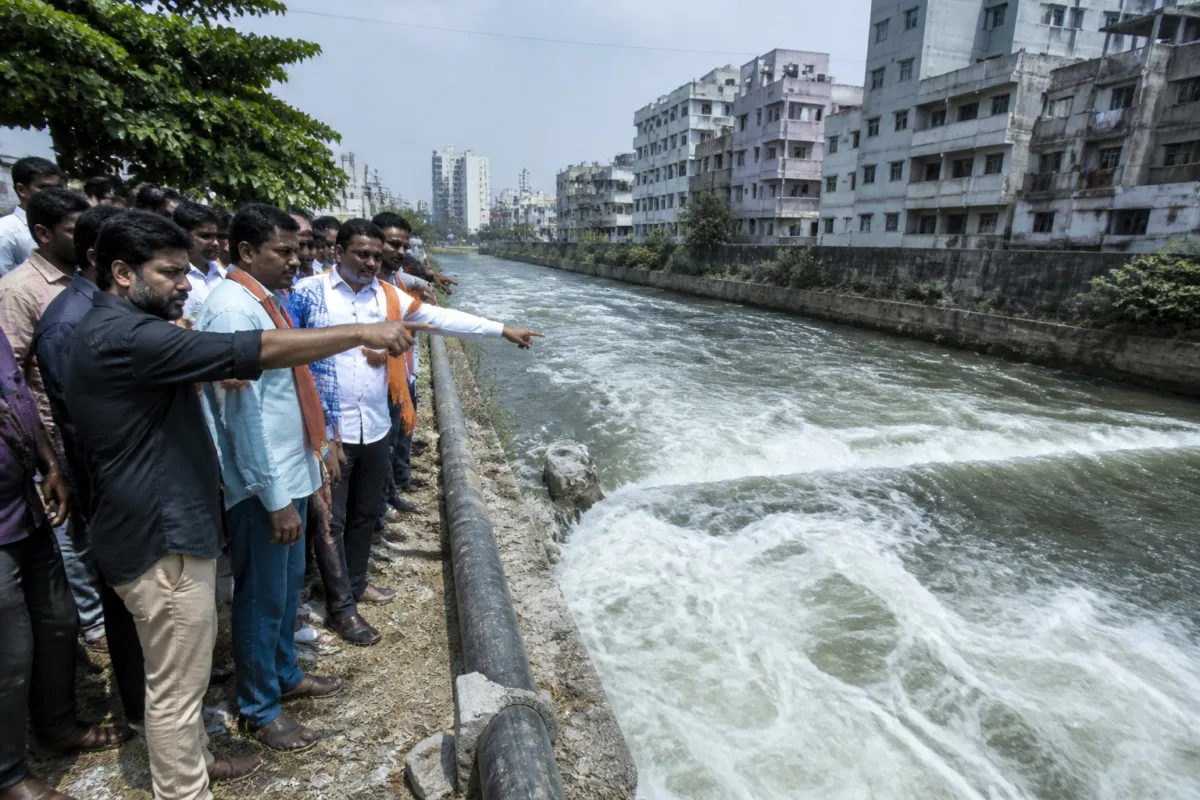
Pune’s water supply dispute intensified on November 12 after the Maharashtra Navnirman Sena (MNS) staged a symbolic swimming competition near Janata Vasahat, alleging that large quantities of water were being wasted from the Mutha Right Bank Canal while parts of the city faced alternate-day supply.
The protest was organised to challenge what the party described as poor water planning by the Pune Municipal Corporation and the Water Resources Department. MNS city president Sainath Babar, office-bearer Babu Wagskar and several party workers took part in the demonstration, entering the canal and raising slogans against the civic and irrigation authorities, according to Lokmat – Pune.
Wagskar alleged that the right bank canal had been overflowing for about a month even as Pune residents were not receiving adequate drinking water. He questioned where the water was being released and who was benefiting from it. The allegation was made during the protest and was not accompanied by official data or an immediate response from the concerned departments in the supplied report.
The protest has brought the city’s water allocation and distribution systems into focus. Pune’s drinking-water supply depends on coordinated decisions involving the municipal corporation, the Water Resources Department and reservoir operations. A mismatch between water released through a canal and water delivered through the city network can involve several stages, including reservoir allocation, irrigation releases, treatment capacity, transmission infrastructure and local distribution schedules. The report does not establish at which stage the alleged wastage occurred.
MNS leaders also referred to the government policy of reserving dam water for drinking purposes and questioned why, in their view, planning had resulted in water being released through the canal while the city faced restrictions. The party further claimed that Pune had previously received better planning under former guardian minister Ajit Pawar, despite a lower water allocation agreement. That political comparison was part of the party’s statement and was not independently assessed in the report.
During the demonstration, MNS representatives also raised an unverified suspicion that water could be getting diverted for a data centre in the Ujani region. The supplied report provides no documentary evidence for that claim, and it should not be treated as an established fact.
The immediate citizen impact is linked to the reported alternate-day water supply, which affects household storage, daily routines and the reliability of municipal services. However, the report does not provide the current citywide supply schedule, reservoir levels, canal discharge figures, Pune’s formal water allocation or details of any departmental investigation.
MNS warned that it would intensify its agitation if alternate-day water cuts continued. The next official response from the Pune Municipal Corporation and the Water Resources Department will determine whether the allegations are answered with discharge data, allocation details and an explanation of the city’s supply planning.

