


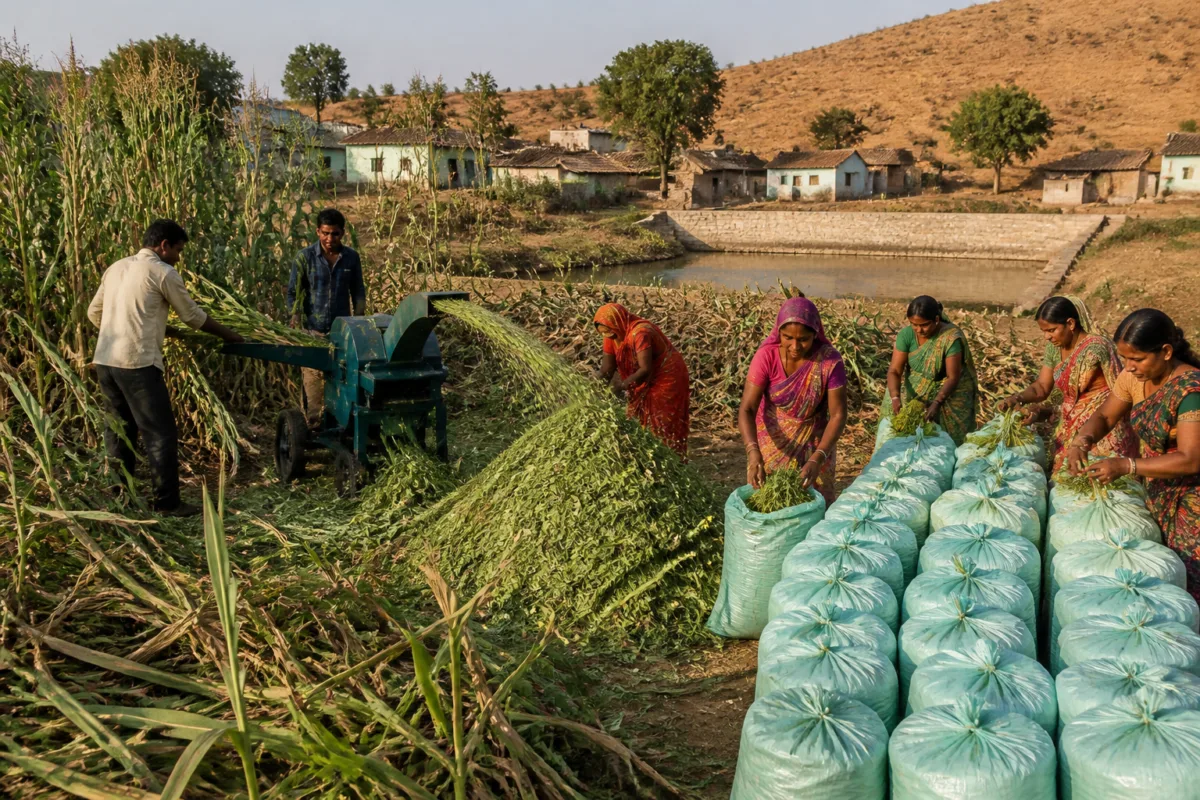
Maharashtra’s new fodder planning framework places livestock feed at the centre of drought management, linking cultivation on individual and community land with rural employment, women’s collectives and local resource management. The approach matters because a failed monsoon does not only reduce crop output or drinking-water availability; it can also weaken the livestock economy that supports rural households.
The state government’s Soil and Water Conservation Department issued a resolution on 6 November 2026 allowing fodder cultivation works under the Viksit Bharat Rozgar Va Aajivika Hami Mission (Rural), or VB-GRAMG. According to the report published by Sakal – Pune, the resolution permits fodder cultivation on both individual land and land intended for community use. It also provides for activities linked to fodder processing and storage, including chopping and silage production.
The policy is significant because fodder is often treated as an emergency requirement after shortages have already become severe. The source report describes an agricultural season marked by uneven rainfall, long dry spells, below-average rainfall in some areas, lower kharif output and a decline in rabi sowing. In such conditions, the loss of crop residue can reduce the feed available to cattle and other livestock precisely when rural incomes are already under pressure.
Livestock feed is not a peripheral concern in this system. A shortage of green fodder, dry fodder or nutritious feed can reduce milk production, affect animals’ physical condition and impair reproduction. For households dependent on dairy or livestock rearing, that can translate into a direct loss of income. The resolution therefore treats fodder cultivation as more than a departmental activity under animal husbandry: it connects employment, food security for livestock and the use of available land and moisture.
The timing of cultivation is central to the proposal. Green fodder available during the monsoon generally begins to decline after October and November. Crop residues and other dry feed may provide temporary support, but the period from January until the arrival of the next monsoon can become difficult, particularly where kharif crops failed or rabi sowing fell. The report identifies drought-prone areas of Marathwada, western Maharashtra, parts of Vidarbha and rain-shadow areas of north Maharashtra as regions where the shortage could become more acute.
The proposed response is to use November and December for cultivation on land where sufficient moisture remains, or where limited protective irrigation is available. This does not mean that every field can be brought under fodder. The source makes a distinction between land with residual soil moisture, land supported by a well or borewell, and community land with a sustainable water arrangement. Crop selection is expected to reflect water availability, the time required for harvesting and the possibility of more than one harvest.
The resolution’s crop list includes maize, sorghum, pearl millet, Napier grass, lucerne, multi-cut sorghum and multi-cut pearl millet. The report states that fodder sorghum can generally be ready for harvesting in about 55 to 75 days, while pearl millet may provide fodder in approximately 45 to 60 days under suitable conditions. Napier is presented as a perennial source of green fodder, with a first harvest in roughly 75 to 90 days and subsequent harvests at intervals of around 45 to 60 days, depending on local conditions.
Lucerne offers a protein-rich fodder option, but its cultivation requires attention to soil type, drainage and water availability. The report specifically cautions against growing it in poorly drained land. These details show why a village-level fodder plan cannot rely on a single crop or a uniform prescription. The choice must follow local moisture conditions, land characteristics and the needs of the livestock population.
Silage is the framework’s most important storage component. Green fodder is available for only part of the year, while livestock require feed through the dry period. Maize can be harvested for green fodder and silage, with the report indicating that it may reach a suitable stage for silage in about 70 to 90 days under appropriate conditions. When sown in November, it could provide fodder by late January or February, although the actual period depends on the variety, temperature, sowing date and water management.
The resolution’s annexure includes fodder chopping, filling silage bags and storage. For one hectare of fodder maize, the reported estimate includes 50 to 60 silage bags of one-tonne capacity, a cost of Rs 550 per bag and a chopping-machine rental cost of Rs 400 per tonne. These provisions matter institutionally because they recognise that cultivation alone does not guarantee feed security. Harvesting, processing, storage and distribution are equally important parts of the supply chain.
The policy also opens a governance question: who controls community fodder and how is it distributed? The report refers to gram panchayat land, legally available common land, grazing land, cultivable land near farm ponds and land near reservoirs. Such areas cannot be treated as an undifferentiated pool. Their legal status, community-use rights, approvals from competent authorities and local rules must be established before cultivation begins. Work around reservoirs and water bodies must also avoid affecting water storage, flows or the primary use of the water source.
At village level, the report proposes that community-produced fodder be managed as a shared resource. A gram sabha resolution could determine cultivation, harvesting, storage and distribution arrangements. This makes the gram panchayat more than an administrative channel for employment works. It becomes a coordinating institution responsible for matching land, water, livestock demand and local labour.
The implementation structure assigns responsibilities to gram panchayats, the agriculture department and the animal husbandry department. For gram panchayat-level works, technical approval is to be provided by the taluka livestock development officer and administrative approval by the block development officer. Agriculture-related works require technical approval from an agricultural supervisor and administrative approval from the taluka agriculture officer. Animal husbandry works involve veterinary officers for technical approval and the assistant commissioner or taluka animal husbandry and dairy development officer for administrative approval.
The taluka animal husbandry and dairy development officer is also identified as a programme officer for these works, with relevant administrative and financial powers. This arrangement can reduce the risk of treating fodder shortage merely as a monitoring issue. It places the animal husbandry department closer to actual production and storage decisions, while retaining roles for agriculture and rural development institutions.
The resolution also provides for obtaining seeds from institutions including Mahabeej, the National Seeds Corporation, Kribhco, NFL, the Indian Council of Agricultural Research and Krishi Vigyan Kendras. The source does not establish how quickly these inputs will reach villages or whether local demand will be fully met. Those are implementation questions that will determine whether the policy remains an order on paper or becomes a functioning feed-supply system.
Women’s self-help groups and the community institutions of Maharashtra’s rural livelihoods mission, Umed, are another important part of the proposed model. The report describes a possible value chain in which groups cultivate fodder, harvest and chop it, prepare silage, store it and sell it to local livestock owners. A cluster of villages could share a silage-making and storage centre rather than building a separate facility in every village.
This approach could connect drought management with rural enterprise, but the source presents it as a proposed opportunity rather than an established outcome. A viable business plan would need to account for cultivation, seed, harvesting, chopping, bags, storage, transport, sale prices and local demand. The report also refers to livelihood funds, community investment funds, bank linkages and other convergence options, subject to eligibility conditions and applicable rules.
The proposed village-level planning process begins with a fodder balance sheet: the number of livestock, available green and dry fodder, the expected shortfall and the land that can be cultivated. The next steps involve assessing soil moisture and irrigation, selecting crops jointly through the agriculture and animal husbandry departments, securing technical and administrative approvals, and storing surplus fodder as silage. The resolution’s conditions, including beneficiary selection, social audit, measurement records, online payments and financial limits, remain part of the implementation framework. The report also notes that machinery cannot be used for work that is required to be performed by labourers under the applicable provisions.
The central shift is from reactive fodder relief to advance planning. The evidence supplied in the report confirms the policy’s administrative design and the technical options identified for cultivation and storage. It does not yet establish the area that will be planted, the volume of fodder that will be produced, the number of livestock covered or the extent to which the expected shortage will be reduced. Those indicators will be more meaningful than the number of hectares recorded under cultivation alone.
Maharashtra’s fodder planning effort therefore sits at the intersection of drought response, decentralised governance and rural livelihoods. Its success will depend on whether village institutions can translate a government resolution into a reliable chain linking land, water, seed, labour, storage and distribution. The next material milestones are the village-level surveys and plans, the approvals for eligible works, cultivation during November and December 2026, and the creation of silage stocks for the January-to-June shortage period described in the report.

