


Adani Enterprises’ agreement with Chilean state-owned miner Codelco to explore the Kaburkaala copper project is more than an overseas mining bet. It is an attempt to address the supply-chain risk emerging behind India’s rapid electrification, infrastructure expansion and industrial growth: the country can increase refining capacity faster than it can secure the copper concentrate needed to keep those facilities running.
The agreement between Kutch Copper Limited, a subsidiary of Adani Enterprises, and Codelco covers exploration in Chile’s northern Antofagasta region. Adani will provide financing for the exploration initiative, which could eventually supply copper to its Mundra complex in Gujarat. The project is not an operating mine, and the agreement does not establish an immediate supply contract. Its commercial value will depend on whether exploration confirms a viable deposit and whether the project can subsequently secure approvals, financing and development infrastructure.
That distinction is important. The Kaburkaala project cannot immediately change Adani’s raw-material position at Mundra. But it reveals how the group is positioning itself in a copper market where access to mined resources is becoming as important as the ability to process metal. Adani’s strategy is beginning to connect three parts of the value chain: overseas resource access, large-scale domestic smelting and refining, and downstream industrial demand in India.
## Mundra’s expansion creates a raw-material challenge
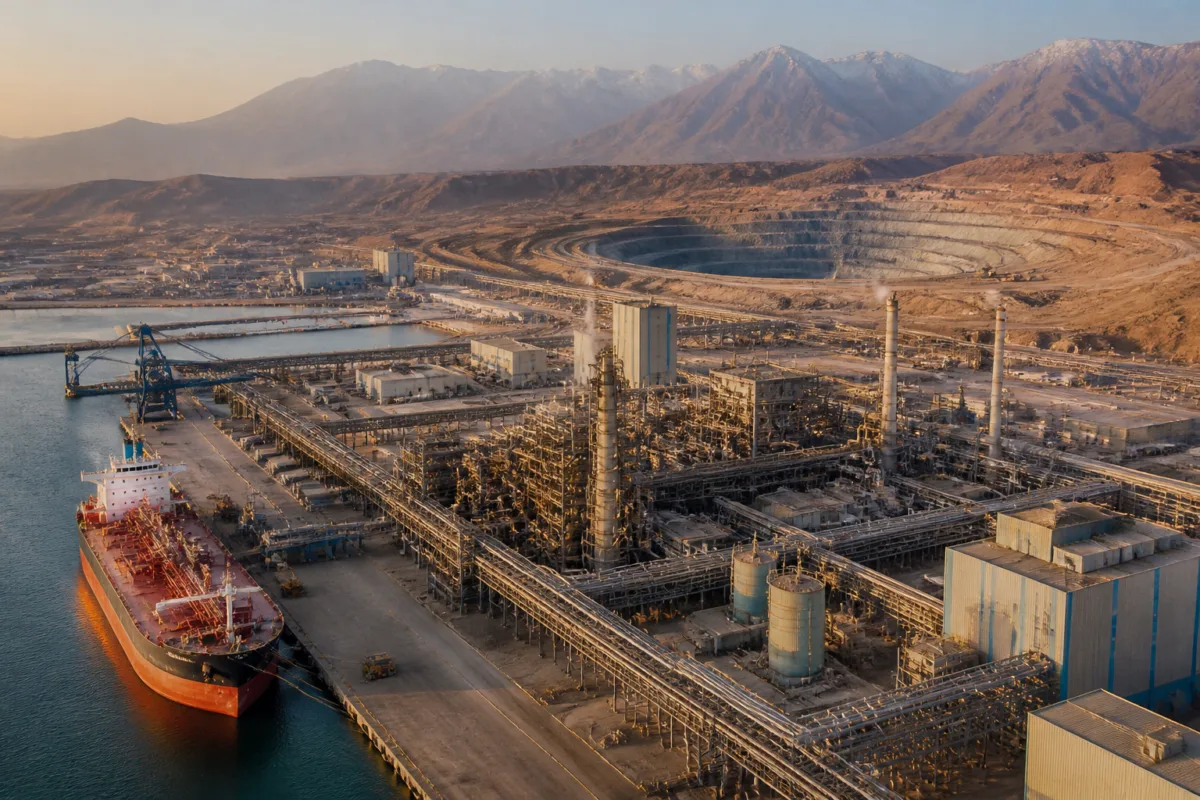
Kutch Copper has established a greenfield copper smelting and refining complex at Mundra, with installed capacity of 500,000 tonnes a year and plans to double that capacity to one million tonnes. The facility, commissioned in 2024, produces refined copper cathodes and rods as well as by-products including gold, silver and sulphuric acid. The project represents an investment of about $1.2 billion.
The scale of the complex changes the procurement question. A smelter does not need to own a mine: it can buy copper concentrate from mining companies, commodity traders or through long-term supply contracts. However, when mined supply tightens, refiners compete more aggressively for concentrate. This can raise procurement costs and put pressure on the processing charges that smelters earn for converting concentrate into refined metal.
Kutch Copper’s capacity utilisation was 64% in the September quarter, and the company is targeting utilisation of 80-85% by March 2027. It had secured around 50-60% of its concentrate requirements through long-term contracts and another 20% through short-term arrangements. The Codelco partnership could eventually provide an additional layer of supply security, although it is too early to treat the exploration project as a guaranteed source for Mundra.
This is the institutional and commercial logic behind the Chile agreement. Adani is not simply adding another mining asset to its portfolio. It is trying to reduce the exposure of a large domestic processing facility to the international market for copper concentrate, where supply availability, contract terms and competition among refiners can change independently of Indian demand.
## Why copper has become an infrastructure issue
Copper is central to electricity infrastructure because of its high electrical conductivity. It is used in power transmission and distribution networks, transformers, motors, cables and industrial equipment. Electric vehicles use more copper than conventional vehicles, while solar and wind projects require the metal in generators, cabling and associated electrical systems.
India’s demand is also being reinforced by urbanisation, manufacturing, renewable-energy deployment, electric mobility and the expansion of data centres. Data centres require extensive power-distribution and cooling infrastructure, adding another source of demand linked to digital growth. As cities and industries become more dependent on electricity, copper moves from being a conventional industrial input to being a strategic material for the built environment.
The source report cites an estimate that India’s copper demand will rise 12% to 2,100 kilotonnes in financial year 2026. It also notes that India has a relatively limited domestic mining base and depends on imported concentrates and refined copper to bridge the gap between consumption and primary production.
That dependence makes domestic refining capacity valuable, but it does not make India self-sufficient. Smelters located in India can improve domestic value addition and reduce dependence on imported finished copper. They cannot eliminate exposure to foreign raw materials unless the country also secures mines or long-term access to overseas concentrate.
## The gap between installed capacity and operational security
India’s copper ecosystem illustrates the difference between capacity on paper and capacity that can reliably serve the market. Kutch Copper’s Mundra complex and Hindalco’s Dahej facility each have installed smelting capacity of 500,000 tonnes annually. Hindalco’s complex also includes refining, copper-rod manufacturing and precious-metals recovery facilities.
Vedanta continues to operate copper refining and rod-making facilities at Silvassa, where copper cathode production reached 170,000 tonnes in financial year 2026, according to the source report. But the company’s 400,000-tonne Tuticorin smelter has remained shut since 2018. The closure demonstrated how a major disruption in domestic processing can increase the country’s dependence on imports even when demand remains strong.
The result is a system with substantial installed or planned processing capability but continuing vulnerability at the raw-material end. India can add smelting and refining capacity, but the benefits will be constrained if concentrate supplies do not expand at a comparable pace. This is why Adani’s overseas exploration strategy has significance beyond the balance sheet of a single company.
The International Copper Study Group’s October 2026 forecast, cited in the source report, places global mined copper production at approximately 23.5 million tonnes in 2026 and 24.2 million tonnes in 2027. Refined copper production is expected to grow by only 0.4% in 2026, compared with estimated usage growth of 1.5%. The group nevertheless projects a modest refined-copper surplus of 104,000 tonnes in 2026, widening to 368,000 tonnes in 2027.
Those figures do not remove the concentrate problem. Refined copper supply and mined copper supply are connected but not interchangeable. Smelting capacity can expand faster than mine output, leaving refiners competing for available concentrate even when finished-metal balances appear less tight. The economics of a smelter therefore depend not only on its size and technology but also on the quality, reliability and cost of its raw-material contracts.
## Chile gives Adani access to a critical geography
Chile is the world’s largest copper-producing country and hosts some of the largest known copper deposits. Codelco is one of the industry’s most established producers, with extensive mining and exploration experience. Working with the company gives Adani exposure to a country that occupies a central position in global copper supply and to a partner with deep geological knowledge of the region.
The wider geography of the copper industry also explains the strategic attraction. Chile, Peru and the Democratic Republic of Congo are major sources of mined copper, while China dominates much of the global smelting and refining landscape. The countries that produce copper ore are not necessarily the countries that process the greatest volumes of refined metal.
For India, this creates both a vulnerability and an opportunity. The country wants to capture a larger share of value addition through domestic refining, manufacturing and infrastructure supply, rather than remain primarily a consumer dependent on foreign suppliers. Overseas mineral partnerships are one way to connect domestic industrial capacity with international resource bases.
However, the Kaburkaala agreement remains at the exploration stage. Neither a production timeline nor a commercially recoverable resource estimate has been announced. Exploration may take years to establish geological and commercial viability, after which development would require further capital, approvals and infrastructure. The project should therefore be understood as a long-term supply-chain option rather than an immediate solution for Mundra.
## A broader industrial strategy is taking shape
The Chile agreement fits Adani’s wider effort to build a copper business around large-scale domestic processing, overseas resource access and downstream manufacturing. The group’s ports and logistics infrastructure could support the movement of imported raw materials into India and finished products to domestic or export markets. That network does not guarantee commercial success, but it gives the copper strategy a broader industrial structure than a standalone smelter would have.
The environmental performance of the Mundra complex will also matter as the copper value chain expands. The facility is designed to recover valuable by-products and improve resource efficiency, while the group has also planned a 115 MW renewable-energy push at the refinery. Such measures are relevant because both mining and processing face growing scrutiny over energy use, emissions and environmental impacts.
The central question is whether India’s copper demand can be matched by a dependable, economically viable and environmentally credible supply chain. Adani’s Codelco partnership addresses only one part of that question: access to future mined resources. It does not yet resolve the development risk of the Chile project, the cost of concentrate procurement or the challenge of operating large smelting capacity through changing global market conditions.
What the agreement confirms is the direction of travel. India’s electrification and infrastructure build-out are making copper a strategic industrial input, while domestic refiners are seeking greater control over the raw-material networks on which they depend. Adani’s Mundra expansion has made that dependence visible. The Kaburkaala exploration project is an early attempt to manage it at the source, but its contribution will remain uncertain until exploration establishes whether a commercially recoverable resource exists and whether production can eventually begin.

