


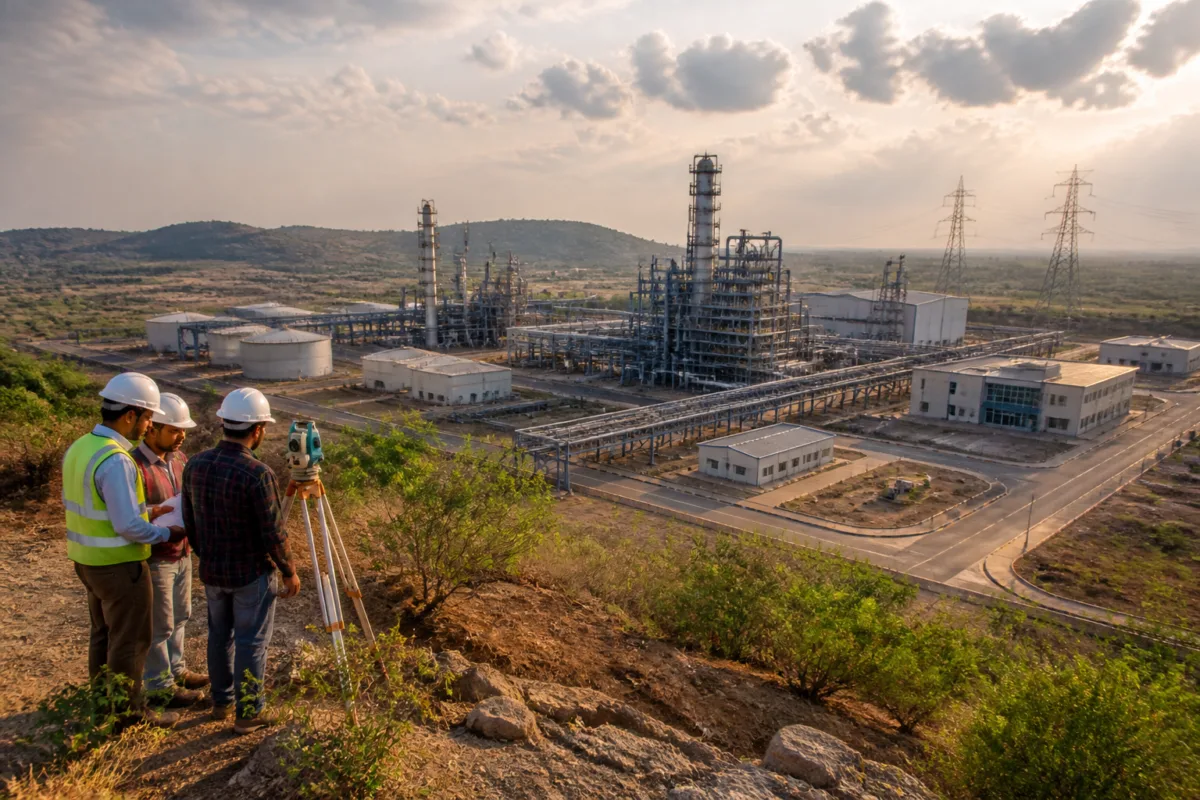
Reliance Industries’ proposed Andhra Pradesh coal gasification project is not simply another large industrial investment. At an estimated ₹43,000 crore across two phases, it would create a new test for how the state converts deep coal reserves, industrial infrastructure and large corporate commitments into actual regional economic capacity. The proposal is still conditional: its larger phase depends on technical and commercial feasibility, regulatory approvals and the success of an initial exploration and pilot programme.
The project, described in a government document seen by Reuters, would use underground coal gasification to convert deep coal reserves into usable gas without conventional mining. Reliance plans to spend about ₹3,000 crore in the first phase on exploration, geological assessments and pilot demonstrations. A second phase, requiring an initial investment of approximately ₹40,000 crore, would proceed only after the first phase is successfully completed and the necessary approvals are obtained.
That sequencing is central to understanding the announcement. The headline investment figure represents a proposed pathway rather than an immediately committed construction outlay. The first phase is designed to answer whether the resource can be accessed, gasified and operated at commercially viable scale. Only after those questions are addressed would the larger investment be released.
This makes the project different from a conventional announcement of a fully approved plant. The government document indicates a staged decision-making process, in which geological evidence, pilot performance and regulatory clearance will determine whether the project advances. The document does not specify the proposed site, production capacity, construction schedule, offtake arrangements or the authorities responsible for each approval. Those details will be important in assessing the project’s eventual infrastructure requirements and regional impact.
The proposed complex arrives as Andhra Pradesh seeks to position itself as a destination for several forms of capital-intensive industry. The report notes that Google has committed $15 billion to build an artificial intelligence hub in the state, while Reliance and its joint venture partners plan to invest $11 billion in data-centre capacity. Kia’s Indian unit has also announced plans to invest about $2 billion in an additional manufacturing plant.
Taken together, these announcements point to a development strategy built around large industrial and digital infrastructure projects. They span energy conversion, data centres, artificial intelligence and vehicle manufacturing. Each has different land, power, water, transport, construction and workforce requirements. The coal gasification proposal therefore needs to be read within a broader question: whether the state can build the common infrastructure and administrative capacity required by multiple large projects arriving at the same time.
The available information does not establish whether these investments will share facilities or be concentrated in the same industrial regions. It also does not state how the proposed Reliance complex would connect to gas networks, electricity systems, transport corridors or nearby industrial users. Those connections will determine how much of the project’s value remains within the host area and how much supporting infrastructure public agencies and private developers must provide.
The employment projections illustrate the scale of the expected economic effect. The project could eventually generate around 5,000 direct jobs and 35,000 indirect jobs, according to the government document. It could also attract investments of up to ₹2.7 trillion over its lifetime. These figures are projections associated with the proposal, not outcomes that have already been delivered. Their significance will depend on whether the project passes its feasibility stage and how the indirect employment estimate is defined and measured.
For local economies, the distinction between direct and indirect employment matters. Direct jobs would be associated with the complex and its operations. Indirect employment would depend on contractors, suppliers, logistics, maintenance, services and other businesses connected to the project. The report does not provide a sector-wise breakdown, wage profile, skill requirement or geographical distribution for either category. Without those details, the employment number indicates potential scale but cannot yet show how widely the benefits would be distributed.
The technology choice introduces another layer of uncertainty. Underground coal gasification is intended to convert deep coal reserves into gas without conventional mining. That could alter the physical requirements of resource extraction compared with an open-cast or underground mining operation. However, the supplied material does not provide technical data on the proposed process, expected gas output, land requirement, water use, emissions profile, waste management or environmental safeguards. The first phase’s exploration and pilot work is therefore not a procedural formality; it is the stage at which the project’s technical case is expected to be established.
The regulatory condition attached to the second phase is equally significant. Reliance would move to the larger investment only after successful completion of the initial phase and receipt of the necessary approvals. The report does not identify those approvals or provide a timeline. Depending on the project’s final design, the approval process could determine the timing of land development, utilities, plant construction, transport access and commercial operations. At this stage, however, the specific regulatory path remains unstated in the supplied document.
The proposal also shows why investment announcements should not be treated as interchangeable with completed infrastructure. A project can attract attention, create expectations and influence public planning before construction begins. But the material available here confirms only the proposed investment structure, the intended technology, the projected employment and the conditions for moving from feasibility work to the larger phase. It does not confirm land acquisition, construction contracts, financing closure, final capacity or an operational date.
For Andhra Pradesh, the institutional challenge will be coordination. A major coal gasification complex would require decisions extending beyond the project company, including resource assessment, environmental and regulatory review, utility connections, transport access and local administrative preparation. At the same time, the state’s other proposed investments in artificial intelligence, data centres and vehicle manufacturing would create separate infrastructure demands. The report does not say whether a common state-level mechanism has been established to coordinate these projects or sequence their requirements.
This matters because the projects represent different kinds of urban and regional growth. A manufacturing plant requires industrial land, freight movement and supplier networks. Data-centre capacity requires reliable power and digital connectivity. A coal gasification complex would require resource-related infrastructure, processing facilities and downstream users or distribution arrangements. Their combined presence could reshape employment centres and supporting settlements, but the supplied evidence does not yet establish the locations or linkages needed to assess that transformation.
The proposal’s lifetime investment potential of up to ₹2.7 trillion is substantially larger than the initial two-phase estimate, but the report does not explain how that lifetime figure is calculated or over what period it could materialise. This makes it useful as an indicator of the project’s stated ambition, but not as a confirmed capital commitment. The more immediate and testable figure is the first-phase allocation of about ₹3,000 crore, because that is the spending associated with exploration, geological assessment and pilot demonstrations.
The next milestone is consequently not the construction of a ₹43,000-crore complex. It is the completion of the feasibility work that would determine whether the second phase can proceed. The evidence currently supports a picture of a high-value proposal at an early decision point: Reliance has outlined a technology and investment pathway, the state is associated with a wider wave of major commitments, and the project’s larger economic claims remain dependent on technical results and regulatory approvals.
What happens next will reveal whether the announcement becomes a functioning industrial asset or remains an investment proposal. The key developments to monitor are the progress of exploration and pilot demonstrations, the publication of technical and commercial findings, the identification of required approvals, and any subsequent confirmation that the second phase has been sanctioned. Until those milestones are reached, Andhra Pradesh’s coal gasification project should be understood as a potentially significant regional investment undergoing feasibility and approval, rather than as an operational facility already reshaping the state’s economy.

