


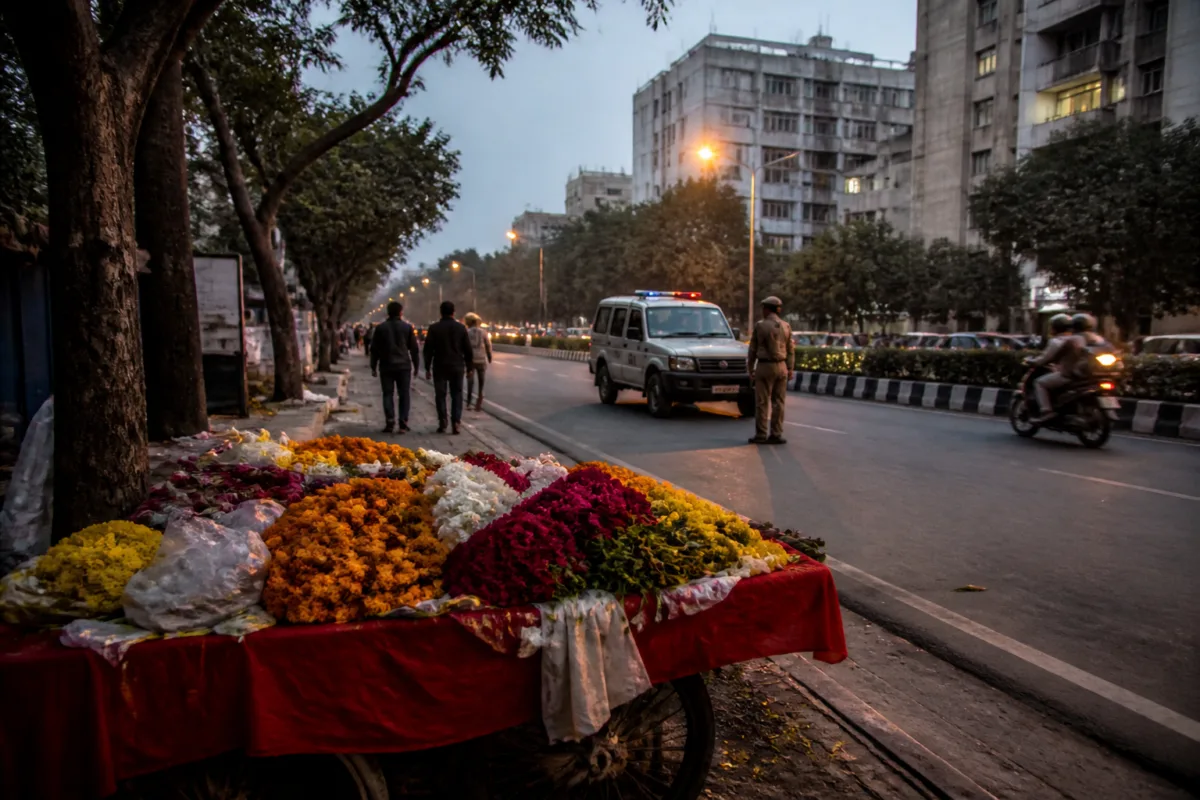
The assault of a flower seller near AIIMS Road in south Delhi has become a test of how the city’s public-safety system responds when a vulnerable informal worker is attacked and no formal complaint is immediately recorded. Police took cognisance after CCTV footage of the incident circulated on social media, but the reported delay also exposes the limits of a response system that can become active only after an incident becomes visible online.
According to a report by Jagran – New Delhi, the woman was beaten with sticks on the night of Chhoti Diwali while selling flowers and garlands on the route connecting AIIMS Road to Gautam Nagar in the Hauz Khas police station area. The report said the attack allegedly followed her refusal to sell drugs. It attributed the allegation to claims that a person identified as Soni, described in the report as a drug mafia figure, had the woman attacked by associates.
The allegation has not been established through a court finding in the material supplied for this report. The reported incident, however, is supported by CCTV footage that was later circulated on social media. That footage became the trigger for police attention, even though the South district deputy commissioner of police said Hauz Khas police station had not received a PCR call or a written complaint at the time of the report.
This sequence is important because it separates three parts of an urban safety response that are often treated as one: the occurrence of violence, the victim’s ability to report it, and the police system’s capacity to act when a complaint is absent. In this case, the report says the incident took place five days before publication. During that period, the victim was reportedly waiting for police action, while the footage travelled through social media.
The city’s informal workers occupy public spaces without always having the institutional protection available to workers in formal workplaces. The woman was selling flowers and garlands on a public route, according to the report. The supplied material does not establish her employment status, residence, income or access to support services. It does show that her livelihood was taking place in an open urban setting where an alleged demand to participate in illegal activity was followed by physical violence.
That distinction matters. The reported attack was not presented as a dispute over a formal contract, a regulated workplace or a documented commercial transaction. It occurred at street level, where the relevant institutions may include the local police station, beat officers, municipal authorities and, depending on the circumstances, agencies responsible for protecting vulnerable workers. The available report does not say whether any of these agencies had previously received complaints about the location or the people allegedly involved.
The immediate police response was based on information obtained from social media rather than a PCR call or written complaint, according to the deputy commissioner of police cited by Jagran. A police team was assigned to identify and trace those involved. The police also said strict legal action would be taken against the accused. These are the confirmed next steps described in the report; the supplied material does not state whether arrests were made, which offences were registered or whether the woman’s medical examination was conducted.
The absence of a formal complaint should not be treated as evidence that no offence occurred. It is also not, by itself, proof of why a complaint was not made. The report does not provide the woman’s account of the delay, whether she was able to approach the police, whether she feared retaliation, or whether she received assistance. Those unanswered questions are central to understanding the case and should not be filled with assumptions.
The episode therefore reveals a narrow but significant institutional problem: a public-safety system may have several routes for receiving information, but those routes do not function in the same way for every resident. A person who is injured, economically dependent on a street location or fearful of alleged local criminal actors may not immediately use a written complaint process. In this case, the police response began after public circulation of visual evidence, as reported by the newspaper.
That does not mean social media can replace first-response policing. Online footage can be incomplete, lack context and expose a victim’s identity. It can also turn an individual’s assault into public content before the person has received medical, legal or psychological support. The supplied report establishes only that the footage circulated and prompted police cognisance; it does not establish how the video was obtained or whether the victim consented to its dissemination.
The location also places the event within a wider urban setting: a busy road and a route between a major medical institution and a dense neighbourhood. The report identifies AIIMS Road and the road towards Gautam Nagar, but it does not provide information about street lighting, surveillance coverage, pedestrian activity, police patrols or the presence of nearby businesses. Those details would be necessary to determine whether the attack reflected a broader safety deficiency at the site or an isolated incident.
Similarly, the material does not establish the scale of alleged drug activity in Hauz Khas or Gautam Nagar, nor does it provide prior police records, arrest data or complaints connected to the named suspect. The description of a “drug mafia” comes from the source report and must remain an allegation unless supported by an official case record or court proceeding. No conclusion about an organised criminal network can be drawn from the supplied account alone.
The administrative responsibility is clearer at the first-response level. The Hauz Khas police station is the local police unit identified in the report, while the South district deputy commissioner of police has publicly described the status of the response. The police team’s stated task is to identify and locate those involved. The report does not identify any municipal role, welfare intervention or formal mechanism for protecting the flower seller’s livelihood.
This is why the case is more than a viral-video incident, while still requiring restraint. The central fact is an alleged assault documented in CCTV footage and followed by police action after online circulation. The institutional question is whether a victim can obtain protection and investigation without first having to overcome barriers to making a formal complaint or waiting for evidence to become publicly visible. The supplied material raises that question but does not answer it.
The evidence also leaves important gaps. It does not state the woman’s condition, whether she received medical treatment, whether a First Information Report was registered, which provisions of law were applied, or whether the alleged attackers were identified. It does not include a statement from the woman, the accused or their representatives. It also does not provide an independent account of the footage beyond the newspaper’s description.
The next developments will determine whether the police response moves from cognisance to a documented investigation. The key milestones are the identification of those involved, the registration of any case, the provision of protection and assistance to the victim, and the outcome of the police team’s search. Until those details are available, the confirmed record remains limited: a flower seller was reportedly beaten in the Hauz Khas area, the attack was captured on CCTV, police said no PCR call or written complaint had been received, and action began after the footage circulated online.

