


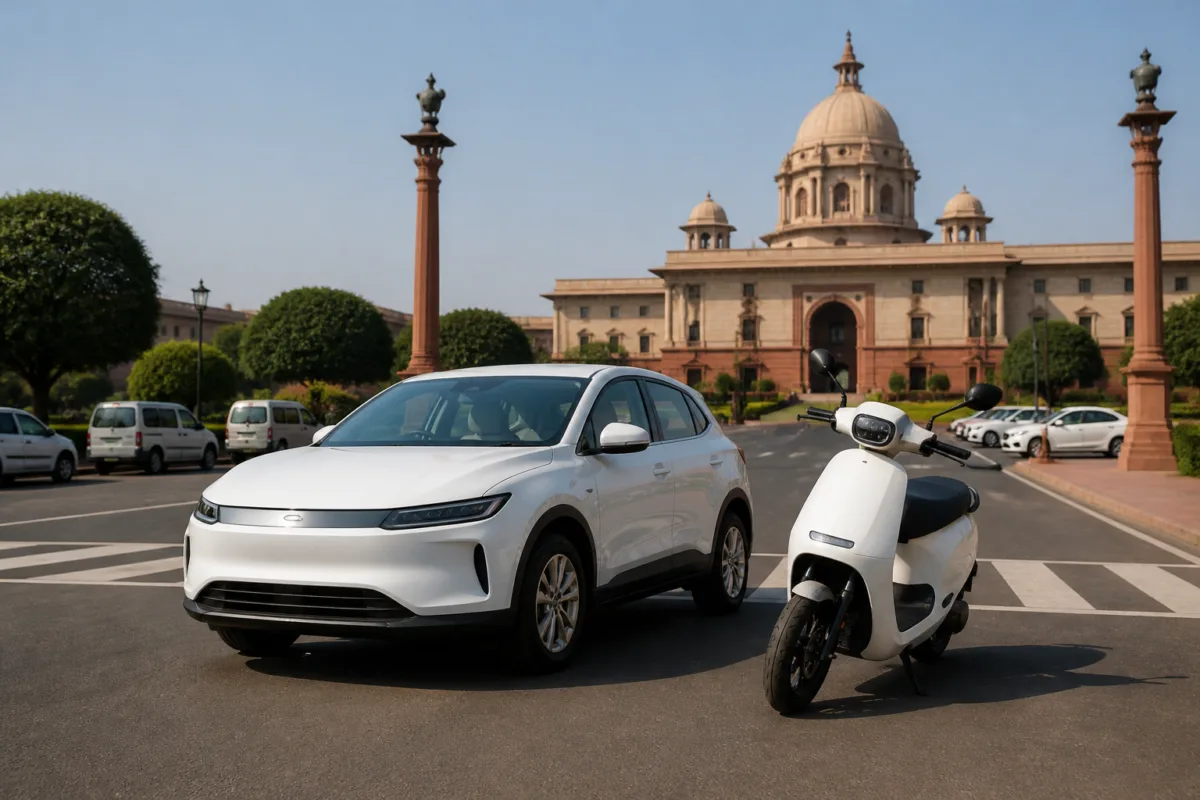
Ola Electric shares have rallied after the Centre made electric vehicles the default and preferred choice for staff-car procurement across government ministries and departments. The market reaction is immediate, but the policy’s larger significance lies elsewhere: it offers a clear institutional demand signal for electric mobility while leaving open the harder question of whether a procurement preference can translate into a durable recovery for individual manufacturers.
The stock rose more than 7% on Thursday, extending its gain over two sessions to around 9%, according to the Economic Times. Shares reached Rs 37 apiece on the National Stock Exchange, a level they had crossed only once in the previous month. The rise added more than Rs 1,400 crore to Ola Electric’s market capitalisation, taking it above Rs 17,150 crore.
The timing has amplified investor attention. Ola Electric, an electric two-wheeler maker, is due to announce its second-quarter results, and investors are looking for evidence of improvement in the company’s business. The policy announcement has therefore become part of a broader market narrative about whether government support for electric mobility can improve sentiment towards EV companies.
The government order changes the procurement hierarchy for central ministries and departments. Electric vehicles are to be ordinarily procured when existing internal-combustion-engine staff cars are condemned or replaced. The order also gives EVs preference when cars are hired for government use. This creates a framework in which replacement cycles, rather than only voluntary consumer purchases, can become a channel for electric mobility adoption.
The policy is not an across-the-board requirement that every government vehicle must immediately become electric. Its wording establishes EVs as the default and preferred choice, while linking procurement to the replacement of existing staff cars. That distinction matters. The pace of actual demand will depend on how many vehicles are replaced, how ministries operationalise the preference and whether suitable electric models meet their practical requirements.
The financial ceiling has also been revised. The net dealer price ceiling for EVs bought by central government ministries and departments has been doubled to Rs 20 lakh. For internal-combustion-engine vehicles, including petrol, diesel and hybrid cars, the ceiling has been fixed at Rs 10 lakh. The order says the changes take into account prevailing market prices and vehicle lifecycle costs, alongside the objectives of promoting electric mobility and reducing dependence on fossil fuels.
That lifecycle-cost reference is important because the initial purchase price is only one part of the public fleet decision. Government vehicles are used within an administrative system that must account for procurement, hiring, replacement and operating requirements. By raising the permissible EV ceiling, the Centre has acknowledged that electric vehicles may need to be assessed differently from conventional vehicles rather than being judged only against their upfront price.
However, the policy does not identify Ola Electric as a beneficiary, nor does it guarantee orders for any particular manufacturer. The procurement change is technology-oriented, not company-specific. Its direct effect is to create preference for eligible electric vehicles; which manufacturers gain depends on their products, pricing, availability and ability to meet government requirements. The market’s positive response to Ola Electric therefore reflects expectations, not a confirmed procurement contract disclosed in the supplied report.
This distinction is especially relevant because Ola Electric operates primarily in the electric two-wheeler market, while the government order concerns staff cars and hired cars for government use. The policy can strengthen the overall institutional case for electric mobility, but the report does not establish that the new staff-car rules will directly generate a material sales pipeline for Ola’s scooter business. The connection is therefore broader and indirect: stronger official preference for EVs may improve the sector’s policy environment, while the company’s own operating performance will still be tested through its consumer market and financial results.
The stock’s recent history helps explain why a policy signal has had an outsized effect on sentiment. After a flat market debut in August 2024, Ola Electric shares climbed to a lifetime high of Rs 157.40 later that year. They subsequently fell to a lifetime low of Rs 22.25 in March 2026. The report says the stock had declined more than 62% from its 52-week high of Rs 59.20, recorded in September, to that low before staging a sharp recovery.
The shares doubled from the March low over the following three months to reach a 52-week high of Rs 49.05 in June, although they later gave up some gains. They were up more than 4% over the previous week and around 3% over the previous month, but remained down more than 2% in 2026 and 15% over the preceding year. These movements show a stock that has recovered from a depressed base without yet returning to its earlier peak.
For investors, the sequence creates two separate questions. The first is whether electric mobility is receiving stronger institutional support. The government order provides evidence of that change within central government procurement. The second is whether Ola Electric can convert a favourable policy environment into improved business performance. The company’s forthcoming second-quarter results are expected to provide the next important information on that question, but the supplied report does not provide the results or any company guidance.
For cities, government procurement is more than a balance-sheet issue. Public fleets and hired vehicles are visible components of urban mobility systems, and procurement decisions can influence the types of vehicles that enter regular government operations. They can also create administrative experience around charging, maintenance, fleet scheduling and vehicle replacement. The order’s preference for EVs places these operational questions inside the government’s own transport decisions rather than leaving adoption entirely to individual consumers.
At the same time, the policy’s implementation will determine its practical reach. The order covers ministries and departments of the Centre, and it refers to procurement at the time of condemnation or replacement of existing staff cars. The supplied material does not specify the number of vehicles covered, a national procurement timetable, charging requirements, model-wise eligibility or the expected value of purchases. Without those details, the size of the immediate demand opportunity cannot be established from the announcement alone.
The price ceilings also indicate that affordability and suitability remain part of the policy design. A higher ceiling for EVs may widen the range of electric cars that departments can consider, while the lower ceiling for conventional vehicles may make EVs more competitive within the procurement framework. Yet the report does not provide comparative lifecycle-cost figures or explain how individual departments will calculate operating costs. The policy establishes a preference, but the evidence supplied does not show how consistently that preference will be applied in actual tenders or replacements.
The market response has consequently run ahead of the operational evidence. Ola Electric’s 9% two-session rally reflects the importance investors attach to policy direction and the company’s upcoming results. It does not, by itself, demonstrate a change in sales, profitability, market share or government orders. Those indicators remain separate from the Centre’s decision to make EVs the default choice for its own vehicle procurement.
The larger urban question is whether public procurement can become a reliable bridge between policy ambition and everyday electric mobility. The Centre’s order creates that bridge in principle by using government buying power and replacement cycles. Its effectiveness will depend on the volume of vehicles replaced, the availability of suitable models, the administration of the preference and the costs of operating the resulting fleets.
For Ola Electric, the immediate test remains commercial rather than merely political. The policy has improved the sector’s institutional backdrop and lifted investor sentiment, but the company’s results will show whether that optimism is supported by business performance. The next developments to monitor are the second-quarter announcement and the eventual implementation of the EV preference in central government procurement.

