


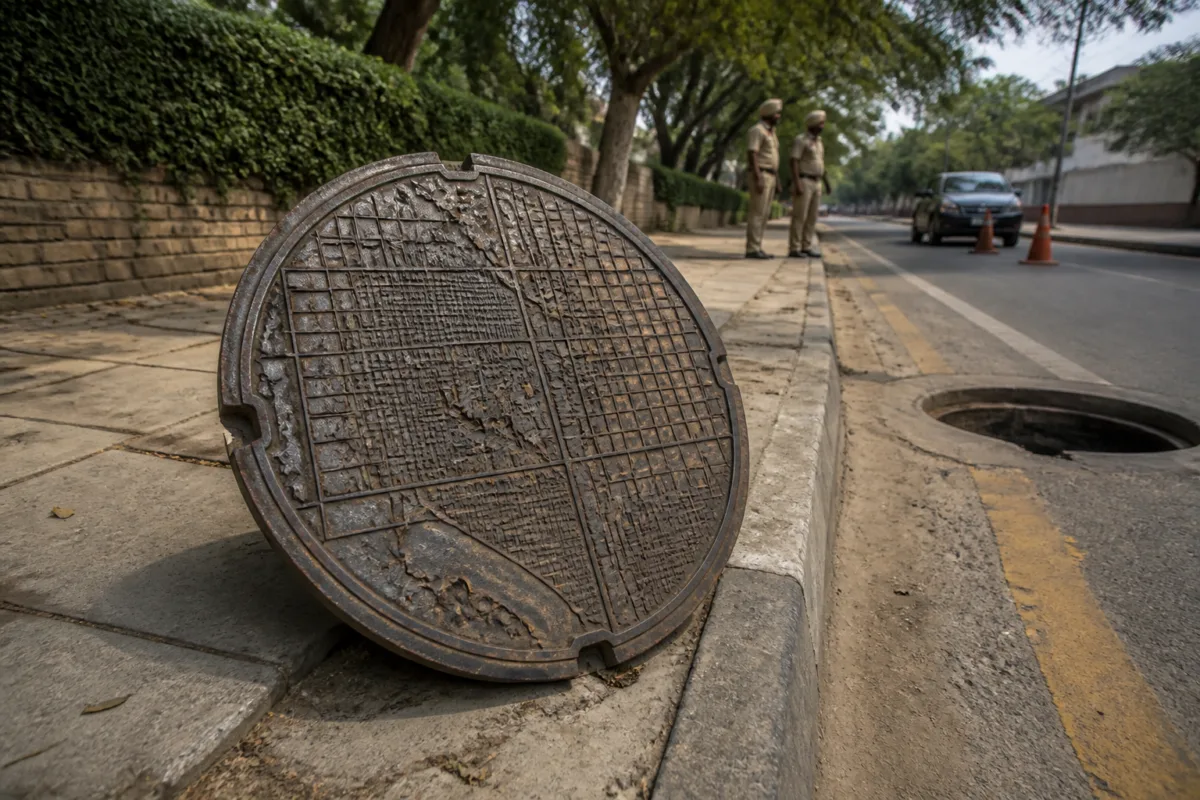
Police in Chandigarh have arrested two men accused of stealing heritage manhole covers from Sectors 45 and 46 and recovered four of the heavy cast-iron artefacts, which can be worth up to ₹17 lakh each at international auctions. The suspects allegedly posed as municipal maintenance workers and attempted to break the covers into scrap.
The two men, identified by police as Raja Ram, 24, of Mohali, and Mukesh, 32, of Chandigarh, were detained by Sector 34 police. Investigators said they recovered the covers, a stolen Honda Activa scooter and the tools allegedly used in the attempted dismantling. Both suspects are originally from Saharanpur in Uttar Pradesh and had recently arrived in the tricity to stay with relatives, according to the report.
Police said the accused wore high-visibility jackets resembling municipal uniforms, allowing them to move around during the day without immediately attracting attention. Passersby allegedly assumed that the pair were carrying out routine sewer or civic maintenance work. Investigators said the men had first stolen the scooter before targeting the covers over several days.
The thefts came to light after Sector 46 councillor Gurpreet Singh Gabi reported that more than seven covers were missing from the area. Police then reviewed security-camera footage and traced the suspects to a forested area in Sector 46, where they were allegedly struggling to smash the approximately 80-kg covers with a pickaxe.
The covers are not ordinary civic fittings. They carry an embossed map of Chandigarh, reflecting the design language and planned-city identity associated with the Union Territory. Similar covers have previously been sold at auctions in London and Paris for between ₹11 lakh and ₹17 lakh, making them valuable targets for the heritage and collectors’ market as well as for scrap traders.
The case highlights the difficulty of protecting heritage elements embedded in everyday infrastructure. Unlike monuments kept inside controlled premises, Chandigarh’s manhole covers are installed across public roads, sectors and pedestrian areas, where they remain exposed to theft, damage and routine civic work. Their function as drainage and access covers also means that their removal can create hazards for pedestrians, cyclists and vehicles.
Police said the suspects appeared unaware of the historical and artistic value of the objects and believed they could be sold as common scrap. Authorities have not ruled out the involvement of an organised trafficking network, particularly because more than eight heritage covers have reportedly disappeared from the area. The investigation is continuing, with the recovered covers now central to efforts to establish the scale and destination of the suspected thefts.

