


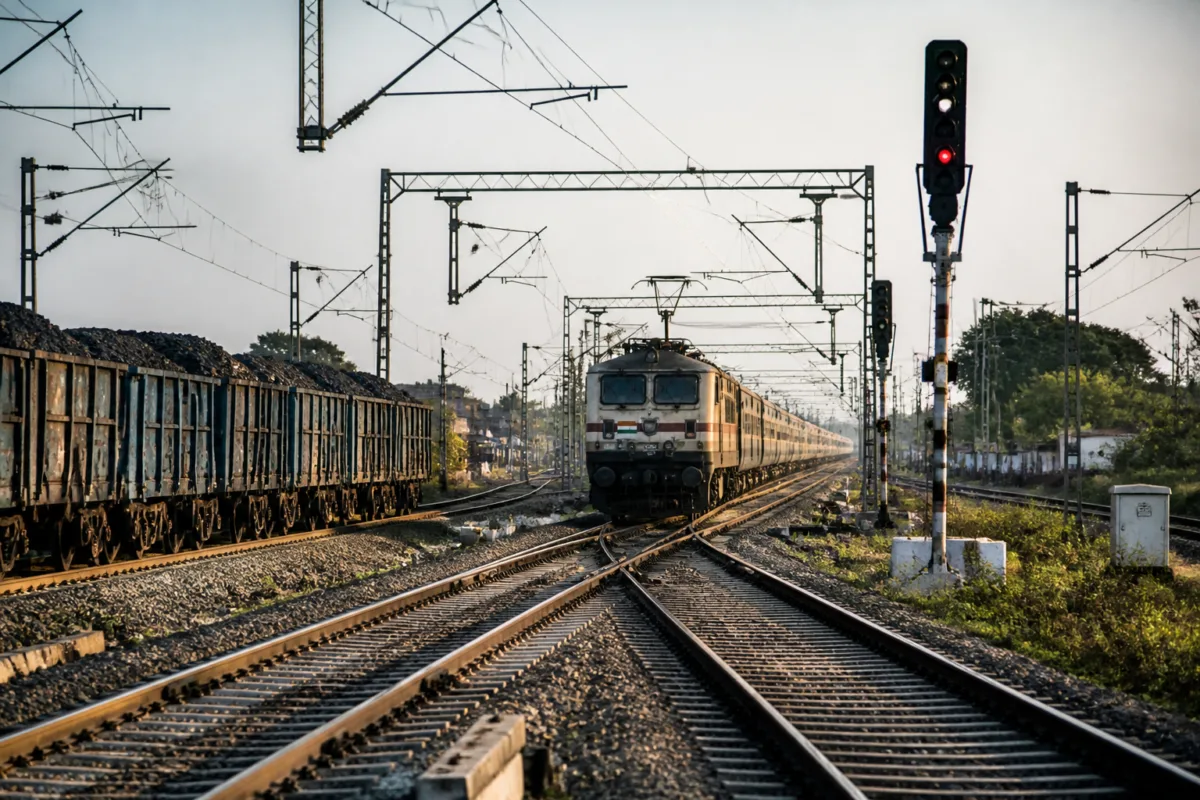
South East Central Railway’s automatic signalling programme shows how rail capacity can be expanded not only by adding track, but also by changing how trains are separated and moved across existing corridors. Between April and November 2026, the zone commissioned automatic signalling across 110 route kilometres in 13 busy sections, an upgrade it equates to the capacity benefit of laying 235 kilometres of double lines.
The intervention is aimed at increasing train capacity, improving punctuality and reducing travel time. Its importance lies in the type of corridors involved: the upgraded sections carry both passenger services and freight consignments of coal, steel, cement and power-related material. In such corridors, the same railway infrastructure must accommodate different traffic requirements, making the management of train movement central to how much service the network can handle.
The latest additions were commissioned in two sections. The Sakti–Jharadih–Kharsia section in the Bilaspur division became operational on November 2, while the Harri–Venkatnagar–Nigaura section was commissioned on November 5. Both are described as important corridors with substantial passenger and freight movement. The source does not provide a before-and-after count of trains, punctuality figures or travel-time savings, but it identifies the operational objectives of the signalling upgrade.
The basic change is from longer block sections to smaller, separately signalled sections. Under conventional signalling, only one train is permitted at a time in the block section between stations. Automatic signalling divides that stretch into smaller sections, each with its own signal. This allows multiple trains to move sequentially, rather than requiring each following train to wait for the entire block between stations to become clear.
Electronic systems monitor train positions and permit movement only when the track ahead is clear. The system therefore changes the frequency with which trains can be admitted into the corridor. It does not, on the evidence supplied, represent the construction of a new railway alignment. Its capacity claim comes from reducing the distance that must remain clear between successive trains while maintaining the signalling controls governing movement.
That distinction matters for understanding the infrastructure choice. Doubling a railway line adds physical track capacity. Automatic signalling instead increases the usable capacity of an existing route by dividing its operating space into more manageable sections. SECR’s comparison between 110 route kilometres of signalling and 235 kilometres of double lines presents the upgrade as a capacity intervention with a substantial network effect, although the source does not provide the cost, construction duration or train-throughput figures needed to compare the two approaches financially.
The Sakti–Kharsia section illustrates the scale and configuration of the work. It covers 16 route kilometres across four lines and includes 32 automatic signals. The Harri–Nigaura section extends across 18 route kilometres and three lines, with 40 automatic signals and 24 semi-automatic signals. These figures show that the programme is not a single uniform installation. The signalling arrangement varies by section, including the use of both automatic and semi-automatic signals on the Harri–Nigaura stretch.
The wider rollout covers 13 sections and 110 route kilometres commissioned between April and November. The supplied report does not list all 13 sections, nor does it identify the individual commissioning dates, the total investment or the agencies and contractors involved. It does, however, establish a pattern of phased implementation rather than a one-time corridor opening. The two November commissions form the latest identified steps in that programme.
For passengers, the intended benefit is a reduction in unnecessary halts and improved punctuality. A train following another service need not wait for the entire station-to-station block to clear if the signalling system can safely manage movement through smaller sections. For freight, the implication is greater operating flexibility on corridors carrying coal, steel, cement and power consignments. The report does not state whether passenger or freight trains will receive priority, or how the additional capacity will be allocated when both compete for the same route.
That unresolved allocation question is part of the institutional significance of the upgrade. Signalling can create more opportunities for train movement, but the operational benefit ultimately depends on how the railway schedules services across the upgraded sections. The source confirms the technical capability being introduced and the objectives set by SECR; it does not establish the precise timetable changes or the number of additional services that will follow.
The programme also demonstrates why capacity should be assessed at corridor level rather than through a single project label. The headline figure is 110 route kilometres, but the equivalent comparison is 235 kilometres of double lines. The two numbers measure different forms of intervention: one describes the length of route receiving signalling, while the other describes SECR’s stated equivalent in terms of double-line capacity. Treating them as identical physical additions would misrepresent what has been built. The value of the upgrade lies in the operating capacity created across the route, not in the addition of 235 kilometres of new track.
The available evidence also places limits on what can be concluded. There are no reported punctuality percentages before and after commissioning, no measured reduction in journey time, no train-volume data and no information on whether congestion has already eased. The report says the system is intended to deliver these outcomes, but a fuller assessment would require operating data after the installations have been in service. Without those figures, the programme can be described as a capacity and efficiency intervention, not yet as a quantified performance improvement.
SECR’s approach is therefore significant because it addresses a central railway challenge through signalling density and train sequencing. The investment targets the relationship between infrastructure and operations: how many trains can safely occupy a corridor, how closely they can follow one another and how quickly the route can be cleared for the next movement. On mixed-use corridors, those questions affect passenger punctuality as well as the movement of industrial freight.
The next stage of scrutiny will be operational. The key indicators will be whether train capacity rises, whether travel times fall, whether punctuality improves and whether freight movement becomes less constrained on the commissioned sections. For now, the evidence confirms that SECR has completed automatic signalling across 110 route kilometres in 13 sections, with the latest identified commissions at Sakti–Jharadih–Kharsia and Harri–Venkatnagar–Nigaura. It does not yet establish the size of the realised benefits, which will depend on subsequent railway operating data.

