


Delhi University’s growing international reach is being matched by a major expansion of its student base, research activity and physical campus network. The university’s 103rd annual report for 2025-26 records more than 9,000 applications from 93 countries, over 2,000 foreign students currently enrolled and the admission of 74 foreign PhD scholars for the first time. Together, these figures point to a university becoming more globally visible while also facing the urban challenge of accommodating scale across a dispersed and highly pressured campus system.
The central figure is the university’s total enrolment. Delhi University, including its regular programmes, School of Open Learning and Non-Collegiate Women’s Education Board, has 6,41,148 students. This is not simply an academic statistic. It represents a large daily population that requires classrooms, laboratories, libraries, housing access, transport connections, public spaces and administrative services. For an institution embedded in Delhi, changes in enrolment directly affect the demand placed on the city around its campuses.
The international numbers add a new layer to that demand. Applications from 93 countries indicate that Delhi University is attracting attention beyond the domestic student market. More than 2,000 foreign students are already studying across different courses, while 74 foreign researchers have entered PhD programmes for the first time. The report presents this as evidence of a stronger international academic identity, but it also raises questions about how a large public university plans for internationalisation in practical terms.
International students and researchers require more than admission capacity. They need clear administrative systems, academic support, accommodation or reliable access to housing, healthcare, mobility and a campus environment that can support students from different countries. The supplied report does not specify how Delhi University is addressing these requirements. That absence is important because the growth of global demand can be measured through applications, while the quality of the international experience depends on systems that are less visible in headline rankings.
The university is also improving its position in prominent rankings. In the National Institutional Ranking Framework 2026, Delhi University moved from sixth to fifth place in the university category, according to the annual report. Its position in the QS World University Rankings improved from 328th in the previous year to 322nd in 2026. These movements are relatively modest, but they matter because rankings influence how prospective students, researchers and academic partners assess an institution from outside the country.
Rankings, however, compress a complex institution into a small set of indicators. Delhi University’s improved position coincides with higher research output. The number of papers published in Scopus-indexed journals rose from 4,120 to 4,618, an increase of about 12 per cent. The university’s H-index also increased from 286 to 309. These figures suggest greater research activity and citation strength, although the report does not establish how this work is distributed across disciplines or how much of it translates into applications for society, industry or technology.
That distinction is significant for a university with such a large public footprint. More publications and a higher H-index can strengthen global visibility, but they do not by themselves show whether research is influencing Delhi’s infrastructure, public services, housing, environment or economy. The available figures establish an increase in output. They do not provide evidence on the practical outcomes, funding sources, collaboration structures or geographic concentration of that research.
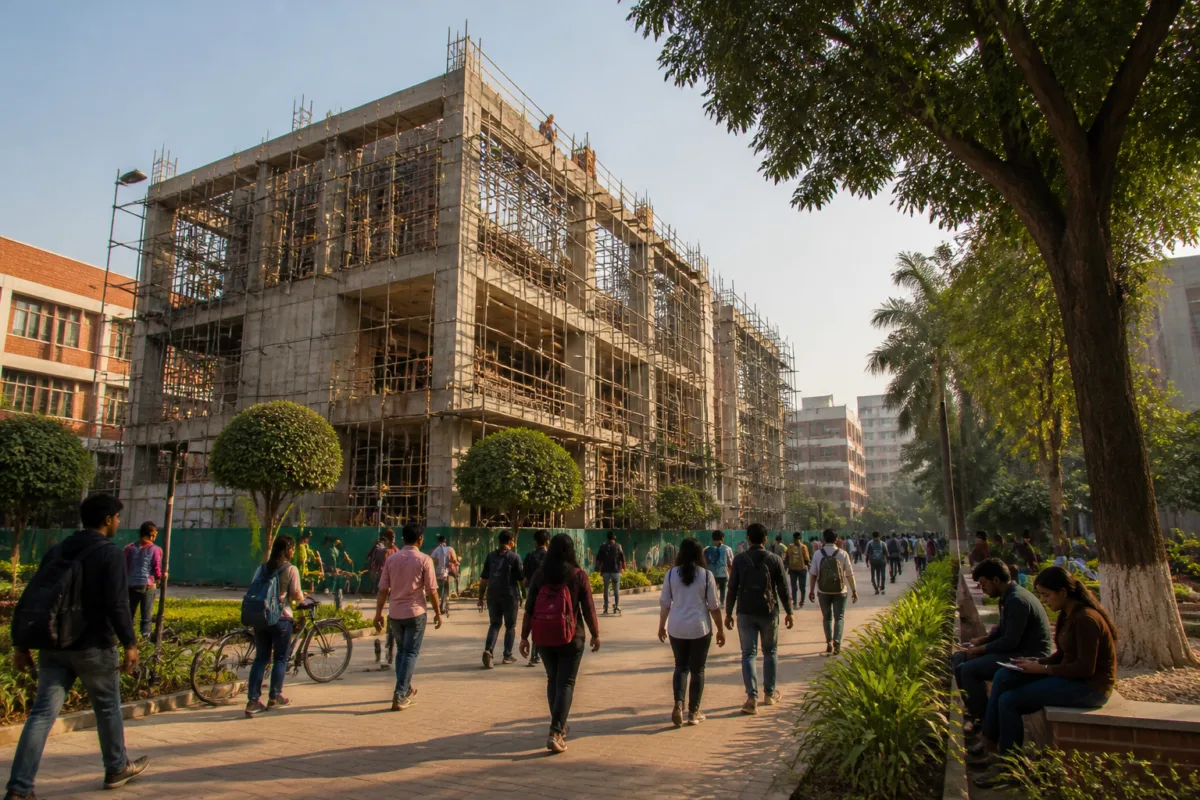
The built environment is becoming an important part of the university’s expansion. Delhi University is constructing an East Campus at Surajmal Vihar, a West Campus in Dwarka Sector 22 and Veer Savarkar College in Najafgarh. These projects are intended to expand academic facilities and create additional institutional capacity. Their locations also show that the university’s growth is not confined to its established central and north Delhi campuses.
A multi-campus model changes the relationship between the university and the city. New campuses can distribute educational activity across different parts of Delhi and bring new institutional investment to areas outside the traditional university core. At the same time, each campus must be connected to transport, utilities and surrounding neighbourhoods. Its success depends not only on the number of buildings completed but also on whether students and staff can reach them affordably and whether the surrounding urban systems can support a large daily population.
The three construction projects therefore have significance beyond the university’s internal administration. Surajmal Vihar, Dwarka Sector 22 and Najafgarh occupy different parts of the metropolitan landscape, with distinct patterns of development and connectivity. The report does not provide project costs, construction timelines, land details, planned student capacity or information on transport and housing arrangements. Without those details, it is not possible to assess how much additional enrolment the campuses will absorb or whether they will reduce pressure on existing sites.
The scale of Delhi University’s existing enrolment makes this planning question more important. A total of 6,41,148 students across regular, open-learning and NCWEB systems reflects multiple forms of access to higher education. They do not all use the city in the same way. Regular students may spend substantial time on campus, while open-learning students may have more limited physical interaction with university facilities. Yet all are part of the university’s institutional footprint, and the distinction matters when planning land, buildings, mobility and services.
The report’s international figures also need to be read alongside this domestic scale. More than 9,000 applications from abroad and over 2,000 enrolled foreign students may indicate rising demand, but they represent only one component of an institution serving hundreds of thousands of learners. The challenge is to improve global competitiveness without allowing international visibility to obscure the basic capacity requirements of the wider university system.
This is where the institutional mechanics behind expansion become important. Delhi University’s annual report records the outcomes—applications, enrolment, rankings, publications and new campuses—but the supplied material does not describe the administrative or financial arrangements supporting them. It does not state how international admissions are processed, how foreign researchers are supported, how campus projects are funded or which milestones govern construction. Those details would determine whether the reported growth is being converted into durable institutional capacity.
The available evidence nevertheless shows three connected trends. First, Delhi University is receiving greater international attention, with applications from 93 countries and a foreign student population exceeding 2,000. Second, research activity is expanding, with Scopus-indexed publications rising from 4,120 to 4,618 and the H-index moving from 286 to 309. Third, the university is extending its physical presence through projects in Surajmal Vihar, Dwarka Sector 22 and Najafgarh.
These trends reinforce one another but are not identical. International applications can rise without corresponding growth in accommodation or student services. Research publications can increase without equivalent social or industrial impact. New campuses can add buildings without immediately resolving mobility or access constraints. The annual report provides evidence of institutional momentum, but it does not yet provide enough information to judge whether academic performance and physical expansion are advancing at the same pace.
For Delhi, the larger urban question is how a public university of this scale should grow. Its expansion affects land use, daily travel, neighbourhood development and the distribution of educational opportunity across the capital. Its international ambitions also make the quality of the urban environment part of its competitive proposition, even though the supplied report does not measure that factor directly.
Delhi University’s latest figures confirm a stronger global profile, rising research output and a continuing need for more academic space. The next stage will depend on how the university translates those gains into functioning campuses, accessible services and measurable research impact. The construction progress at the three new sites, the capacity they are designed to provide and the systems created for international students and researchers will be the key developments to monitor.

