


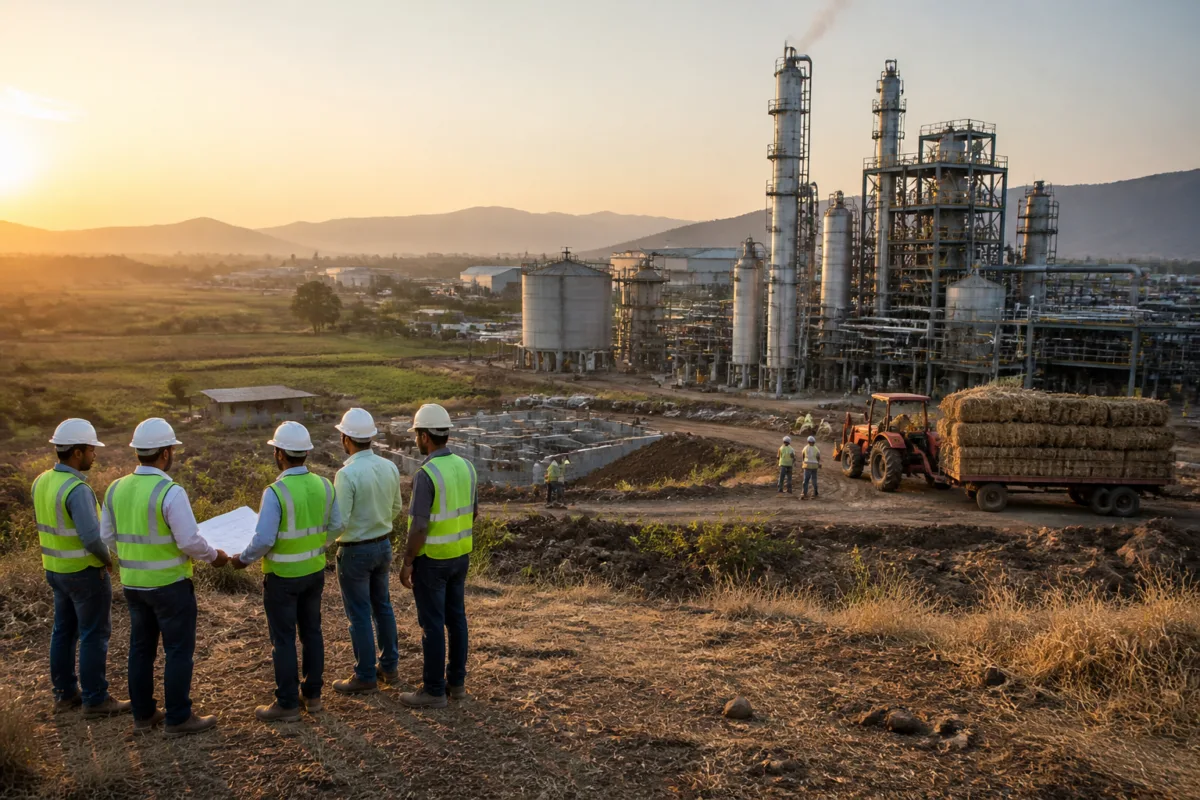
Greenjoules Private Limited has secured ₹150 crore in Series B funding and a ₹100 crore government loan to develop a renewable fuels plant at Khed City near Pune, with planned capacity to produce 200,000 litres of biocrude daily from agricultural waste.
The funding round was co-led by Amazon’s Smbhav Venture Fund and Climate Pledge Fund. Rainmatter, the investment arm of Zerodha, and Singularity’s Strategic Autonomy Fund also participated. Blue Ashva Capital, which led Greenjoules’ Series A round in 2021, remains the company’s largest shareholder.
The ₹100 crore loan has been secured from the government’s Technology Development Board, taking the company’s total financing to ₹250 crore. Development of the Khed City plant is scheduled to begin in phases in 2027. Once completed, Greenjoules expects the facility to be India’s largest of its kind.
The company’s technology converts agricultural residue into biocrude, which can then be refined into renewable diesel. Greenjoules said the fuel is designed as a drop-in alternative that can be used in existing vehicles and fuel infrastructure without modification. The process was developed and tested at the company’s Chakan plant near Pune.
The project links industrial fuel production with the management of agricultural waste, a challenge that affects air quality and rural incomes when crop residue is burned or discarded. Greenjoules said it would source crop residue from farmers, potentially creating an additional income stream while putting locally available waste to productive use.
India imports more than 80 per cent of the crude oil it consumes, according to the information provided by the company. The proposed plant therefore places renewable fuel production within a wider effort to reduce dependence on imported fossil fuels and expand domestic energy capacity. The company also plans to apply its technology to sustainable aviation fuel, green hydrogen and sustainable materials.
Shweta Viraghavan, Greenjoules’ co-founder and chief technology officer, said the company had spent more than six years developing the process and proving that low-energy-density agricultural waste could be converted into specification-grade fuel. She said the company was ready to expand into sustainable aviation fuel, green hydrogen and sustainable materials.
Abhinav Singh, vice-president of Amazon Operations for Amazon India, APAC, the Middle East and Türkiye, said decarbonising long-haul transportation would require simultaneous investment in railways, alternative fuels and electric mobility. He said Amazon’s investment formed part of its effort to reduce emissions across its transportation network as it works towards net-zero carbon emissions by 2040.
Rainmatter’s Abhinav Singh Negi said Greenjoules had developed and operated the process at a real plant rather than limiting it to laboratory testing. Suyash Kela of Singularity’s investment team said the company’s approach converted a domestic resource into a fuel that India needs.
The next major milestone is the phased start of development at Khed City in 2027. The company’s ability to scale feedstock collection, plant operations and fuel production will determine how quickly the proposed facility can move from pilot-scale industrial experience to commercial output.

