


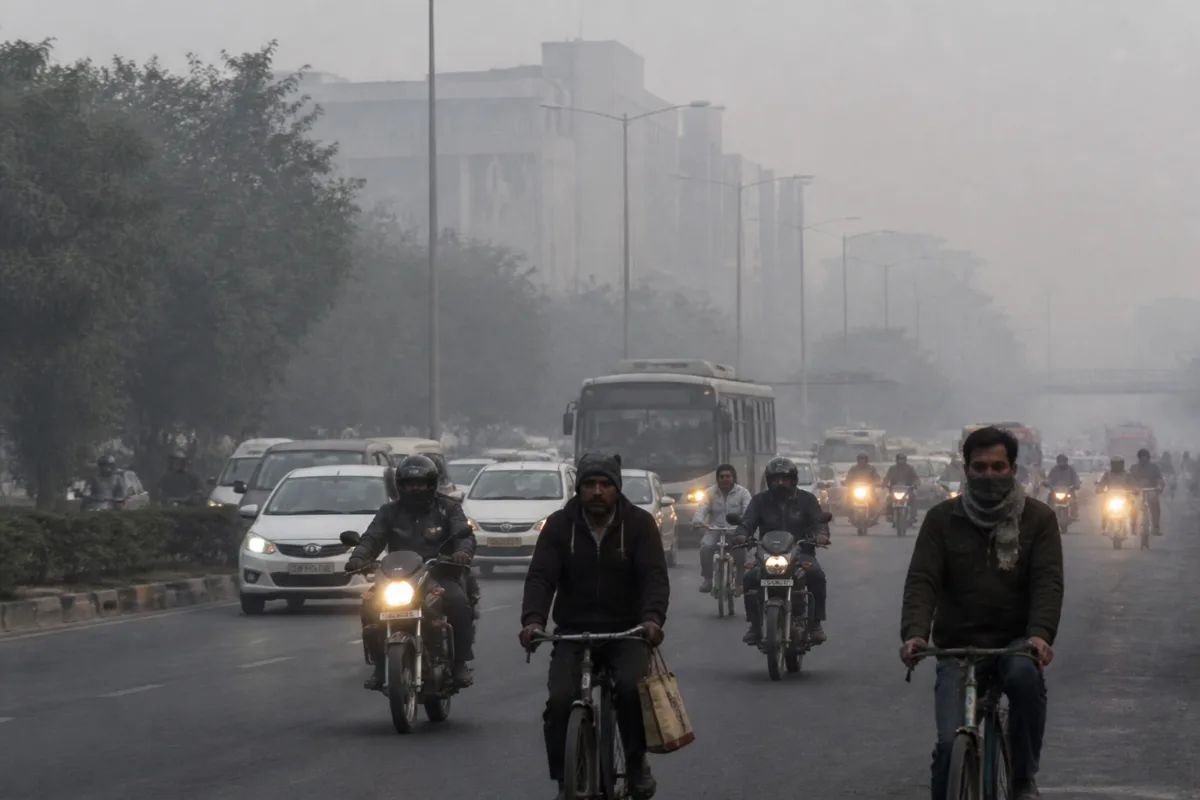
Delhi’s air quality improved marginally on Tuesday morning but remained in the very poor category, with the overall Delhi AQI recorded at 307 at 7:00 am, according to Central Pollution Control Board data reported by Deccan Chronicle and attributed to the CPCB.
The improvement came after several monitoring stations recorded severe pollution levels on Monday, a day after Diwali. Pollution levels remained elevated as falling temperatures and moderate fog contributed to persistent poor air quality across the national capital.
Chandni Chowk recorded the highest AQI among Delhi’s monitored areas at 395, followed by Safdarjung at 371, Punjabi Bagh at 355 and Aya Nagar at 354. RK Puram recorded an AQI of 328. All four locations were in the very poor category under the CPCB’s classification system.
Several other parts of the city recorded poor air quality. Anand Vihar reported an AQI of 290, while Ashok Vihar recorded 278. Narela recorded 272, and the India Gate and Kartavya Path areas recorded 258. The CPCB classifies AQI readings between 201 and 300 as poor and readings between 301 and 400 as very poor.
The Delhi government is implementing pollution-control measures, including the use of water sprinklers across the city, to reduce the impact of particulate matter. The report did not provide details of the areas covered, the volume of water being used or the measured effect of the sprinkling operations.
The India Meteorological Department recorded Delhi’s morning temperature at 17°C, accompanied by moderate fog. The IMD forecast that moderate fog was likely to persist over the next five days, indicating that the weather conditions associated with the current pollution episode were expected to continue during that period.
The pollution episode has also affected visibility during early morning hours. Visibility remained poor on Monday, when several monitoring stations recorded AQI readings above 400, placing them in the severe category.
Outside Delhi, Ambala in Haryana recorded an overall AQI of 250, classified as poor. Maharashtra recorded an overall AQI of 146, placing it in the moderate category. Under CPCB classifications, AQI from 0 to 50 is good, 51 to 100 satisfactory, 101 to 200 moderate, 201 to 300 poor, 301 to 400 very poor and 401 to 500 severe.
The IMD’s five-day fog forecast and the Delhi government’s ongoing pollution-control measures remain the immediate developments being monitored as the capital’s air quality stays in the very poor range.

