


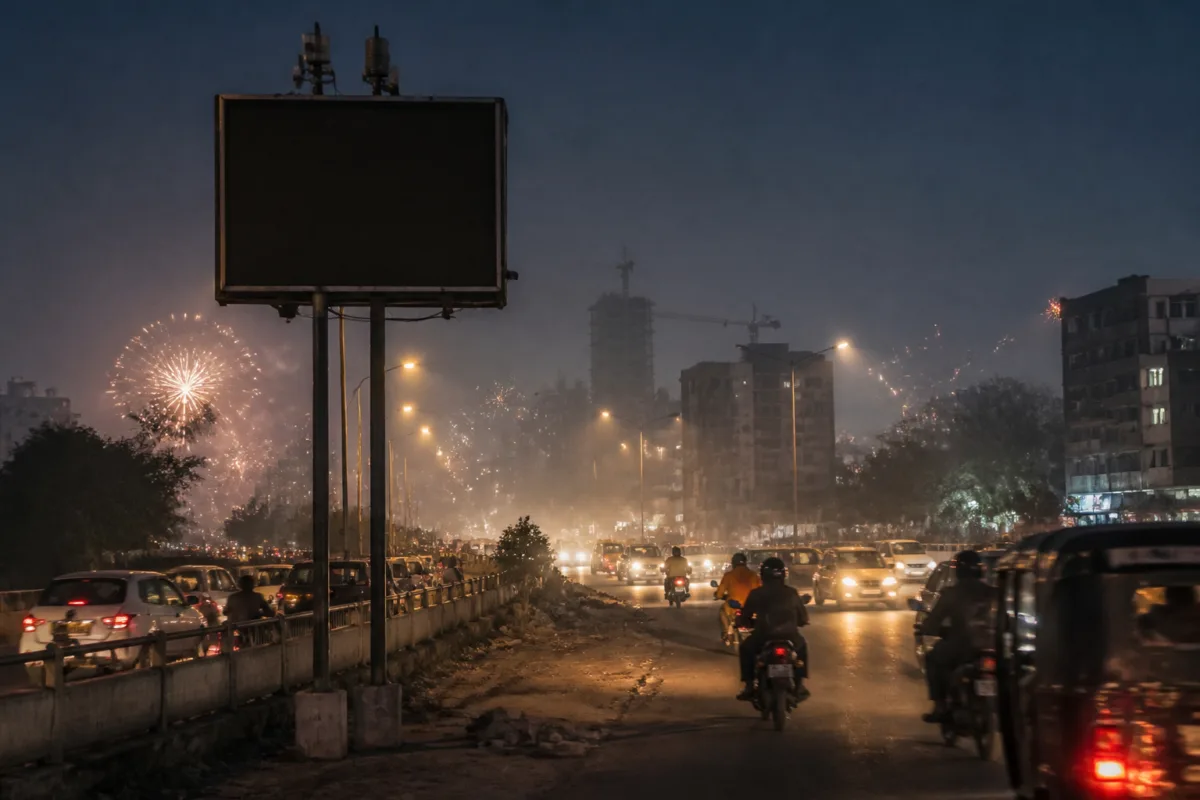
Ahmedabad AQI readings crossed 500 on Diwali night, while Rajkot recorded a reported peak of 922, but the more enduring urban concern is not only the pollution spike. It is the apparent failure of the public monitoring system that should tell residents how dangerous the air has become. A report by Sandesh says all eight display boards installed in Ahmedabad under the SAFAR project have remained non-functional since 2021, even as pollution continues to vary sharply across the city.
The figures reported from Diwali night show how unevenly an urban air-pollution episode can affect neighbourhoods. In Ahmedabad, the average Air Quality Index crossed 500, with a reading of 529 recorded at 1 am. The Sola area reportedly reached 735, while Thaltej recorded 456, South Bopal 334 and Prahladnagar 302. In Rajkot, the AQI reportedly reached 922 after midnight, with Junction Plot recording 797.
These numbers were reported in the context of Diwali fireworks, road dust, vehicle emissions and dust from construction sites. Sandesh described the combined pollution burden as creating extremely hazardous conditions in both cities and linked the episode to increased respiratory complaints. The report does not provide medical data, hospital records or an independent assessment of the health impact, so the scale of those complaints cannot be established from the supplied material. The readings themselves, however, point to a substantial short-term deterioration in air quality during the festival night.
The Ahmedabad data also reveal why citywide averages can conceal the experience of individual neighbourhoods. A single average number cannot show the difference between Sola and South Bopal, or between Thaltej and Prahladnagar. The reported readings varied from 735 in Sola to 302 in Prahladnagar during the night. That spread matters for residents, schools, hospitals, outdoor workers and people with respiratory conditions because exposure is experienced at street and neighbourhood level, not through a citywide average alone.
The monitoring gap becomes significant in this context. According to the Sandesh report, Ahmedabad launched eight SAFAR display boards in 2017 to provide residents with local air-quality information. The boards were installed at Bopal, Satellite, the airport, Pirana, Rakhial, Chandkheda, Raikhad and GIFT City. The report says each display cost approximately Rs 10 lakh to Rs 12 lakh, putting the total expenditure on the eight installations at an estimated Rs 80 lakh to Rs 96 lakh. All eight, it says, have been shut since 2021.
Public display infrastructure is not the same as pollution control. A functioning board cannot reduce emissions from fireworks, vehicles, construction or road dust. It can, however, make pollution visible to people who are exposed to it and create a public record of changing conditions. When such infrastructure is installed with public money and then remains unusable for years, the problem moves beyond a technical fault. It becomes a question of maintenance, institutional ownership and whether information systems are treated as continuing public services or as one-time projects.
The report attributes the continued closure of the boards to administrative inaction and says the Ahmedabad Municipal Corporation has remained a silent observer while residents lack information about air quality. That is a characterisation made by the source, not an independently established finding in the supplied material. The report does not include a response from the civic body, an explanation for the shutdown, a maintenance contract, a repair timeline or details of whether the display network was replaced by another public information system.
The available readings from the days around the festival also show that the pollution problem was not limited to the peak Diwali night. Sandesh cited data from the Pune system for 9 am on 8 November. At that point, the airport area recorded 282, Raikhad 241, Rakhial 233 and Chandkheda 225. These four locations were reported in the poor category. Maninagar recorded 174 and Satellite 140 in the moderate category, while Gyaspur recorded 108 and Bopal 85, described as satisfactory.
This distribution is important for understanding the administrative challenge. Ahmedabad does not experience air pollution as a uniform citywide condition. The reported data show significant differences between locations at the same broad period. Airport, Raikhad, Rakhial and Chandkheda had considerably higher readings than Bopal and Gyaspur. The reasons for those differences are not established in the supplied report, and the available information does not allow a firm conclusion about the relative contribution of traffic, construction, road dust, local activity or weather. What it does establish is the need for neighbourhood-level information if public authorities want residents to understand exposure patterns.
The reference to the Pune system raises a second institutional question. Ahmedabad’s local display network is reported to be inactive, while readings cited for the city came from a system identified in the report as Pune’s. The source does not explain the technical relationship between the two systems, whether the Pune data were being used as a substitute, or how Ahmedabad residents are expected to access current and reliable information. Without that clarity, residents may face a fragmented information environment in which data exist but are not consistently visible, locally explained or connected to official public-health communication.
The episode also shows the limits of seasonal responses. Diwali fireworks can produce a sharp short-term increase in pollution, but the source places them alongside road dust, vehicle emissions and construction-site dust. Those sources belong to different administrative and regulatory domains. Fireworks involve festival-period enforcement and public messaging. Vehicle emissions relate to transport activity and compliance. Road dust involves street maintenance and construction management. Construction dust requires site-level controls and monitoring. Treating the peak as only a festival problem would leave these other sources outside the response, although the supplied report does not quantify their individual contributions.
The reported condition of the SAFAR boards similarly points to a recurring weakness in urban infrastructure: commissioning is visible, maintenance is not. The initial expenditure figures are easy to announce and display. Repair budgets, equipment replacement, calibration, data continuity and responsibility for operating the network are less visible but determine whether the system remains useful. The five-year period cited in the report—from 2021 to 2026—makes this more than a brief interruption. It suggests that the city’s public-facing monitoring layer has been absent through multiple pollution seasons, although the source does not state whether alternative digital platforms or sensors have been operational during that period.
For municipal administration, the issue is therefore not simply whether eight boards should be switched on again. The evidence raises questions about the full chain from measurement to public action: who owns the equipment, who validates the readings, who publishes them, which authority responds when levels rise, and how residents receive warnings at neighbourhood level. The supplied material does not answer these questions. It does show why they matter when readings differ substantially between parts of the city and when an extreme event occurs overnight, outside ordinary office hours.
For citizens, the immediate concern is access to credible information during high-pollution episodes. The reported readings from Sola, Thaltej, South Bopal and Prahladnagar demonstrate that a resident’s local conditions may be materially different from the city average. A city that publishes only a broad average risks obscuring that variation. Conversely, a network of local displays without maintenance, data explanation or response protocols risks becoming a symbol of information without accountability.
The evidence supplied by Sandesh confirms three linked facts: Ahmedabad experienced a severe reported pollution spike on Diwali night; readings varied considerably across localities; and the eight SAFAR display boards installed in 2017 are reported to have remained defunct since 2021. It does not establish the independent accuracy of every reading, the precise source-wise contribution to the spike, the health burden, or the civic body’s explanation for the inactive boards. Those unanswered points are central to what should be monitored next: whether Ahmedabad restores a reliable public monitoring network, publishes neighbourhood-level data consistently, and clarifies which agency is responsible for acting when air quality deteriorates.

