


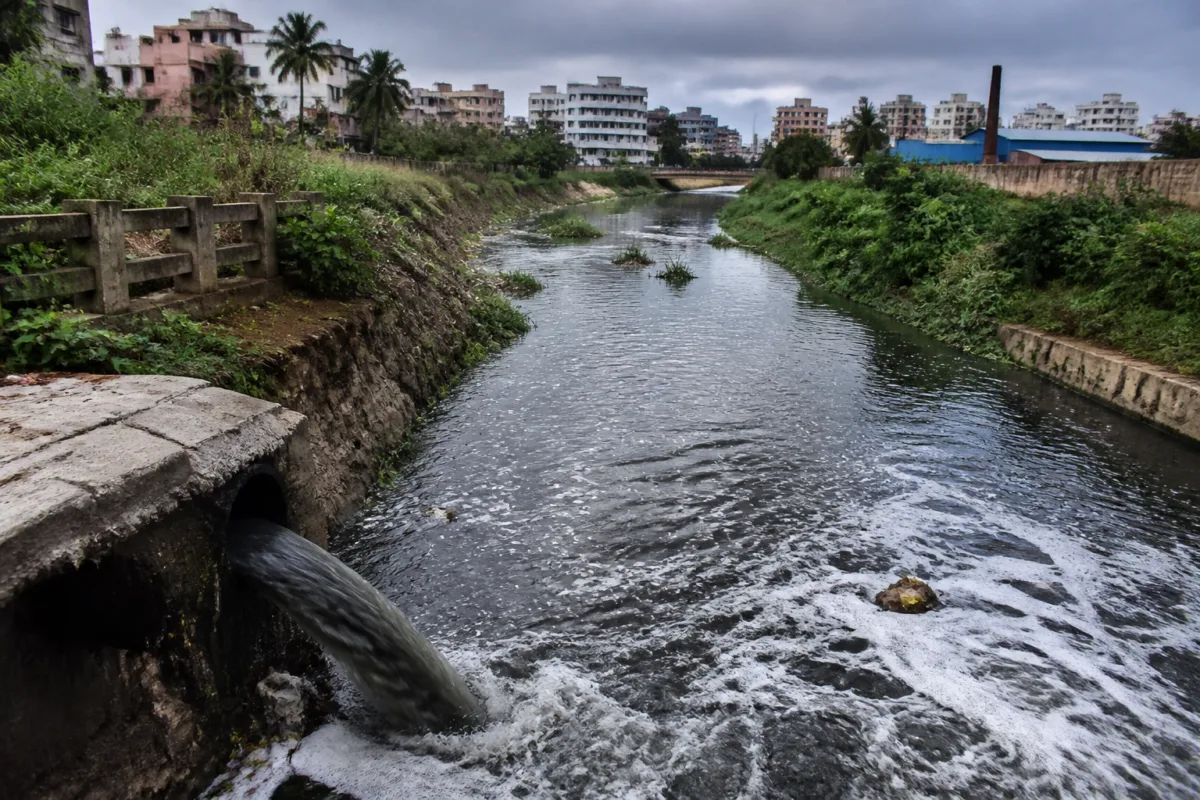
Karnataka’s latest river water-quality assessment shows that drought and pollution are no longer separate risks. The Karnataka State Pollution Control Board’s August 2026 readings from 66 monitoring locations across 14 polluted river stretches indicate severe contamination at some sites, with high biochemical oxygen demand, high faecal-coliform counts and, in some locations, little or no dissolved oxygen available for aquatic life.
The immediate concern is water quality. The larger problem is the way Karnataka’s cities and towns collect, convey, treat and price wastewater. The assessment described by the Times of India shows that polluted rivers are not the result of one isolated discharge or one failing waterway. Contamination extends across multiple stretches, including the Dakshina Pinakini and Arkavathi, while untreated sewage remains the primary source identified by a senior KSPCB official.
This turns the river pollution issue into an urban systems question. Rivers receive what cities fail to treat. Natural drains carry household wastewater, industrial effluents and urban runoff into lakes and downstream channels. Where underground drainage networks are incomplete, sewage treatment plants cannot solve the problem by themselves because the wastewater does not reliably reach them.
The assessment uses three key indicators to show the condition of the water. Biochemical oxygen demand, or BOD, measures the oxygen consumed by microorganisms while breaking down organic pollution. When BOD is high, less dissolved oxygen remains for fish and other aquatic life. Faecal-coliform counts indicate contamination by faecal matter and the possible presence of disease-causing pathogens. Dissolved oxygen, or DO, indicates whether the water can support aquatic organisms. A combination of high BOD and low DO is therefore a sign of heavy organic pollution and ecological stress.
The reported findings are particularly significant for a state facing water scarcity. When water is limited, the quality of every available source becomes more important. Pollution reduces the usability of rivers and lakes, places additional pressure on treatment systems and raises the risk that contaminated water will affect aquatic ecosystems and groundwater. The supplied assessment does not establish the extent of groundwater contamination at specific sites, but experts cited in the report warn that industrial discharges into drains can create that risk.
Bengaluru illustrates how this pattern develops. Hydrogeologist KC Subhash Chandra said the city’s rajakaluves, or natural drains, have become conduits for sewage, with residential discharges flowing into lakes. These flows are perennial, meaning that pollution can continue even when rainfall patterns change. The central issue is not merely the presence of a polluted lake; it is the absence of a complete system that prevents sewage from entering the drain network in the first place.
The impact is visible in the vulnerability of urban lakes. The report links sewage inflows to reduced dissolved oxygen and increased oxygen demand, and notes that recent fish deaths should serve as a warning. Fish mortality is not a complete measure of river or lake health, but it can indicate that the ecological balance has been disrupted. Without stopping and treating the inflows, lake restoration remains exposed to the same pollution loads that caused the damage.
The problem extends beyond Bengaluru. Townships across Karnataka generate domestic wastewater, while industrial areas add effluents with potentially greater local impacts. Water conservation expert Vishwanath S said domestic sewage is greater in volume, but industrial pollution can have a more severe effect. He specifically referred to Peenya industrial area and said it did not have a functional common effluent treatment plant of sufficient scale to address the problem.
That distinction matters for policy. Domestic sewage requires extensive networks of household connections, underground pipes, pumping systems and treatment capacity. Industrial pollution requires source-level compliance, effluent treatment and monitoring of individual units or industrial clusters. A city may build a sewage treatment plant and still fail to improve river quality if household sewage does not reach it or if industrial discharges bypass the treatment system.
Karnataka has prepared action plans for all identified polluted river stretches, but implementation is being slowed by gaps in sewage infrastructure, funding constraints and coordination delays. A senior official cited in the report said sewage treatment plants need to be established along rivers, while inadequate underground drainage networks remain a major hurdle. The official said laying pipes requires a large budget that cannot be released at once, so projects must be taken up in phases, with priority for cities such as Bengaluru, Mysuru and Mangaluru.
The stated expectation is that the works could be completed over the next two years. That timeline, however, depends on a chain of decisions by several institutions. Around 270 urban local bodies and panchayats are involved in the wider implementation challenge. These bodies must secure clearances, budgets and permissions for treatment facilities, while the KSPCB is responsible for monitoring and enforcement. The arrangement creates a familiar urban governance problem: pollution is experienced as one continuous river-system failure, but responsibility is divided across multiple administrative jurisdictions.
The existence of sewage treatment plants also does not necessarily mean that wastewater is being treated effectively. The report says almost all cities have STPs, but some have been discontinued. This raises questions about operation and maintenance, electricity costs, inflow connections, staffing, compliance monitoring and the financial capacity of local bodies. The supplied material does not provide plant-wise performance data, so it cannot establish how much installed capacity is functioning or how much sewage is actually treated. It does show that infrastructure availability and pollution control are not the same thing.
Funding is therefore central to the pollution debate. Vishwanath argued that the polluter-pays principle should cover both industrial units and households or apartment complexes that discharge sewage. He said users should pay for collection, conveyance and treatment, and linked the problem to the pricing of water and wastewater. The argument identifies a structural gap in municipal finance: local bodies are expected to provide expensive, continuous wastewater services, but the revenue model required to operate those systems is politically difficult.
This is not simply a question of imposing higher charges. A functioning wastewater tariff would need to be connected to reliable service delivery, transparent accounting and enforcement against illegal discharges. If residents are charged for treatment but sewage networks remain incomplete, the charge may lack legitimacy. If industries are regulated unevenly, compliant units may bear costs while others continue to discharge. The report establishes the funding challenge but does not provide a proposed tariff structure or evidence on current collection levels.
Enforcement has begun to move beyond routine fines. The KSPCB official said the board had filed around 40 to 42 criminal cases under the Water Act against polluters, with several cases pending before district magistrate courts. Earlier action largely involved fines, while criminal proceedings are now also being pursued. This indicates a tougher enforcement approach, but the number of cases alone cannot show whether pollution has declined. The decisive measure will be whether notices, prosecutions and court proceedings lead to stopped discharges and sustained compliance.
The KSPCB also conducts awareness programmes, particularly during festivals, to discourage dumping into rivers. Such campaigns address visible waste, but the assessment suggests that the deeper and more persistent source is untreated wastewater. Public messaging cannot substitute for sewer networks, treatment plants, industrial compliance and regular water-quality monitoring. It can, however, support enforcement where dumping and household behaviour contribute to pollution.
National Green Tribunal and High Court orders have helped urban local bodies access pollution-control funding more actively in recent years, according to the report. Allocations are being made progressively, but the implementation challenge remains distributed across cities, towns and panchayats. The reference to orders and funding shows how environmental compliance is increasingly tied to judicial oversight, yet court-directed action still has to be converted into functioning municipal infrastructure.
The data available in the assessment points to a broad pattern rather than a single crisis location: 66 monitoring points, 14 polluted stretches, high BOD, high faecal-coliform counts and low or absent oxygen at some sites. The report identifies the Arkavathi as a major concern around Bengaluru and points to Belagavi as another area with numerous polluted riverbanks. It does not provide the individual readings for every monitoring location, a year-on-year comparison or the total sewage load entering each river. Those gaps limit the conclusions that can be drawn about trends, but they do not diminish the significance of the network-wide warning.
The bigger urban question is whether Karnataka treats wastewater as a basic public utility or as an occasional environmental clean-up exercise. Repeated assessments, notices and action plans can document deterioration, but rivers will not recover unless sewage is intercepted, conveyed, treated and monitored continuously. The institutional system must also connect responsibility with money: local bodies need the resources to run treatment systems, industries need enforceable discharge standards and households need a dependable collection service.
The assessment confirms that Karnataka’s river pollution problem is closely linked to urban growth, incomplete drainage and weak coordination between agencies. It also shows why water security cannot be measured only by the volume of water available. The next meaningful indicators will be whether phased sewerage works are completed, whether discontinued treatment plants return to operation, whether industrial discharges are stopped, and whether the reported criminal cases produce enforceable outcomes. Until those changes are visible in monitoring data, polluted rivers will remain a continuing liability for a water-stressed state.

