


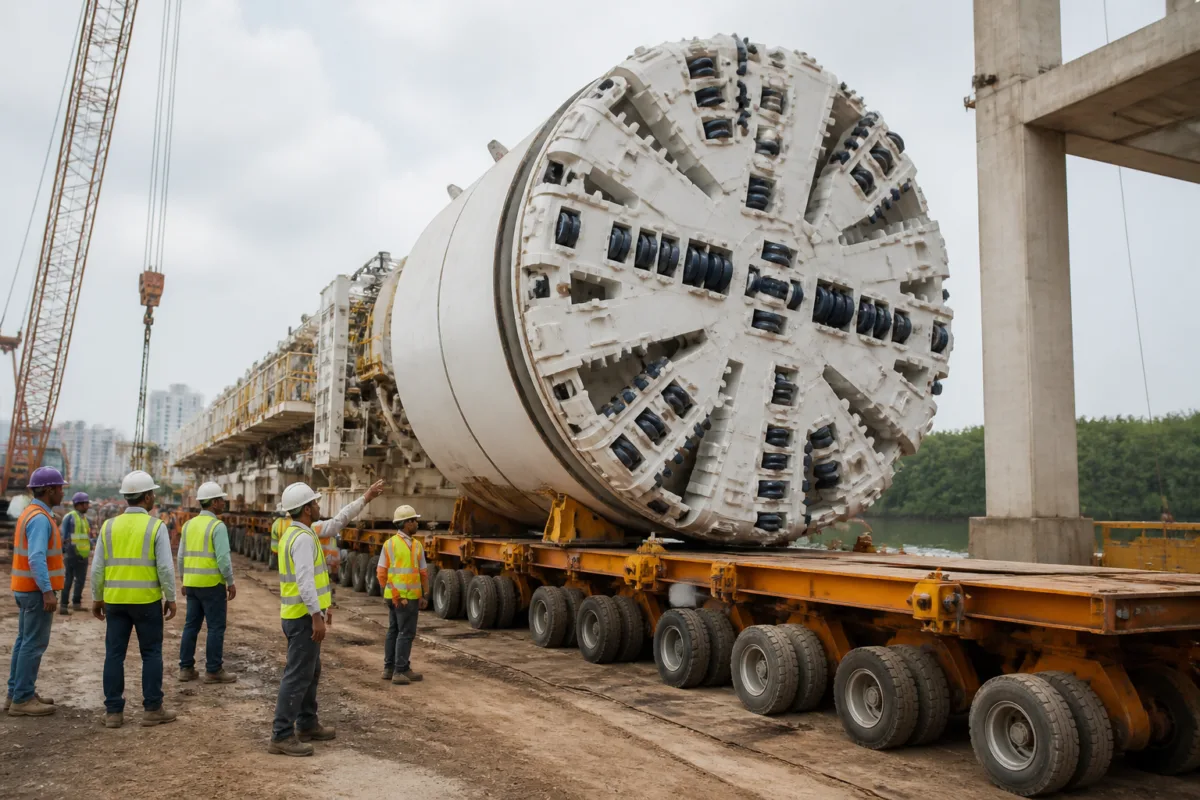
Mumbai’s Coastal Road tunnels between Malad and Kandivli have moved closer to construction after the giant tunnel boring machines (TBMs) assigned to the project underwent their first major factory tests in Chennai, according to BMC officials cited by the Times of India. The twin four-lane tunnels are scheduled to begin boring in May 2027 as part of the proposed Versova-Dahisar Link Road.
The 3.9-km twin tunnels will pass about 40 metres below ground and form part of the 22-km Coastal Road (North), also known as the Versova-Dahisar Link Road. The larger alignment will include roads at ground level, elevated sections, roads on stilts, a cable-stayed bridge and a cut-and-cover tunnel beneath a creek.
The TBMs, manufactured by Herrenknecht in Germany and assembled at its plant in Chennai, have a cutterhead diameter of 15.6 metres. They are among the largest machines of their kind to be used for a road tunnel project in India. Each fully assembled machine is 87 metres long, while the finished diameter of each tunnel will be 14.2 metres.
A team of BMC officials conducted a factory acceptance test on one of the two machines. The inspection covered the cutterhead’s rotation, the shield, grouting system, pressure levels, thrust jacks, segment-lifting mechanism, mechanical and electrical systems, ventilation, air pressure, operator cabins and the control cabin that monitors pressure inside the machine, an official said.
The machines will undergo another round of site acceptance tests after reaching Mumbai. BMC officials said factory conditions cannot replicate the actual ground and operating conditions at the tunnel-launching site, making the second set of checks necessary before excavation begins.
The machines will be launched from a 31-metre-by-120-metre shaft at Charkop, where work began in August. Megha Engineering & Infrastructures Ltd has been appointed as the contractor for this stretch. Packages C and D each cover a 3.9-km section. Around 3 km of each tunnel will be excavated using TBMs, while the remaining 900 metres will use the rectangular cut-and-cover method. Package C covers the northbound tunnel between Mindspace, Malad, and Charkop Creek, while Package D covers the southbound tunnel between Charkop Creek and Mindspace, Malad.
The project will face difficult geological and logistical conditions. Mumbai’s Deccan Trap basalt is dense, hard and abrasive, with variations in weathering and composition that can affect excavation. The alignment also passes through creek and mangrove areas, where limited storage space and unexpected ground conditions have complicated design and construction.
Transporting the TBMs from Chennai to Mumbai will require their components to be dismantled and moved in phases on an estimated 95 to 100 trailers. A BMC official said storage space along the alignment was limited, unlike the south Coastal Road project, where reclaimed land provided more room for construction materials.
The proposed corridor is intended to provide a signal-free route through the western suburbs and ease traffic pressure on the Western Express Highway. However, the project has also raised environmental concerns. According to figures cited in the report, about 60,000 mangroves lie within the project’s influence zone, with 45,000 expected to be affected and around 9,000 permanently felled. Civic officials said compensatory afforestation would be undertaken in Bhayander and Chandrapur near Tadoba forest. The next major construction milestone is the site acceptance testing and launch of the TBMs, scheduled for May 2027.

