


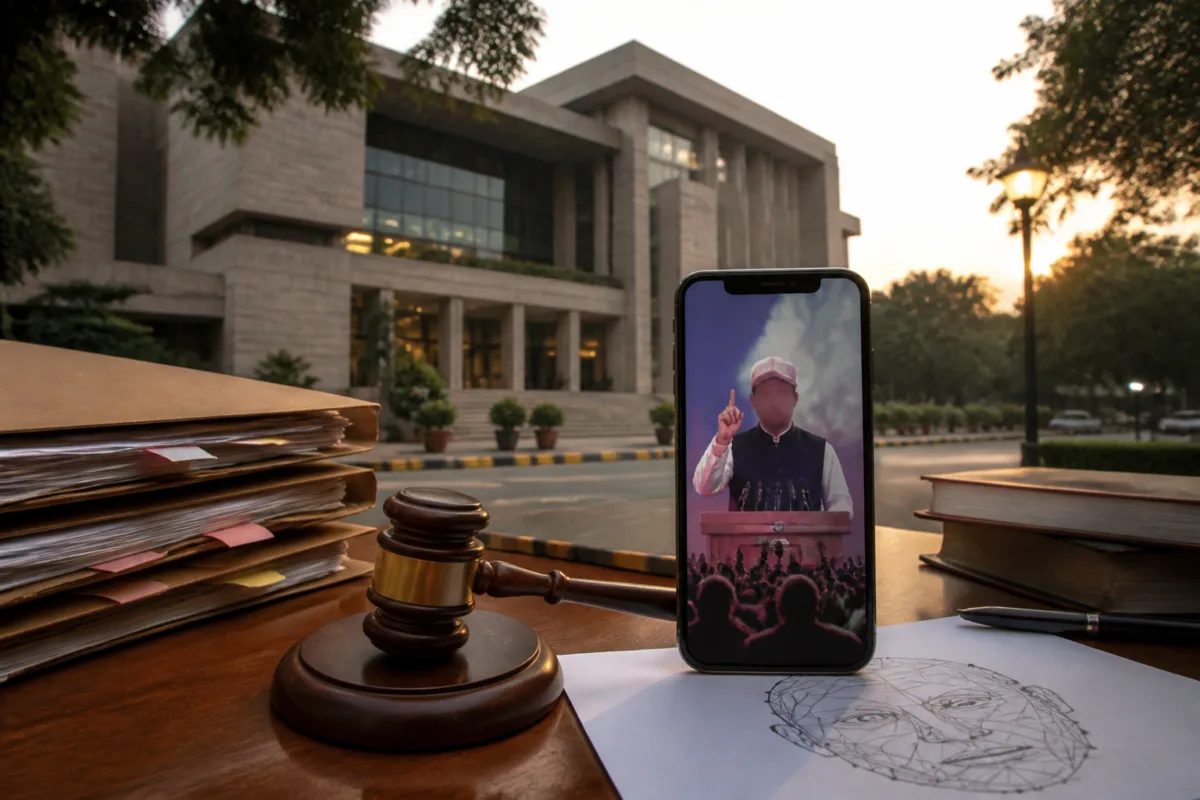
The Delhi High Court’s order directing the removal of AI-generated videos depicting Delhi Chief Minister Rekha Gupta as a liquor seller, delivery agent and street hawker has moved the debate over political communication beyond ordinary campaign rhetoric. The case is significant not only because of the content at issue, but because the court has attempted to define where criticism of a government ends and a digitally manufactured personal attack begins.
According to the report, Gupta approached the court after videos and images were posted on the Aam Aadmi Party’s official and verified social media accounts. She alleged that the material represented her in occupations with which she had no connection. The court treated the portrayals as defamatory and objectionable and directed their removal.
The order, as reported, does not question the right of a political party to criticise a government’s policies, decisions or administrative actions. Justice Manoj Jain specifically recognised that right. The court’s intervention was instead tied to the manner in which the criticism was presented: through AI-generated videos that portrayed the chief minister in what the court considered an insulting and degrading manner.
That distinction is central to the case. Political communication traditionally allows space for caricature, parody, satire and sharp opposition. Digital tools, however, can make fabricated audio-visual material appear more immediate and realistic while allowing its creator to place a public figure in situations that never occurred. The report does not establish how widely the videos circulated or what technical methods were used to create them. It does establish that the court considered publication, rather than mere creation, to be a point at which human responsibility remained decisive.
The court reportedly observed that the possibilities for creating such videos and images are virtually unlimited, but that the decision to publish or not publish remains within human control. That observation places responsibility on the political organisation and individuals distributing the material, rather than treating AI as an independent actor. The technology may generate an image, but the act of selecting, approving and publishing it remains an institutional decision.
This is an important governance question for political parties. Verified social media accounts are not private communication channels in the ordinary sense. They are official publishing platforms through which parties communicate with voters, attack opponents and frame public policy debates. When AI-generated material is posted through such accounts, the dispute is no longer only about an individual post. It also concerns the internal controls that a political organisation applies before publishing content in its name.
The court’s reasoning, as quoted in the report, rests on a line between satire and humiliation. Justice Jain said that courts might not intervene where the material is genuinely humorous or satirical, but that intervention becomes necessary when a person’s dignity is harmed. He also stated that freedom of expression cannot be used as a shield for presenting someone in a degrading manner or turning them into an object of ridicule.
That line is not presented as a complete technical test in the supplied report. The case therefore leaves open questions about how courts will assess future AI-generated political material. The report does not specify whether the videos carried disclaimers, whether viewers could identify them as synthetic, or whether the court examined their reach, intent or audience response. Those details could matter in later proceedings because the same fictional depiction may be assessed differently depending on its context, presentation and purpose.
The order also illustrates a structural difficulty created by synthetic media: the difference between factual falsity and expressive exaggeration can become harder to identify. A conventional political cartoon signals its artificiality through recognisable visual conventions. An AI-generated video can place a real person into an invented setting with enough visual detail to make the scene appear documentary. The supplied material does not say that viewers believed the videos were real, but the court’s description of the content as an attack on the dignity of a constitutional office shows why the boundary has become a legal concern.
The case has a direct institutional dimension because the person who approached the court is not only a political leader but also the holder of a constitutional office. The court’s reported reasoning does not grant the office-holder immunity from criticism. Instead, it distinguishes criticism of public action from personal depiction that crosses into humiliation. This is a narrower and more defensible basis for judicial intervention than a general protection from political opposition.
The proceedings also show how disputes over digital political content are being handled through existing legal institutions. Gupta filed a suit seeking removal of the material. The court issued notice to the Aam Aadmi Party and other respondents and directed them to submit written replies within 30 days. The report says that no one appeared for the defendants even after notice was issued. The available material does not establish the final outcome of the suit or whether the respondents later respond within the period granted by the court.
That procedural position matters. The removal direction is an immediate consequence of the court’s consideration of the material before it, while the direction to file written replies indicates that the broader dispute remains before the court. The supplied report does not provide a final finding on every legal issue raised by the suit. It also does not report the respondents’ explanation, which means their position cannot be assessed from the available material.
For public institutions, the case points to a growing need to separate three decisions that are often treated as one: whether to criticise a policy, how to represent the political opponent, and whether a digitally created representation should be published. The court’s reported remarks suggest that the first is protected political activity, while the second and third can attract scrutiny when they produce a degrading personal portrayal.
For citizens, the issue is linked to the reliability of the visual information environment around elections and governance. A fabricated video can be used to communicate a political argument without documenting the underlying policy dispute. In this case, the court’s concern was not that the chief minister could not be criticised, but that criticism was expressed through portrayals the court regarded as offensive and unrelated to any actual conduct by her.
The decision therefore shifts attention from whether AI was used to what was done with the resulting material. The technology itself is not described in the report as prohibited. The court instead focused on the content, the dignity of the person depicted and the responsibility attached to publication. That approach leaves room for political satire while rejecting the assumption that every AI-generated political attack is protected merely because it is presented as humour or commentary.
The Delhi case also exposes an accountability gap that is larger than one party or one chief minister. Political parties now communicate through fast-moving digital channels where approval, publication and circulation can happen rapidly. The report does not say what review process was followed before the videos appeared on the Aam Aadmi Party’s verified accounts. The court’s observation that publication remains a human choice makes that missing institutional detail especially relevant.
What the available evidence confirms is limited but important. The Delhi High Court ordered the removal of AI-generated videos and images depicting Rekha Gupta in degrading roles; Justice Manoj Jain distinguished policy criticism from objectionable personal portrayal; and the court required the respondents to file written replies within 30 days. What remains unresolved in the supplied material is the defence of the respondents, the eventual legal conclusion and the precise standard that will govern similar synthetic-media disputes.
The next stage of the case will show whether the court’s reasoning develops into a broader framework for political satire involving AI or remains confined to the specific material before it. Until then, the order establishes a clear institutional signal: political parties may challenge governments forcefully, but the use of synthetic media does not remove responsibility for the dignity and meaning of what they publish.

