


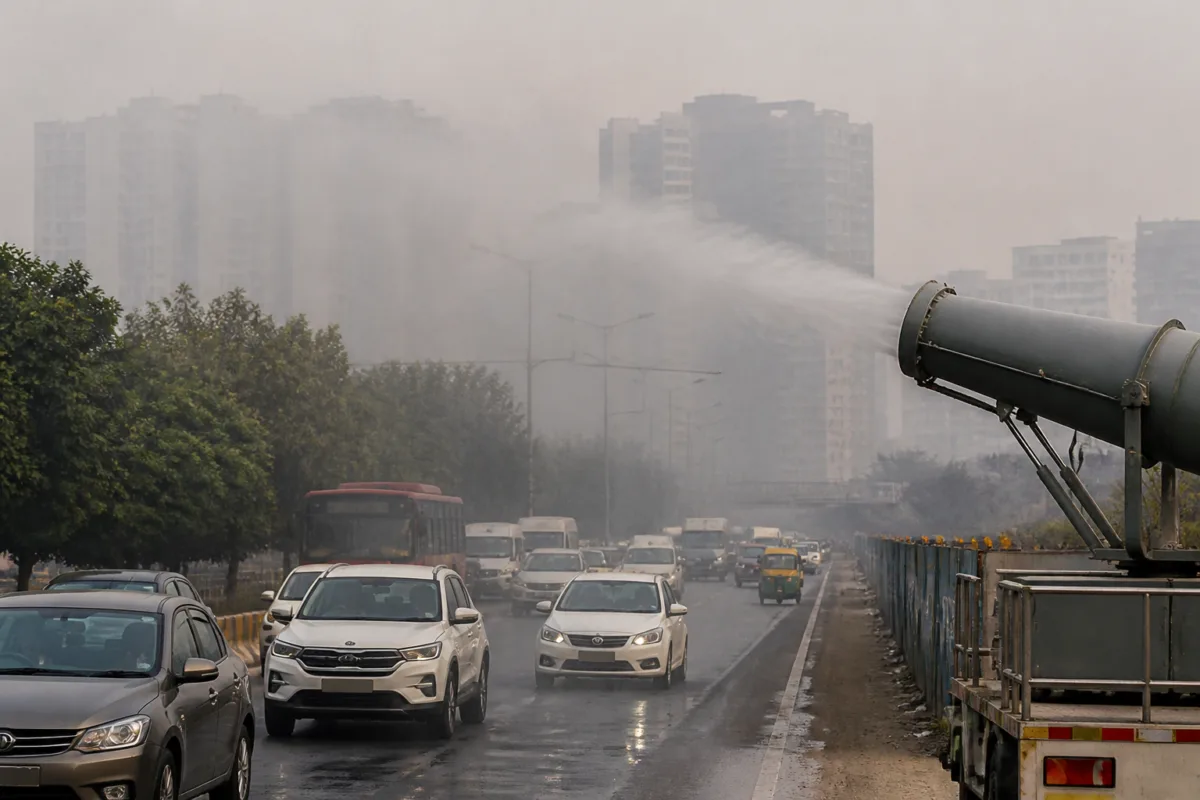
Delhi air pollution has pushed the National Capital Region closer to the severe category, prompting the Commission for Air Quality Management (CAQM) to impose Stage III measures under the Graded Response Action Plan (GRAP) across the region. The restrictions include a ban on dust-generating construction and demolition work, while Delhi-NCR governments have been asked to consider allowing 50% of staff in government, municipal and private offices to work from home.
The measures were announced after Delhi recorded an average Air Quality Index (AQI) of 382, up from 369 a day earlier. The reading was close to the severe category threshold of 401. The restrictions have been introduced ahead of Diwali, when authorities typically prepare for additional pollution from firecrackers alongside emissions from traffic, construction and regional sources.
Data from Delhi’s monitoring network showed that 26 of the capital’s 38 stations recorded air quality in the severe category, while 31 stations reported very poor conditions. Punjabi Bagh recorded the highest AQI at 453, followed by Jahangirpuri at 447 and Rohini at 444. Lodhi Road was the only area mentioned in the report where air quality remained in the poor category.
The CAQM’s Stage III measures apply across Delhi-NCR and specifically target construction and demolition activities that generate dust. The restrictions cover dust-producing work, making them directly relevant to construction sites, redevelopment activity and other projects that can release particulate matter into the air. Emergency measures under the pollution response plan are also to remain in force to prevent conditions from worsening.
The decision is based partly on air-quality forecasts from the Indian Institute of Tropical Meteorology in Pune. The forecast cited in the report indicated that Delhi’s air could remain in the severe category from November 7 to November 9. Air quality was then expected to fluctuate between severe and very poor levels for the following six days.
The report attributed the worsening conditions to unfavourable weather and slow wind speeds, which allow pollutants to remain concentrated near the surface. PM2.5 was identified as the main pollutant in Delhi’s air. These fine particles can travel deep into the lungs when inhaled, making the pollution episode a public-health concern as well as an operational challenge for the city’s construction and office economy.
The 50% work-from-home measure has not been described as an automatic region-wide closure. Instead, Delhi and other National Capital Region governments have been directed to take a decision on implementing it across government, municipal and private offices. This places responsibility on individual administrations to determine how the measure will be applied while the air-quality restrictions remain active.
The next official benchmark will be the air-quality assessment over the November 7-9 period, when forecast conditions are expected to remain severe. Authorities will use subsequent pollution levels and forecasts to determine whether the GRAP restrictions continue, are strengthened or are reduced.

