


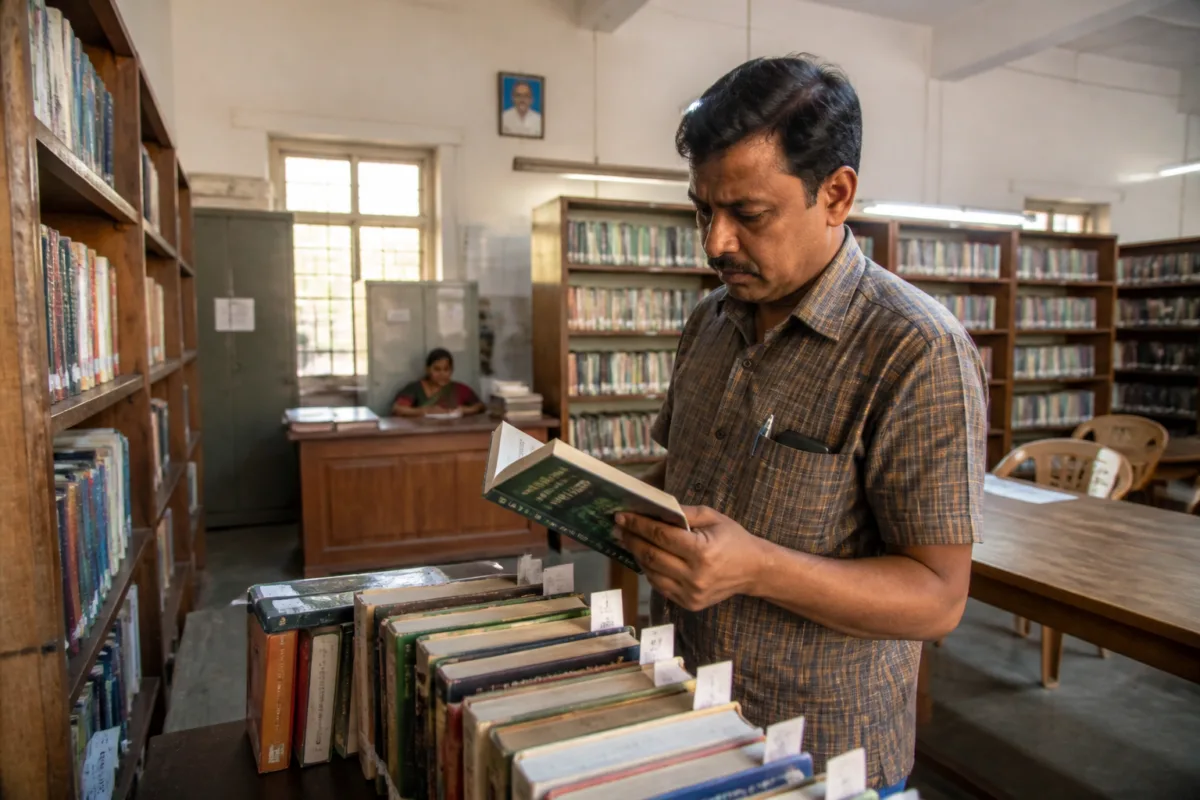
Dinamalar has appealed to readers in Tamil Nadu to inspect books held in local libraries and report publications they believe are fake, unnecessary or overpriced, following allegations of irregularities in the purchase of books linked to the E.V.R. knowledge-world programme. The supplied report does not include procurement documents, library records, an official statement or an independent confirmation of the allegations.
In its appeal, Dinamalar alleges that books were purchased under the names of fake authors and that unsuitable publications have accumulated in libraries. The report describes the alleged procurement irregularities as an attack on Tamil society’s intellectual resources, but does not identify the libraries involved, the number of books purchased, the publishers or authors concerned, the financial value of the purchases, or the government agency responsible for the procurement.
The publication has asked readers to visit libraries near their homes and examine the books available there. It has specifically requested information about books that readers consider fake, unnecessary or excessively priced. Readers have been asked to send details to Dinamalar at dotcomdept@dinamalar.in.
The appeal places library users, teachers, researchers, social activists and other readers at the centre of a proposed public scrutiny exercise. Dinamalar says that information received from readers could help identify and remove unsuitable books from libraries. It also asks participants to avoid personal hostility and presents the exercise as an effort to protect libraries as public repositories of knowledge.
However, the supplied material does not establish that any books were falsely attributed, improperly selected or purchased at inflated prices. It also does not clarify whether the allegations relate to a government tender, a specific procurement order, a library department initiative or purchases made by individual institutions. Without those details, the scale and institutional responsibility for the alleged irregularities cannot be determined.
Public library procurement involves questions of public spending, collection standards, cataloguing and access to reliable knowledge. Establishing whether a purchase was improper would require evidence such as tender documents, purchase orders, invoices, approved book lists, author and publisher records, library catalogues and inspection findings. A comparison between the purchase price and market price would also be necessary before describing a book as overpriced.
The report does not provide a response from Tamil Nadu’s library authorities, the department responsible for the alleged purchases, any procurement committee, publishers or authors named in connection with the allegations. It is therefore not possible from the supplied material to assess whether the claims have been formally investigated or whether any books have already been removed.
The reader campaign announced by Dinamalar may generate leads, but individual complaints alone would not establish a procurement violation. Each allegation would need to be checked against official records and the relevant purchasing rules. The central claims in the report remain allegations pending documentary evidence and responses from the authorities concerned.

