


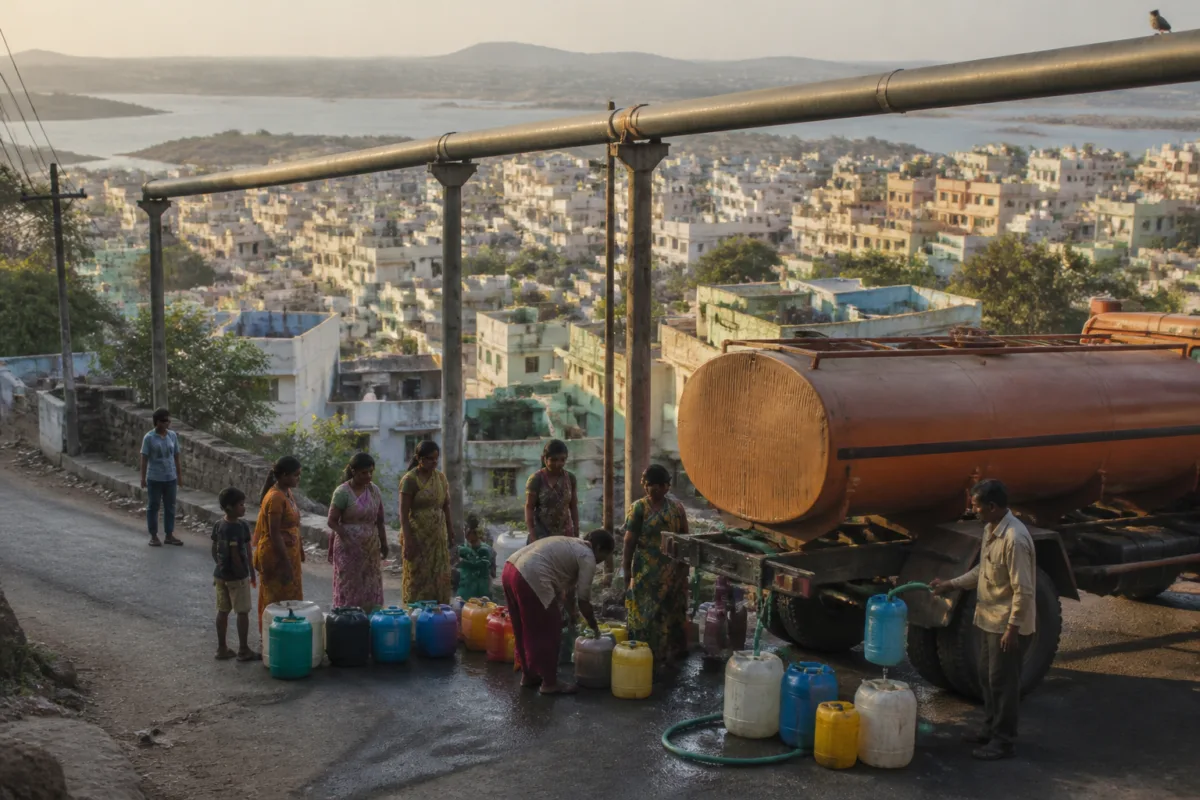
Hyderabad is preparing for water stress from December, with the Hyderabad Metropolitan Water Supply and Sewerage Board (HMWSSB) drawing up a contingency plan to protect nearly three lakh connections after the Singur and Manjeera reservoirs were reported to have storage for only around 55 days.
HMWSSB managing director K. Ashok Reddy said the board currently has about 560 million gallons per day (MGD) available from its existing sources. He said Osman Sagar, Himayat Sagar, Godavari at Yellampally and Krishna at Nagarjuna Sagar had sufficient reserves to last 300 days or more.
The contingency plan covers areas in nine Assembly constituencies, either fully or partly. These include Serilingampally, Patancheru, Khairatabad, Jubilee Hills, Sanathnagar, Kukatpally, Karwan, Rajendranagar and Qutbullapur. The listed locations include Erramanzil, Somajiguda, Banjara Hills, Yousufguda, Borabanda, Ameerpet, Sanathnagar, KPHB, Moosapet, Bharat Nagar, Shaikpet, Tolichowki, Kismatpur, Nizampet and Pragathi Nagar.
Under the plan, HMWSSB intends to arrange an additional 60 MGD for the affected areas. Godavari sources are expected to provide 40 MGD, while 15 MGD will come through additional pumping and rationalisation of Krishna supplies. The remaining 5 MGD will be created through adjustments within the existing distribution network.
The board also plans to withdraw the existing 20 MGD supplied to Mission Bhagiratha and make an additional 20 MGD available through the scheme by November 15. It plans to pump another 15 MGD of Krishna water from Mir Alam towards the Sainikpuri Balancing Reservoir through Shahebnagar MBR, and divert 5 MGD to Manikonda by rationalising supplies from Krishna Phase-II Ring Main-I.
Ashok Reddy said Singur and Manjeera had become less dependable because they receive significant flood inflows only once every three to four years. The reservoirs received almost no substantial inflows this year, he said, while groundwater recharge had also declined compared with the previous year. HMWSSB has consequently had to depend more heavily on storage in the Krishna and Godavari systems.
The increase in demand for alternative supplies is reflected in the board’s tanker figures. Tanker bookings rose from 48,284 in October 2025 to 192,889 in October 2026. Deliveries increased from around 87,000 to 227,000 over the same period.
For longer-term supply security, HMWSSB is relying on Godavari Phase II and III projects, which are expected to add around 300 MGD to Hyderabad’s drinking water supply by December 2027. Ashok Reddy said this would increase the city’s existing availability by nearly 60 per cent and expressed confidence that Hyderabad would have adequate drinking water supplies by summer 2028.

