


Viksit Bharat 2047 is increasingly being framed not as a demographic aspiration but as an institutional engineering challenge. Discussions at the second TOI Ideas for India 2047 summit in New Delhi brought together infrastructure investment, sovereign technology, industrial finance, judicial reform, water security and workforce redesign under one question: can India build the systems needed to convert national scale into durable economic capacity?
The summit’s Ideas for India 2026 Compendium, as described by The Times of India, presents a broad strategic playbook rather than a single policy announcement. Its central argument is that a developed economy cannot be built through infrastructure spending alone. Ports, shipyards, digital systems and manufacturing capacity matter, but their impact depends on how capital is allocated, how institutions process decisions and whether smaller firms and grassroots innovators can access the systems that larger organisations take for granted.
That framing is significant for cities because the urban economy is where these pressures meet. Ports and industrial corridors depend on transport and logistics networks. Manufacturing requires land, utilities, skilled labour and reliable supply chains. Technology companies need research facilities, testing environments and institutional support. Water security and judicial efficiency affect the daily functioning of households, firms and public agencies. The summit therefore placed urban development inside a wider architecture of economic resilience.
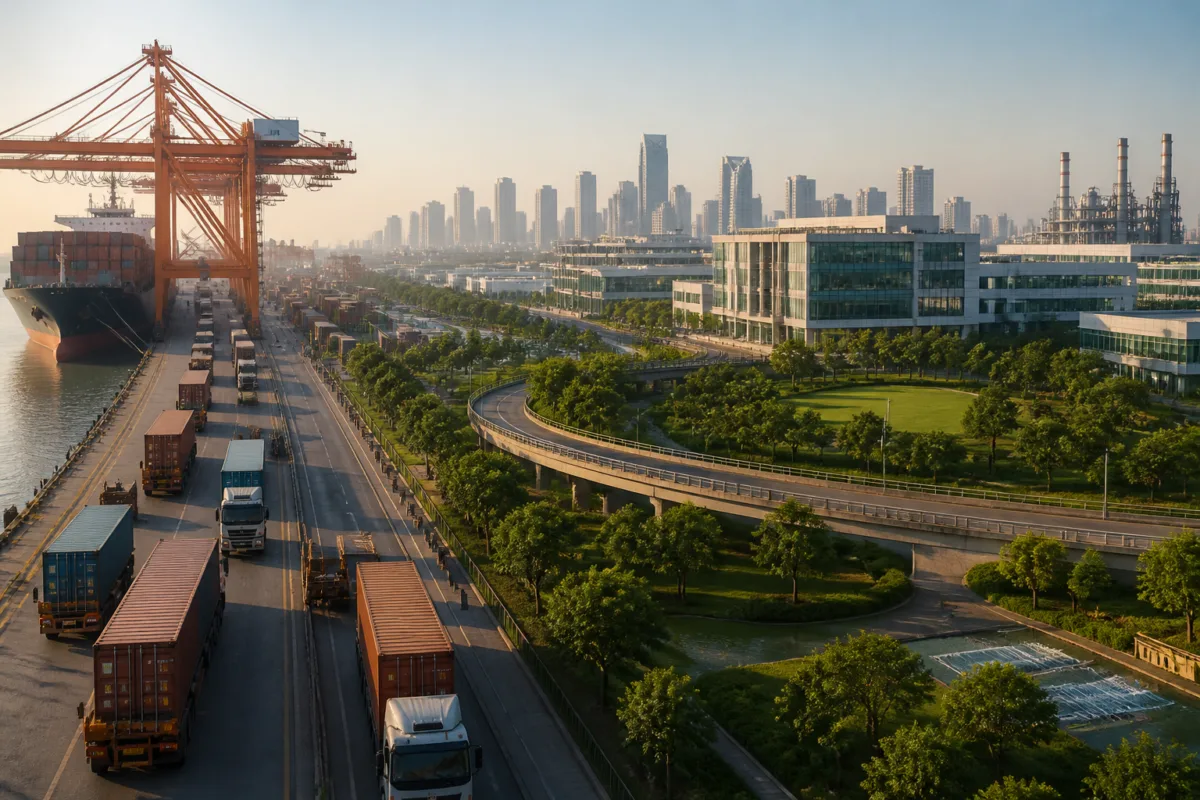
The first part of that architecture is strategic infrastructure. Union Minister Sarbananda Sonowal cited the Rs 76,000-crore Vadhavan Port and a Rs 70,000-crore shipbuilding revitalisation package as examples of large capital commitments intended to reduce India’s dependence on foreign transshipment hubs. The stated objective is not only to add physical capacity but to reduce vulnerability in the logistics chain and strengthen domestic maritime capability.
Yet the summit discussions also exposed the limits of treating capital expenditure as a complete development strategy. Geetanjali Kirloskar, chairperson of Kular Systems, pointed to India’s research and development expenditure of 0.65% of GDP. Her intervention placed an institutional question beside the infrastructure question: who will generate the technologies, materials and industrial processes that allow new assets to produce greater domestic value?
That gap is particularly relevant to cities that are trying to attract advanced manufacturing and technology-led employment. Industrial facilities cannot be separated from research ecosystems, testing laboratories, skilled workers and dependable finance. The summit’s emphasis on semiconductors, advanced materials and biotechnology indicates that industrial self-reliance requires more than assembling imported components. It requires the ability to develop and improve the underlying systems.
The capital debate also moved beyond the conventional distinction between public investment and venture funding. Asish Mohapatra, co-founder of Of Business and Oxyzo, argued that founders should not rely on equity financing too early and should instead consider operational cash flows, customer advances and debt channels. He said institutional liquidity available through these routes is 20 to 30 times deeper than equity.
That claim, as reported from the summit, points to a financing problem with direct urban consequences. Small and medium enterprises often operate within city-level manufacturing, construction, services and logistics networks. If their growth depends only on limited equity pools, businesses with viable operating models may remain too small to invest in technology, equipment or formal employment. A wider financing architecture could strengthen the distributed economic base that supports large infrastructure projects.
The discussion on digital intelligence made the same point from an operational angle. Surinder Singh, senior vice-president for operations at Optum Global, argued that shared digital intelligence could help micro, small and medium enterprises address forecasting weaknesses. For smaller firms, better forecasting can influence inventory, procurement, staffing and cash-flow decisions. The summit did not establish a specific programme or implementation mechanism, but it identified a structural divide between the availability of digital tools and the capacity of smaller enterprises to use them.
The institutional reform agenda extended into the justice system. South Delhi MP Bansuri Swaraj proposed using artificial intelligence for documentary-heavy matters such as cheque-bouncing disputes and rent-control cases, with human appellate panels retained and AI excluded from cases involving personal liberty. She also proposed digital tracking IDs for undertrials to reduce the risk of people remaining in custody because of administrative delays in bail filings.
For the built environment, the significance lies in the connection between legal time and economic time. Rent disputes, commercial claims, construction disagreements and land-related processes can affect how quickly homes, businesses and infrastructure projects move through the system. Faster processing of routine documentary matters could reduce administrative friction, but the proposal also underlines the need for clear limits and human oversight when state power affects liberty.
Water security formed another part of the summit’s institutional argument. Mahesh Gupta, founder of Kent RO, raised concerns about microplastics entering drinking water and argued that public infrastructure alone cannot address the emerging threat. Jal Shakti Minister C. R. Patil, according to the report, pointed to water conservation networks developed without government capital through community mobilisation and corporate social responsibility funding.
This example shifts the water discussion from asset creation to maintenance, participation and financing. Urban water systems are often judged through visible infrastructure such as treatment plants, pipelines and reservoirs, but their resilience also depends on monitoring, source protection and local participation. The summit material does not provide performance data for the cited networks or establish whether the model can be replicated across different regions. It does, however, highlight the continuing search for financing and governance arrangements beyond conventional state-funded projects.
The human-capital debate showed why these reforms cannot be separated from education and employment. Prashant Mehra of GT Bharat and Stovekraft founder Rajendra Gandhi argued that companies can no longer treat educational institutions as passive talent pipelines. They called for greater corporate involvement in curriculum design and placed more value on job-ready abilities in robotics, manufacturing supervision and technology integration than on static degrees alone.
The issue is especially important as automation changes the shape of entry-level work. The summit discussions described a movement from traditional corporate hierarchies towards structures that place greater emphasis on human judgement and reduce routine execution. Whether that transition produces better employment will depend on access to training, the quality of industrial workplaces and the ability of educational institutions to respond quickly. The source material identifies the direction of change but does not establish its scale across sectors or regions.
The final component was grassroots innovation. Actor and cultural commentator Avinash Tiwary said inventors in hubs such as Hyderabad and Bengaluru often face limited access to laboratories and institutional grants. The discussion referred to Telangana’s T-Works as an example of a regional prototyping infrastructure model and cited innovations including edge-AI counter-drone systems and biodegradable packaging made from agricultural waste.
This is a critical distinction between invention and deployment. An idea can emerge from a university, start-up or individual workshop, but moving from prototype to usable product requires testing facilities, grants, procurement pathways and customers willing to adopt new solutions. Without those links, innovation remains dependent on personal resources or charitable support. The summit’s call for institutionalised prototyping sandboxes therefore addresses a capacity problem rather than merely a technology shortage.
Taken together, the summit’s themes describe Viksit Bharat 2047 as a coordination problem. Strategic ports and shipbuilding packages address physical capacity. Research investment addresses technological capability. Alternative financing addresses the growth constraints of smaller businesses. Digital tools address operational inefficiency. Judicial technology addresses institutional delay. Community-led water conservation addresses resource security. Curriculum redesign and prototyping facilities address the human and innovation systems behind production.
The evidence presented at the summit does not amount to a single implementation plan, and several proposals remain at the level of recommendations or examples. The report does not specify timelines for the judicial AI proposals, the funding structure for grassroots laboratories or measurable outcomes for the cited water networks. It also does not establish how the various initiatives would be coordinated across ministries, states, cities, companies and communities.
That uncertainty is central to the larger urban question. India’s development challenge is not simply whether it can build more infrastructure. It is whether institutions can connect infrastructure to research, finance, skills, legal certainty, environmental security and inclusive enterprise. The summit’s strongest contribution is to place those links in the same frame. The next test will be whether the ideas move from roundtable consensus into funded programmes, accountable institutions and measurable results before 2047.

