


Telangana’s latest urban infrastructure approvals do more than add five projects to the state’s investment pipeline. They bring together Hyderabad’s long-term drinking-water security, Warangal’s chronic flood exposure, heritage-led regeneration and a financing model that requires states and urban local bodies to mobilise substantial funds beyond central assistance.
The National Apex Committee of the Union ministry of housing and urban affairs has approved five Telangana projects with a combined value of ₹3,892 crore, according to a report by the Times of India citing the state municipal administration department. The Centre’s assistance for these projects will total ₹873 crore. With the latest approvals, Telangana has eight projects sanctioned under the Urban Challenge Fund, involving total investments of ₹9,573 crore and central support of ₹2,293 crore.
The portfolio is significant because it spans very different urban functions. The largest project is the second and third phases of Hyderabad’s Godavari drinking-water supply scheme. The other approvals cover stormwater drainage in Greater Warangal, restoration of the Warangal Fort moat, a central business district in Hanumakonda and an integrated heritage and tourism project at Alampur. Together, they show how the UCF is being used to package water supply, flood mitigation, public-realm improvements and place-based economic activity within one state-level urban investment programme.
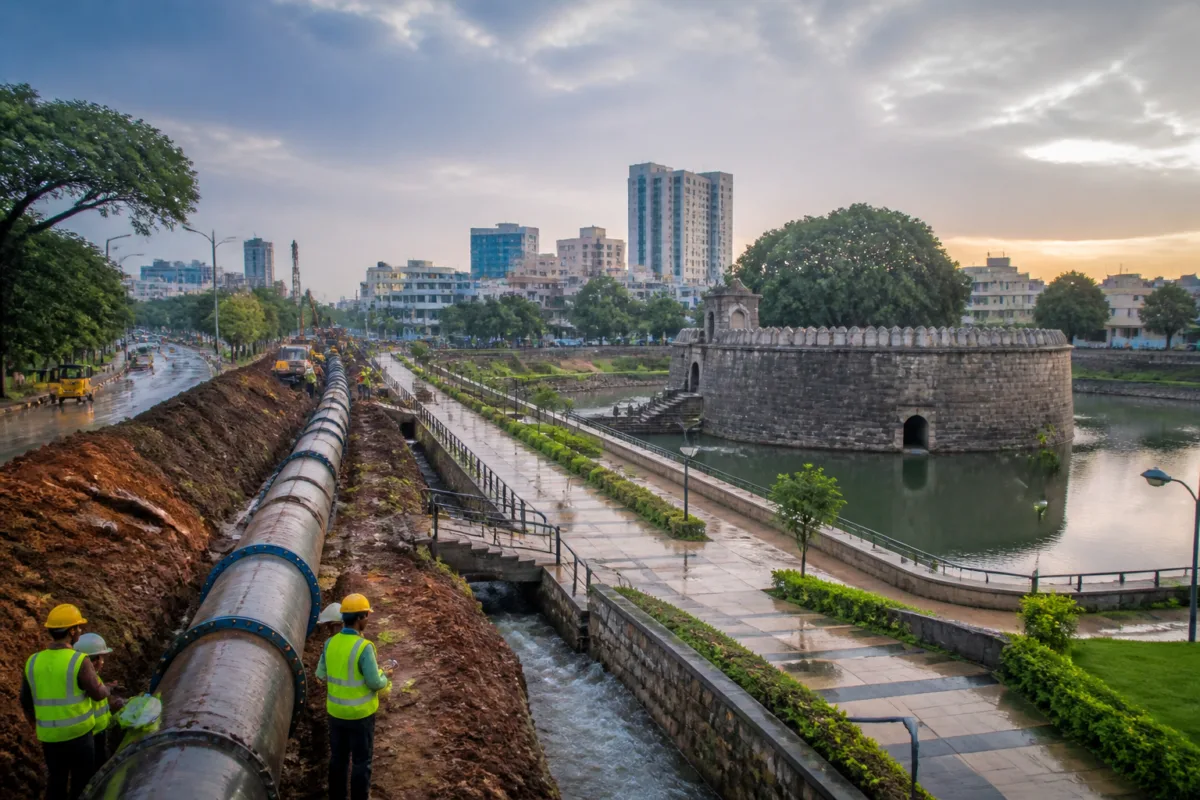
The Hyderabad water project accounts for ₹1,992 crore of the newly approved investment. It proposes nearly 120 km of transmission pipelines from Ghanpur to the Osmansagar and Himayatsagar reservoirs, along with two water treatment plants with capacities of 120 million litres per day and 70 million litres per day. Combined with the first phase, the project is expected to augment the city’s water supply by 20 tmc and meet the requirements of 1.74 crore people up to 2035.
The numbers point to a city planning problem that is different from simply adding treatment capacity. Water must be conveyed across a large urban and regional system before it reaches reservoirs and then the distribution network. The proposed pipeline length and treatment capacity indicate that the project is designed as a bulk-water infrastructure intervention. The supplied report does not establish the present supply gap, the condition of existing networks or the timetable for commissioning the new facilities, but it does make clear that the project is intended to support Hyderabad’s projected requirements through 2035.
That longer horizon is important for the way the approval should be understood. A drinking-water scheme of this scale is not an isolated construction project. It creates continuing responsibilities for treatment operations, transmission maintenance, reservoir management and last-mile distribution. The approval identifies the physical components and the intended service population, while the eventual urban outcome will depend on how those components are delivered and integrated with the existing system.
Warangal’s ₹1,465 crore stormwater drainage project addresses a different form of urban stress. Covering 407.70 square kilometres, it is designed to eliminate flooding at 24 identified vulnerable locations through new stormwater drains and the rejuvenation of 10 major tanks. The project places drainage capacity and water-body restoration within the same intervention rather than treating flooding only as a question of moving water through underground or roadside channels.
The proposal also provides a useful indication of the scale of the challenge. A city-wide project covering more than 400 square kilometres and 24 vulnerable locations suggests that the problem is distributed across the urban area rather than confined to one damaged road or one undersized drain. The inclusion of tanks is equally relevant because the project is not limited to grey infrastructure. However, the supplied material does not specify the causes of flooding at each location, the proposed drain capacities, the ownership of the tanks or the operating arrangements after construction.
Those details will matter during implementation. Drainage infrastructure can be built as a network, but its performance depends on the continuity of channels, the availability of outfalls and the maintenance of tanks and drains. The approval provides the broad design intent—new drains and rejuvenated water bodies—but does not yet provide a project schedule, tendering status or detailed performance indicators beyond the target of addressing 24 vulnerable locations.
The other three projects move from basic services to the quality and economic role of urban places. The ₹209 crore Warangal Fort moat restoration project includes desilting, landscaping, promenades, viewing decks and bridges. Around 400 metres of the moat has already been cleared as part of initial works. The ₹168.8 crore Hanumakonda central business district project includes an integrated bus terminal-cum-commercial complex, multi-level parking, redevelopment of the central plaza and infrastructure improvements around the Bhadrakali and Thousand Pillar temples.
At Alampur, the ₹57.5 crore integrated heritage, tourism and urban regeneration project will improve infrastructure around the Jogulamba and Navabrahma temples. Its components include approach roads, parking, a crafts village, a sponge park, refurbishment of the Pushkara ghat and a 300-metre pedestrian heritage corridor.
These projects are connected by a place-based approach to urban development. The Warangal and Alampur proposals treat heritage assets not simply as monuments requiring conservation, but as anchors around which public space, access, pedestrian movement, drainage and local economic activity can be improved. Hanumakonda’s proposal similarly combines transport infrastructure, parking, commercial space and temple-area improvements within a central district.
That combination can make projects more visible to residents than a conventional utility upgrade. A new treatment plant or transmission line is essential but largely experienced indirectly. A bus terminal, public plaza, pedestrian corridor or restored moat changes how people move through and use a district. The available information does not, however, establish how local communities, traders, heritage authorities or transport operators will participate in the design and operation of these places.
The financing structure of the Urban Challenge Fund is central to the significance of the approvals. Central assistance is limited to 20-25% of project costs. At least 50% of funding must be mobilised through public-private partnerships, hybrid annuity model arrangements or institutional borrowings. The remaining share is to be contributed by the state government and urban local bodies.
For the five newly approved projects, the Centre’s ₹873 crore assistance represents roughly 22% of the combined ₹3,892 crore project value. That is broadly consistent with the stated UCF framework, but it also means that the approvals are not equivalent to full funding. The state and participating urban local bodies must assemble the balance through their own contributions and the financing mechanisms permitted under the scheme.
This shifts the main institutional question from sanction to delivery. A project can receive central approval while still requiring detailed financing agreements, land and right-of-way decisions, procurement, inter-agency coordination and operating arrangements. The report identifies the funding channels available under the UCF, but it does not state which mechanism will be used for each of the five projects or how the state and local bodies will divide their financial responsibilities.
The earlier three Telangana projects approved under the scheme in May provide the wider programme context. They included the Greater Warangal underground sewerage system, the Karimnagar urban transformation project and an artificial-intelligence-enabled integrated command and control centre for Khammam. The latest approvals therefore expand an existing state portfolio rather than representing a standalone announcement.
Taken together, the eight projects have a combined sanctioned value of ₹9,573 crore, with central support of ₹2,293 crore. The portfolio covers water supply, sewerage, drainage, urban transformation, technology, heritage and tourism. Its breadth may allow the state to address several urban systems at once, but it also creates a broad implementation workload across multiple cities and departments.
The distribution of the latest investment is uneven. Hyderabad’s water project and Warangal’s drainage project together account for ₹3,457 crore, or nearly 89% of the five-project total. The remaining projects are smaller in financial terms but have a more concentrated impact on specific districts, public spaces and heritage precincts. This split reflects two different scales of urban intervention: metropolitan network infrastructure in Hyderabad and district-level place transformation in and around Warangal and Alampur.
The approval also highlights a recurring feature of urban infrastructure in India: the agency that plans a project, the agency that finances it and the institution that ultimately operates it may not be the same. The municipal administration department is cited as the source of the project details, while the central approval comes through MoHUA’s National Apex Committee. State government departments, municipal bodies, utilities, transport agencies and heritage-related institutions will have to coordinate the next stages, although the supplied material does not specify the institutional structure for each project.
For residents, the immediate significance lies in the services and spaces these projects are intended to improve: more bulk water for Hyderabad, fewer flood-prone locations in Greater Warangal, better access and public amenities around heritage sites, and a new central district facility in Hanumakonda. For the administration, the harder task will be converting sanctioned project value into functioning infrastructure that remains funded and maintained after construction.
The evidence currently confirms approvals, project values, proposed components, coverage areas and the UCF funding framework. It does not yet establish construction completion dates, tender awards, detailed financing arrangements, land acquisition requirements, operating costs or measurable service outcomes. Those milestones will determine whether the programme becomes a coordinated urban investment strategy or a collection of separately delivered projects.
Telangana’s latest UCF approvals therefore deserve attention not only for their ₹3,892 crore headline value, but for the delivery test they create. Hyderabad’s water expansion and Warangal’s drainage plan address essential urban resilience, while the heritage and CBD projects attempt to connect infrastructure with public space and local economic activity. The next evidence to watch is implementation: financing closure, procurement, construction progress and the eventual performance of the networks and places these approvals are meant to create.

