


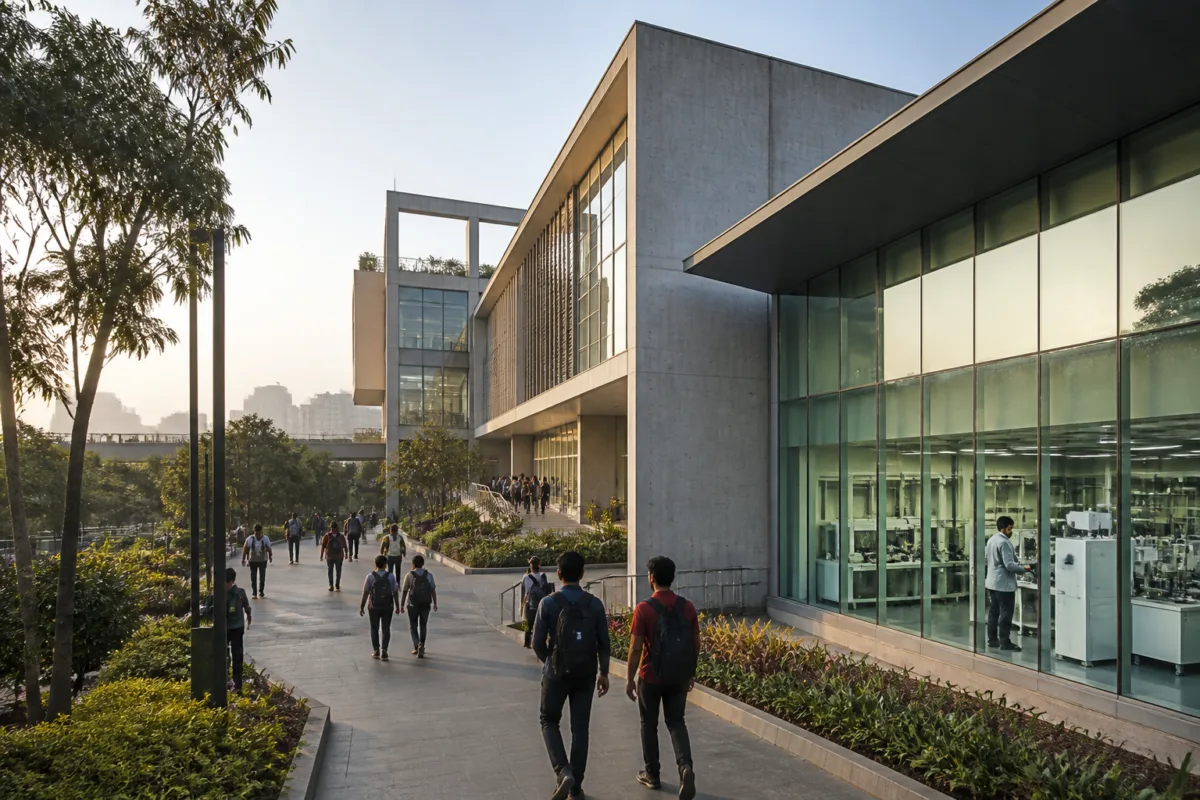
The QS Asia University Rankings 2027 have placed Telangana’s higher education system on a sharply uneven trajectory: IIT Hyderabad has advanced to 251st in Asia, NIT Warangal has made a substantial jump to 624th, while the University of Hyderabad and Osmania University have moved down. Taken together, the results show that institutional performance is being shaped not only by reputation, but also by research productivity, faculty strength, industry links and the ability to build international networks.
IIT Hyderabad rose 19 places from 270th in the previous edition to 251st. NIT Warangal moved from the 771-780 band to 624th, while Jawaharlal Nehru Technological University Hyderabad entered the rankings in the 1201-1300 band. Woxsen University, a private institution, also improved significantly, moving from 694th to 499th.
The gains are not shared across the state’s institutions. The University of Hyderabad slipped 24 places from 246th to 270th, although it improved its academic reputation ranking by 11 places, from 176th to 165th. Osmania University fell 180 places from 470th to 650th. Maulana Azad National Urdu University remained in the 1101-1200 band, while the English and Foreign Languages University moved into the 1501+ band from 1401-1500.
This divergence matters because universities are not isolated campuses. They are part of the institutional infrastructure that supports cities and regions: producing skilled workers, attracting research funding, building technology ecosystems and connecting local economies to national and international networks. The rankings do not measure the entire contribution of a university to its city, but the patterns in the results offer a view of which institutional capabilities are currently gaining recognition.
At IIT Hyderabad, research productivity was identified as the main driver of the improvement. Saurabh Shandilya, the institute’s QS rankings coordinator, said that papers per faculty member and citations per paper were the biggest contributors, followed by academic and employer reputation. IIT Hyderabad ranked 30th in Asia for papers per faculty member and 41st for staff with PhDs. It stood at 209th for employer reputation and 226th for academic reputation.
The distinction between publication volume and research quality is significant. Shandilya told the Times of India that the institute was not merely publishing papers but focusing on high-quality research. That emphasis reflects a wider institutional challenge for younger technical universities: improving output is only one part of building credibility. Research must also attract citations, influence employers and contribute to technology development or problem-solving outside the campus.
IIT Hyderabad director Professor B S Murty attributed the improvement to sustained efforts by faculty, students, researchers and staff. He said the institute was connecting education and research with technology, deep-tech innovation and real-world problem-solving. The statement places the ranking result within a broader institutional strategy rather than treating it as a standalone reputational achievement.
The ranking indicators also expose areas where IIT Hyderabad remains weaker. Shandilya said attracting international faculty and students, as well as increasing outbound student exchanges, continued to be a challenge. Funding constraints were identified as one factor limiting student exchange programmes. This is an important qualification to the institute’s rise: stronger research productivity has not automatically produced comparable internationalisation.
For a university in a technology-oriented urban region, internationalisation is more than a reputational metric. International faculty and students can widen research networks, create new academic collaborations and connect local institutions to global technology and innovation systems. The supplied report does not establish the scale of IIT Hyderabad’s international faculty or student population, but the institute’s own rankings coordinator identifies the gap as a continuing institutional priority.
NIT Warangal’s improvement points to a different route to higher performance. Director Professor Vidyadhar Subudhi attributed the jump to a stronger research ecosystem and a deliberate effort to make faculty more active in research and development. He said almost all faculty members were now proactive in securing sponsored projects and publishing in high-quality journals.
The institute also recruited 120 faculty members from across the country. According to Subudhi, many had academic backgrounds that included PhDs from IITs and the Indian Institute of Science, Bengaluru, as well as international exposure. This suggests that faculty expansion and recruitment quality were central to the institute’s recent progress, alongside improvements in research publications, technology transfers and start-ups.
NIT Warangal has also introduced programmes in quantum technology, artificial intelligence, VLSI and e-mobility. These fields are closely tied to emerging industrial and infrastructure systems. However, the rankings report does not establish how many start-ups were created, how much sponsored funding was secured or how many technologies were transferred. The available evidence therefore shows the direction of institutional change, but not its full economic scale.
The contrast between IIT Hyderabad and NIT Warangal illustrates two related requirements for technical institutions. The first is the production of credible research, measured through publications, citations and faculty qualifications. The second is the conversion of research capacity into institutional networks, sponsored projects, technology transfer, start-ups and employability. A university can improve its research profile without resolving weaknesses in international engagement, while another can strengthen its ecosystem through faculty recruitment and industry-linked activity.
The University of Hyderabad presents a different pattern. Although it dropped to 270th overall, the university improved its academic reputation position and said it had outperformed 84.4% of institutions ranked. It described this as its highest share across nine editions of the rankings. Nearly 93% of its faculty members hold PhDs, and it ranked 130th in Asia for staff with PhDs.
These figures complicate any simple reading of a fall in overall rank. A lower position does not necessarily mean every institutional indicator has worsened. The University of Hyderabad’s academic reputation and faculty qualification figures indicate areas of strength, even as its overall position declined. The result demonstrates how rankings combine multiple dimensions, and how progress in one area may not offset movement in others.
Osmania University’s 180-place decline is more substantial, but the supplied report does not identify the specific causes. That limitation is important. The ranking itself establishes a change in position, but it cannot, on the available evidence, explain whether the movement was driven by research output, reputation, faculty indicators, internationalisation or changes in the wider ranking field.
The emergence of JNTU Hyderabad in the 1201-1300 band and the improvement of Woxsen University to 499th add another layer to Telangana’s higher education landscape. The state now has institutions entering, rising within and falling out of different levels of regional recognition. Only IIT Hyderabad and the University of Hyderabad retained positions in the top 300 among Telangana institutions listed in the report.
For urban policy, the central question is how these institutional changes connect to the wider development of Hyderabad and Warangal. The evidence supplied points to research infrastructure, faculty recruitment, sponsored projects, technology transfer, start-ups and specialised programmes as important components. It also points to constraints, particularly the cost of international exchange and the difficulty of attracting international faculty and students.
Those factors are partly within university control, but they also depend on public funding, research partnerships and the surrounding innovation ecosystem. The report does not provide budget figures or details of government support, so the precise institutional financing model cannot be established here. What can be established is that the institutions themselves are linking ranking performance to sustained research activity, faculty quality and industry-facing outputs.
The rankings therefore offer neither a simple success story nor a straightforward decline narrative. IIT Hyderabad’s rise and NIT Warangal’s jump show the gains that can follow from stronger research systems and faculty capacity. The University of Hyderabad’s mixed performance shows that high faculty qualifications and improved academic reputation do not guarantee a higher overall position. Osmania University’s fall highlights the need for more evidence before drawing conclusions about institutional causes.
The next stage of Telangana’s higher education development will be measured not only by ranking movement, but by whether the capabilities identified by the institutions become durable. That includes high-quality research, stronger international participation, sponsored projects, technology transfers, start-ups and programmes aligned with emerging fields. The QS results establish a varied institutional picture; they do not, by themselves, establish how deeply those changes are transforming the cities and economies around the campuses.

