


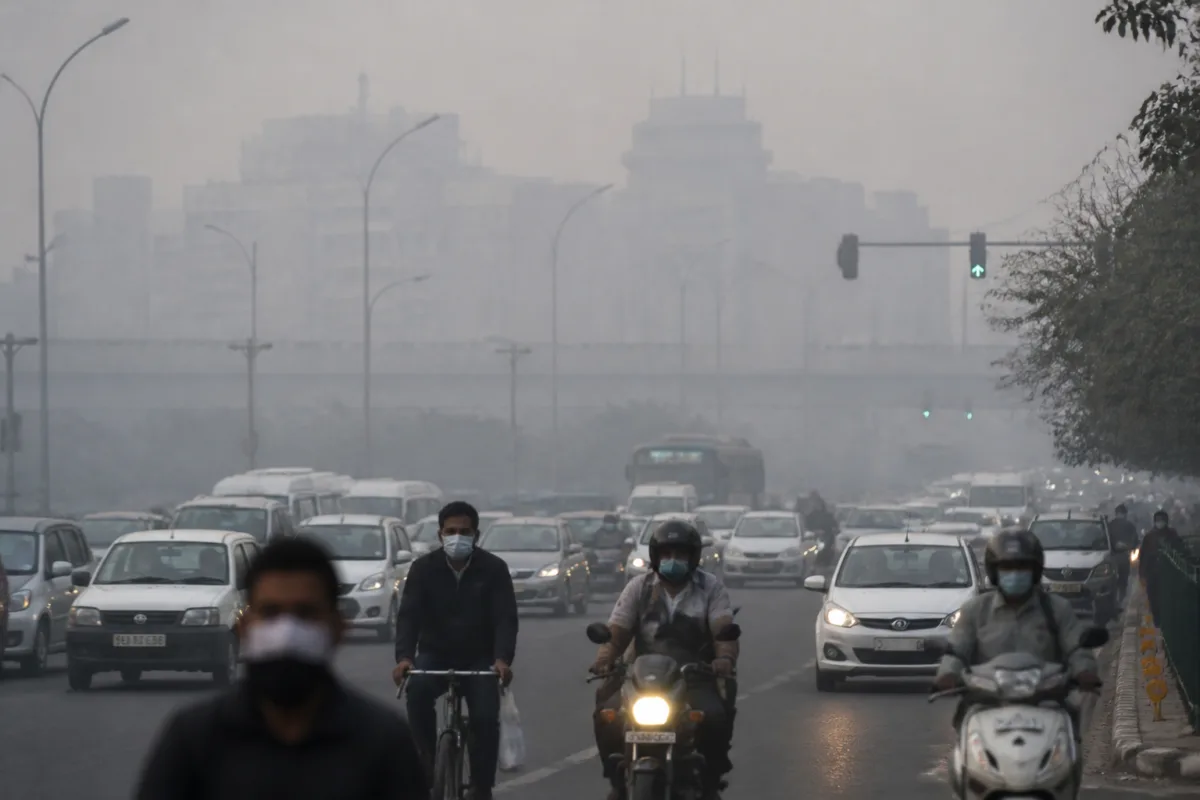
Delhi AQI rose to 350 on Tuesday, marking the capital’s worst average air quality in 287 days, while Jahangirpuri recorded an AQI of 462 as pollution intensified despite the implementation of GRAP-2 restrictions.
The city’s average AQI increased from 324 on Monday to 350 on Tuesday, according to the report by Jagran – New Delhi. Ten monitoring stations recorded air quality in the severe category, with Jahangirpuri registering the highest reading among the locations cited.
The increase came after light fog in the morning and sunshine during the day. The report said there was no significant change in weather conditions, but pollution levels continued to rise. The previous highest AQI recorded in Delhi this year was 378 on January 20.
The Air Quality Early Warning System forecast that Delhi’s air could remain in the very poor category through November 6. It also indicated that conditions could deteriorate further and enter the severe category after that period. Weather experts cited in the report similarly warned that pollution levels may increase in the coming days.
The rise follows the implementation of Stage II of the Graded Response Action Plan after Delhi’s air entered the very poor category on Monday. The further increase in AQI has placed attention on how effectively the restrictions are containing pollution across the capital and its surrounding urban region.
Data from the Decision Support System identified several source groups contributing to Delhi’s pollution, including stubble burning in neighbouring states, industries in and around Delhi, and thermal power plants in neighbouring states. The report also referred to contributions from districts around the National Capital Region, with Jhajjar recording the highest share among the districts mentioned. However, the supplied report did not provide the numerical shares for these sources.
The episode highlights the difficulty of managing Delhi’s air through short-term restrictions when pollution sources extend across administrative boundaries. Delhi’s monitoring stations capture local conditions, but the source categories cited in the report include transport-linked urban emissions, industrial activity, power generation and agricultural burning beyond the capital’s limits.
The immediate impact is being felt at street level, with motorists travelling through heavy smog near ITO and other parts of the city. The report also noted that the pace of dust-control measures remains a concern: a related update said only 40 of 200 planned anti-smog guns were ready, prompting a warning from the Delhi minister. The supplied report did not specify the operational status or coverage of the remaining equipment.
Authorities and forecasting systems will continue to track the AQI and weather conditions in the coming days. The next key marker is the early-warning forecast for November 6, after which Delhi’s air could move from very poor to severe conditions.

