


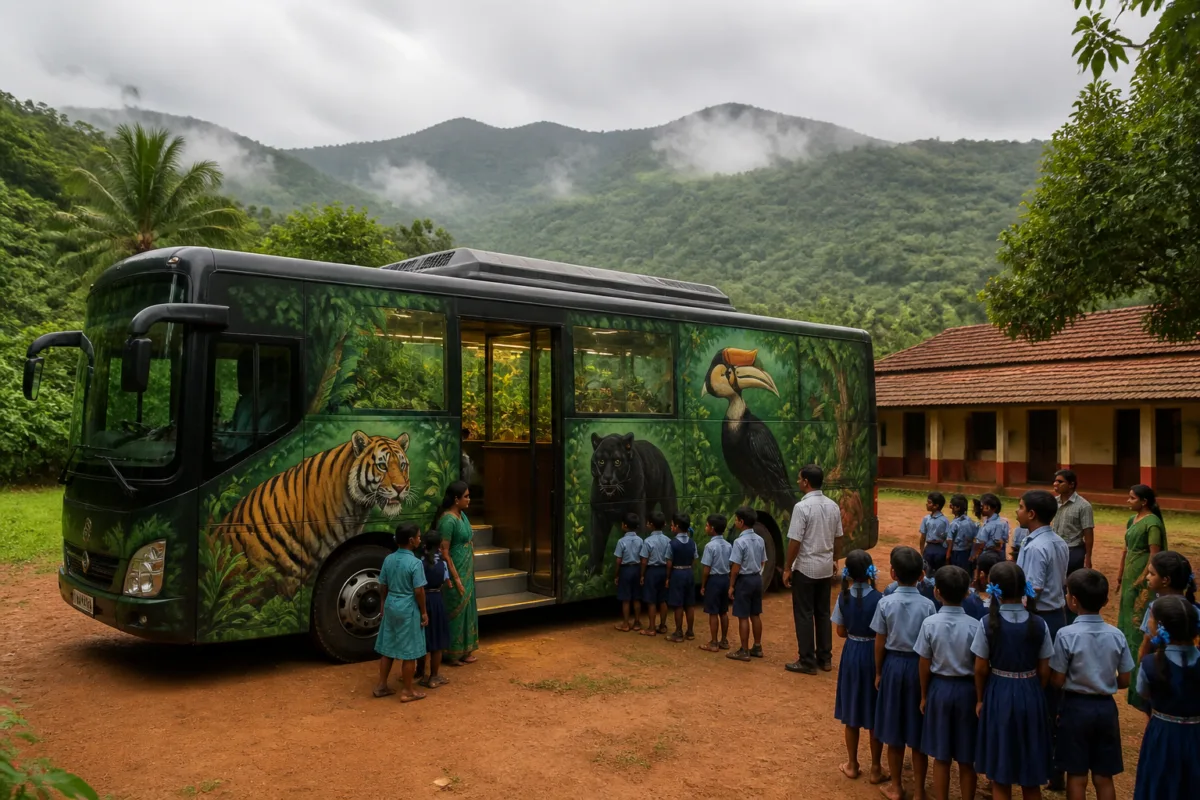
Karnataka’s proposed Western Ghats mobile museum is designed to take rainforest education beyond forest boundaries and into school campuses across all 31 districts. Called ‘Western Ghats on Wheels’, the project would convert a 15-metre multi-axle bus into an immersive biodiversity museum, combining living displays, augmented reality, holograms and live forest-camera feeds.
The proposal matters because access to ecological landscapes is uneven. A student living close to the Western Ghats may still have limited opportunity to enter a forest, while children in inland or rural districts may encounter the region mainly through textbooks and occasional awareness programmes. The Karnataka State Western Ghats Conservation Task Force says the mobile museum is intended particularly for rural schools and could reach millions of students who may not otherwise experience the biodiversity of the Ghats firsthand.
That makes the project more than a travelling exhibition. It is an attempt to use a transportable public institution to address a geographical problem: the ecosystems that require public understanding are not located where most classrooms are. Instead of expecting schools to organise visits to forests, the proposed model would move an educational facility between schools.
The task force has described the bus as a fully immersive mobile biodiversity museum. Its planned interior would be climate-controlled and include living terrariums, flowing waterfalls and representations of shola vegetation. These elements are intended to recreate aspects of the rainforest environment inside the vehicle rather than present biodiversity only through static panels or displays.
The proposal also relies heavily on digital interpretation. Three-dimensional holographic displays and augmented reality technology would be used to show endangered fauna found in the Western Ghats. Live camera feeds from forests are planned to give visitors views of biodiversity in its natural habitat. The project therefore combines physical simulation with remote observation: the first recreates selected environmental conditions, while the second connects students to locations they cannot directly visit.
The distinction is important for environmental education. A recreated rainforest cannot substitute for an actual ecosystem, and the proposal does not suggest that it can. Its stated purpose is to create awareness and make environmental education more inclusive. The use of live feeds could help preserve the link between the museum experience and functioning forests, provided the technology and camera network can be maintained after the vehicle is deployed.
The planned vehicle also illustrates the logistical challenge of taking a museum to remote schools. According to the task force, the 15-metre bus is being designed to navigate narrow ghat roads. That requirement places mobility at the centre of the project. The vehicle must be large enough to accommodate multiple exhibits and visitors, but sufficiently manoeuvrable to reach locations where road width, gradients and turning space may constrain movement.
The input material does not establish the final route plan, the number of schools to be covered, the duration of each stop or the operating agency that would manage school bookings and maintenance. These details will determine whether the museum becomes a regularly used education service or remains a high-profile demonstration vehicle. At present, the proposal establishes the intended geographic reach but not the operating calendar.
Energy use has been included in the design through a proposed 5.2 kW solar-panel system. The task force says the panels would power Internet of Things-based forest camera feeds. This is a specific renewable-energy component within a larger mobile facility, although the supplied information does not state the bus’s total electricity demand, battery-storage capacity or whether solar power would support other museum systems such as climate control, holographic equipment and augmented-reality installations.
That gap is relevant because the most technically ambitious features are also likely to be the most maintenance-sensitive. Terrariums, waterfalls, climate control, networked cameras and digital displays require regular servicing and operational oversight. The proposal identifies the components, but it does not yet provide a public cost estimate, maintenance framework or performance indicators. Without those details, it is not possible to assess the long-term viability of the museum from the announcement alone.
The institutional structure is also still taking shape. The concept has been developed by the Karnataka State Western Ghats Conservation Task Force. The task force’s chairperson, Tabrez Alam Shariff, said the initiative was envisioned under the guidance of Deputy Chief Minister D K Shivakumar, Forest Minister Ramalinga Reddy and Additional Chief Secretary for Forest, Environment and Ecology Anjum Parvez. The proposal therefore sits within the state’s forest and environment administration, while also depending on partnerships outside government.
Discussions are underway with Volvo Group India to provide the bus, according to Shariff. Once the vehicle is secured, the task force expects its interior and exterior transformation to take about six months through a corporate social responsibility partnership. This means the announced timeline begins only after a vehicle is obtained and a partnership arrangement is finalised. The source does not provide a launch date or confirm that the procurement has been completed.
The proposed CSR model raises a wider governance question about public environmental infrastructure. A mobile museum serving schools across a state would need continuity beyond its initial fabrication. Corporate support may help create the vehicle, but the source does not specify who would fund staffing, fuel, insurance, repairs, digital connectivity, exhibit renewal or accessibility over time. Those responsibilities will be central to whether the initiative can operate consistently across 31 districts.
The task force is pursuing the museum alongside other conservation and public-engagement proposals. These include declaring ancient Myristica swamp regions as eco-sensitive zones and biodiversity heritage sites, preparing what it describes as the first inter-state national policy for Western Ghats conservation, releasing an official anthem and developing a ‘Treasure Hunt Passbook’ initiative with UNESCO, WWF-India and India Post. The proposals cover different administrative and educational functions, from ecological protection to public participation.
Their grouping around the mobile museum suggests an effort to build public-facing conservation infrastructure rather than rely only on protected-area rules. However, the measures are at different stages and have different institutional requirements. A travelling museum can be designed and deployed through a vehicle partnership, while an eco-sensitive-zone declaration or biodiversity-heritage-site designation involves formal processes that are not detailed in the supplied material. The announcement does not establish that these parallel proposals have been approved.
The numbers attached to the museum give the concept a clear physical scale: one 15-metre vehicle, a proposed 5.2 kW solar installation and a planned journey across 31 districts. They also reveal what remains unquantified. There is no stated budget, visitor target, district-wise schedule, number of annual school visits or confirmed estimate of the student population to be reached. The task force refers to millions of students as the expected audience, but the source does not provide a methodology for that estimate.
This distinction between ambition and implementation is important. The project’s strongest promise is its ability to connect a conservation message to children who may be far from forest landscapes. Its principal test will be whether the experience is repeated, accessible and linked to credible ecological learning rather than treated as a one-time spectacle. The proposal’s technology can attract attention, but the educational value will depend on how exhibits are designed, how visits are integrated with schools and whether the forest feeds remain reliable.
The larger urban and regional question is how governments can make environmental knowledge part of everyday public infrastructure. The Western Ghats are geographically concentrated, but the institutions and communities affected by decisions about forests, water, land and biodiversity extend beyond the forest edge. A mobile museum offers one way to carry that conversation into places that fixed museums and protected-area visits may not reach.
For now, the evidence confirms a detailed state-level proposal, not an operational museum. Its next milestones are the securing of the bus, completion of the proposed six-month transformation and clarification of the partnerships, route, staffing and operating model. Those details will determine whether Western Ghats on Wheels becomes a durable conservation-education network or remains primarily an ambitious concept announced by the task force.

