


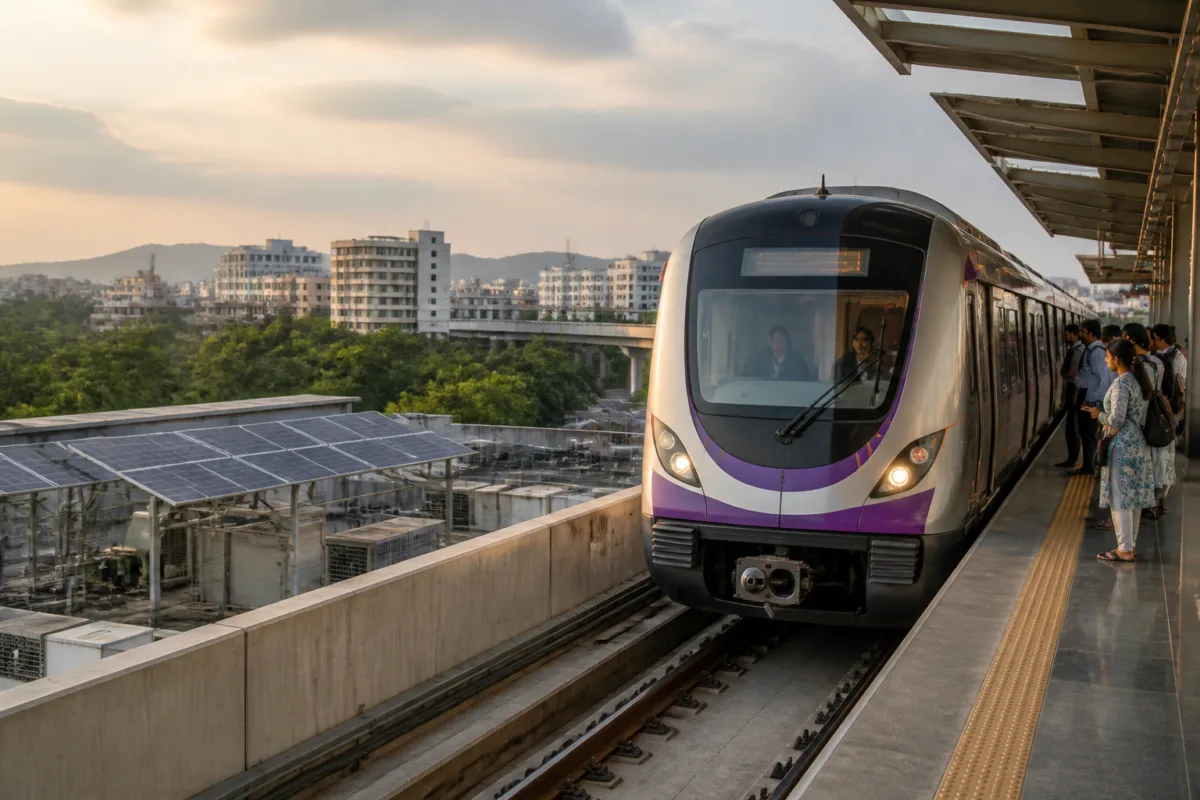
Pune Metro will generate 30% of its total energy needs internally, Maharashtra Chief Minister Devendra Fadnavis said during a programme that marked the inauguration and foundation-laying of different parts of the approximately Rs 21,800-crore metro project. The announcement places energy self-generation and network expansion at the centre of Pune’s next phase of urban transport development.
The programme was attended virtually by Prime Minister Narendra Modi, who inaugurated the project and launched the foundation-laying ceremony for various upcoming stages through video conferencing. Fadnavis said the metro was designed not only to reduce travel time for passengers but also to establish new benchmarks in several areas.
According to the announcement reported by Lokmat, the metro is being positioned as a green transport system because it will produce 30% of its overall energy by itself. The report does not specify the energy sources, the generation capacity, the locations of the proposed facilities or the timeline for reaching the target. Those details will be important for assessing how the plan will work alongside Pune Metro’s operational electricity requirements.
The existing operational network covers 23 kilometres and has 23 stations, the report said. The government plans to extend the system across all four sides of Pune, eventually taking the network to 120 kilometres. The foundation stone for four new corridors was laid during the programme, although the announcement did not provide their individual lengths, station counts, construction schedules or expected commissioning dates.
The expansion is intended to address Pune’s growing need for mass public transport while the city continues to face pressure from road traffic and longer daily commutes. Metro expansion can change travel patterns only when new corridors are connected to major residential areas, employment centres and other public transport services; the announcement, however, did not provide details of interchange planning, projected ridership or last-mile connectivity for the proposed routes.
Fadnavis also said the route would have 100 women pilots and that women would operate the entire route. Women are expected to account for 50% of the total staff, according to the report. The figures mark a workforce target for the system, but the announcement did not set out the recruitment process, staffing timeline or the operational roles covered by the broader staff calculation.
The chief minister said the project had overcome several technical and geographical difficulties. He added that some minor works remained and would be completed soon, after which the project’s quality could be discussed. The government also said it was committed to accelerating Pune’s overall development.
The next milestones are the completion of the remaining works on the current project and the development of the four newly inaugurated corridors. Further official details are awaited on the energy-generation plan, construction timelines, corridor alignment, station locations and the proposed route to a 120-kilometre Pune Metro network.

