


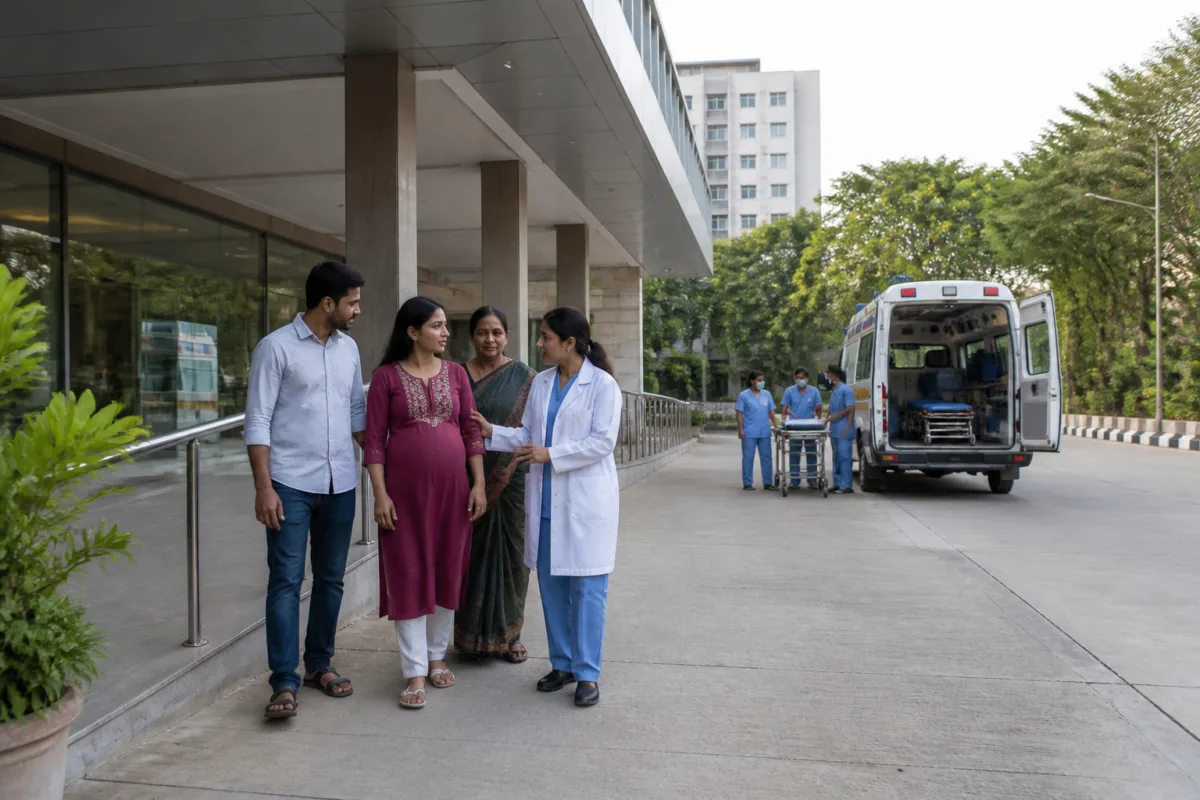
Karnataka’s plan to reduce its maternal mortality ratio below 70 is shifting the measure of success from hospital activity to whether women and newborns safely complete the journey home. That change, outlined by Additional Chief Secretary for Medical Education Mohammed Mohsin at the Times Future of Maternity Summit 2026 in Bengaluru, places emergency response, early risk detection and continuity of care at the centre of the state’s maternal-health challenge.
Mohsin said the number of antenatal-care visits or institutional deliveries alone cannot provide a complete picture of maternal health. The report cited India’s maternal mortality ratio at between 88 and 97 deaths per 100,000 live births, while Karnataka’s figure was placed at 73 under the Sample Registration System. The state’s immediate target is to bring that number below 70.
The difference between the current figure and the target is small in numerical terms, but the policy message is broader than a marginal improvement in a statistic. It suggests that Karnataka is treating maternal mortality as an outcome of an entire care pathway rather than as a problem that can be solved by increasing the number of hospital visits or deliveries recorded in official systems.
That pathway begins before pregnancy, continues through antenatal care and delivery, and extends into the post-partum period. According to the account of Mohsin’s remarks, conditions such as anaemia, hypertension, diabetes and obesity need to be identified and managed before they become complications. The emphasis is therefore on risk assessment and management, not merely on counting contact with the health system.
This distinction matters because complications can develop quickly even when pregnancy begins as a normal physiological process. Mohsin identified post-partum haemorrhage, hypertensive disorders of pregnancy, severe anaemia, sepsis, unsafe abortion and delays in emergency care among the risks requiring attention. He said several such cases can be detected earlier when women receive timely care.
The reference to delays is significant because a maternal-health system is not defined only by the quality of a single facility. It also depends on whether a complication is recognised in time, whether the patient is referred to the appropriate level of care, whether the referral is completed and whether emergency treatment is available when the woman reaches the facility. The remarks at the summit place each of these links within the state’s responsibility for reducing deaths.
The report also highlights a weakness in treating antenatal care as a series of hospital visits. Mohsin argued that antenatal care should be understood as a continuous process of risk evaluation and management. In that approach, a visit is not the final indicator of service delivery. Its value depends on whether it identifies a danger, triggers an appropriate response and keeps the woman connected to care through delivery and the period after childbirth.
The proposed framework described in the report is an expanded version of the Pradhan Mantri Surakshit Matritva Abhiyan, aimed at high-risk pregnancies. It screens women across 25 categories of risk, provides three antenatal check-ups by doctors for high-risk patients and tracks every woman by name for 45 days after delivery.
Those elements point to a more administrative understanding of maternal safety. Risk categories have to be recorded, high-risk women have to be identified, referrals have to be completed and follow-up has to continue after delivery. The reference to named tracking also indicates an effort to prevent women from disappearing between one stage of care and the next.
However, the supplied report does not establish how consistently each part of this framework is being implemented across Karnataka. It does not provide district-wise maternal mortality figures, referral completion rates, the number of high-risk pregnancies enrolled, emergency response times or details of staffing and facility capacity. These gaps matter because a policy can be clearly designed while its results remain uneven across locations and institutions.
The available figures nevertheless establish the scale of the state’s stated task. Karnataka’s reported maternal mortality ratio of 73 is already below the India figure cited in the report, which ranges from 88 to 97. The state now wants to move below 70. The target is not presented as an endpoint; rather, it is an immediate goal within a larger effort to ensure that mothers and newborns return home safely.
The choice of indicator is itself important. Hospital deliveries are an input or service-use measure. They can show whether women are reaching institutions, but they do not by themselves show whether complications were identified, whether emergency care was timely or whether the mother survived the post-partum period. Similarly, the number of antenatal visits can reveal contact with providers without demonstrating the quality or effectiveness of those interactions.
Mohsin’s formulation therefore moves the policy discussion towards outcome-based monitoring. The question is not only how many women entered the system, but what happened after they entered it. The report records his view that audits and reviews should not end with documentation. Findings should lead to corrective action, turning each preventable maternal death into a signal requiring institutional response.
This creates a governance obligation beyond the collection of statistics. A review must identify where the care pathway failed: detection, referral, transport, emergency treatment, post-operative care, post-partum monitoring or follow-up. The supplied account does not attribute specific failures to individual facilities or districts, and no such conclusions can be drawn from it. But it does establish that the state’s proposed measure of success requires officials to examine the pathway rather than rely on aggregate activity numbers.
The framework also makes the post-partum period part of maternal care rather than treating delivery as the conclusion of the public-health intervention. The proposed 45-day tracking period is important in that context. It recognises that the risks associated with childbirth do not necessarily end when a woman leaves the hospital and that follow-up must remain connected to the individual woman.
For urban areas such as Bengaluru, the issue raises questions about how a large and expanding healthcare network coordinates care. The event was held in the city, and the report identifies senior health officials and government representatives among those present. But it does not provide city-level data or distinguish between urban and rural outcomes. The available evidence therefore supports a statewide policy analysis, not a claim that Bengaluru has a particular maternal-mortality performance.
The institutional architecture described in the report involves the medical education department, the health system, doctors, hospitals and programmes for high-risk pregnancies. The effectiveness of the target will depend on how these responsibilities connect in practice. A woman identified as high-risk must receive more than a label in a record; the designation must result in additional clinical attention, completed referrals and access to emergency care when required.
The same principle applies to audits. An audit that records a death without changing procedures may improve documentation but not outcomes. Mohsin’s comments, as reported, call for reviews to result in corrective steps. That makes the quality of the feedback loop central: information must travel from an individual case to a facility review and then into changes in practice or system management.
The evidence in the report does not show whether Karnataka has already achieved improvements through this expanded approach. It provides the state’s current reported ratio, the national comparison cited by the speaker, the immediate target and the design of the high-risk monitoring framework. It does not include a time series, independent assessment or outcome data from the 25 risk categories.
That distinction is essential. A target below 70 is a policy commitment, not an achieved result. The framework of three doctor-led antenatal check-ups for high-risk women and 45 days of post-delivery tracking is an operational description, not proof that every eligible woman receives those services. The next meaningful evidence will be whether these processes produce measurable reductions in preventable deaths and whether the gains are consistent across the state.
Karnataka’s maternal-mortality discussion consequently points to a wider urban-governance question: whether public systems measure activity or outcomes. Counts of visits, admissions and deliveries are easier to compile, but the safety of a mother depends on a chain of decisions and services that extends beyond any single count. The state’s own stated goal now places that chain at the centre of evaluation.
What the report confirms is that Karnataka wants to reduce its reported maternal mortality ratio from 73 to below 70 and is focusing on early detection, high-risk pregnancy monitoring, emergency care and post-partum follow-up. What remains unestablished in the supplied material is how the approach is performing across districts and whether the proposed corrective mechanisms are reducing deaths. Those implementation outcomes will determine whether the shift from counting services to measuring safe returns home becomes a meaningful change in maternal-care governance.

