


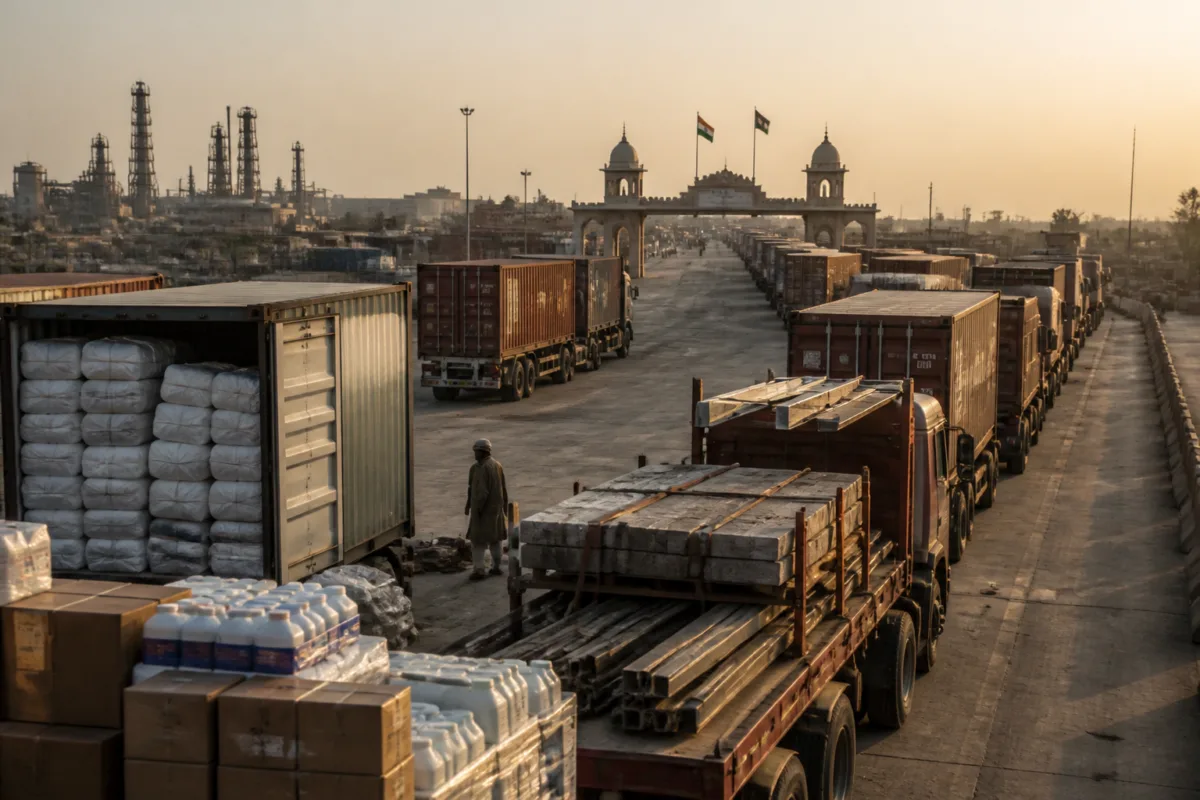
Pakistan’s business community is calling for the restoration of trade with India after years of disrupted commercial ties, arguing that the suspension has increased import costs, lengthened delivery times and placed additional pressure on industries ranging from pharmaceuticals to textiles. A report by Aaj Tak Business, citing PTI and Pakistan business representatives, says the country has suffered an estimated $40 billion economic loss since bilateral trade was halted in 2019.
The figure comes from a business advocacy group associated with the Pakistan-India Business Council and is presented as an estimate of the economic damage caused by the prolonged trade interruption. It is not described in the supplied report as an official government calculation. That distinction matters because the estimate combines the effects of higher sourcing costs, supply-chain delays and reduced access to nearby industrial inputs rather than identifying a single fiscal loss.
The immediate issue is geographical. India and Pakistan share a border, but the suspension of commercial ties has pushed Pakistani companies towards suppliers in more distant markets. According to Noor Mohammad Kasuri, chairman of the council cited in the report, businesses are now procuring essential raw materials and industrial products from countries farther away. That has increased freight costs and extended delivery timelines.
For manufacturers, distance is not simply a logistics concern. It directly affects the cost at which medicines, textiles, agricultural products, fuels and manufactured goods can be produced. When a nearby supplier is replaced by a distant one, companies may face higher transport bills, longer lead times and greater uncertainty in maintaining inventory. The Pakistan business representatives cited in the report argue that these pressures are now feeding into the wider cost structure of domestic industry.
Pharmaceuticals are one of the sectors highlighted in the report. Kasuri said Pakistani drug companies could save about $3 billion annually if access to Indian raw materials were restored. The claim is linked to the availability of Indian inputs and the potential reduction in production costs. The report does not specify the precise products covered by this estimate or provide a separate methodology for calculating the proposed savings.
The underlying supply-chain argument is straightforward: pharmaceutical production depends on reliable access to raw materials, and sourcing from geographically closer markets can reduce both transport expenses and delivery time. Pakistani business representatives say that reopening access to Indian inputs would help companies improve production efficiency. Whether that could happen would depend on the scope of any policy change, the products permitted for trade and the financial and regulatory terms attached to such commerce.
Textiles face a different but related pressure. Pakistan’s textile sector has reportedly incurred an additional $5 billion in costs after sourcing cotton from Brazil, Egypt, China and the United States. Kasuri linked the extra burden to a fall in domestic cotton production and increased dependence on imports. The calculation, as presented in the report, is an estimate from the business council rather than a government audit.
The textile example shows how the effects of a trade barrier can extend beyond the direct import of finished goods. Cotton is a basic industrial input, so a change in sourcing affects mills before fabric or garments reach the market. Higher fibre costs can place pressure on production margins, export competitiveness and the financial condition of mills. The supplied report does not provide comparative figures for production, exports or employment, but it identifies imported cotton as a significant cost concern for the sector.
The list of affected products is wider than pharmaceuticals and textiles. Pakistani industry representatives cited sugar, fertiliser, cement, petroleum products, iron and steel, vegetables and heavy machinery as goods that Pakistan is importing from distant markets despite India’s production capacity and geographical proximity. These products span essential consumption, agriculture, construction, energy and industrial activity.
That range gives the dispute an urban and infrastructure dimension. Cement, steel and heavy machinery are inputs into construction and industrial expansion. Fertiliser and agricultural products influence food supply chains, while petroleum products affect transport and commercial distribution. The report does not establish that all these goods are currently unavailable from alternative suppliers. Its argument is that sourcing them from farther away can raise the cost and time involved in moving them into Pakistan.
Petroleum is used as a specific example. Kasuri said Indian refineries are closer to Pakistan than several existing international suppliers, potentially allowing faster and cheaper deliveries. This is a claim made by the business council, not an announced arrangement between the two governments. It illustrates how the location of production infrastructure can influence the commercial consequences of a political decision.
The institutional question is therefore not only whether trade should resume, but how commercial access would be structured. Any restoration of trade would involve decisions on permitted commodities, customs procedures, transport routes, payments, regulatory approvals and the treatment of politically sensitive goods. The supplied report records a demand from Pakistan’s business community for broad economic cooperation, but it does not report a government decision to reopen trade or set out an implementation timetable.
This gap between business demand and state policy is central to the story. The Pakistan business community is presenting renewed trade as an economic response to rising costs and industrial pressure. The report does not say that the Shehbaz Sharif government has accepted the proposal. Nor does it provide a statement from India’s government, Indian industry bodies or regulators on the prospect of renewed commercial ties.
The trade suspension followed the Pulwama terror attack and the subsequent deterioration in relations between the two countries, according to the report. That means the commercial question remains closely linked to the wider bilateral relationship. For businesses, the economic cost is measured through freight, inputs and delivery times. For governments, trade policy is part of a broader framework involving security and diplomatic considerations. The supplied evidence does not establish how those considerations are currently being weighed.
The $40 billion estimate should consequently be read as an industry-backed assessment of accumulated economic damage, not as a complete national accounts measure. Its significance lies in the sectors and cost channels it identifies: distant sourcing, higher freight, longer delivery schedules, imported cotton, pharmaceutical inputs and essential industrial goods. Together, these factors show how the interruption of neighbouring trade can affect production systems well beyond customs revenue or the value of recorded bilateral commerce.
The report establishes that Pakistani business representatives are seeking renewed India trade and have put specific figures on the costs they associate with the current arrangement. It does not establish that trade will resume, that the estimated savings will materialise or that the two governments have reached an agreement. The developments to monitor are any official policy announcement, a change in permitted import categories and formal responses from the governments and industry bodies on both sides.

