


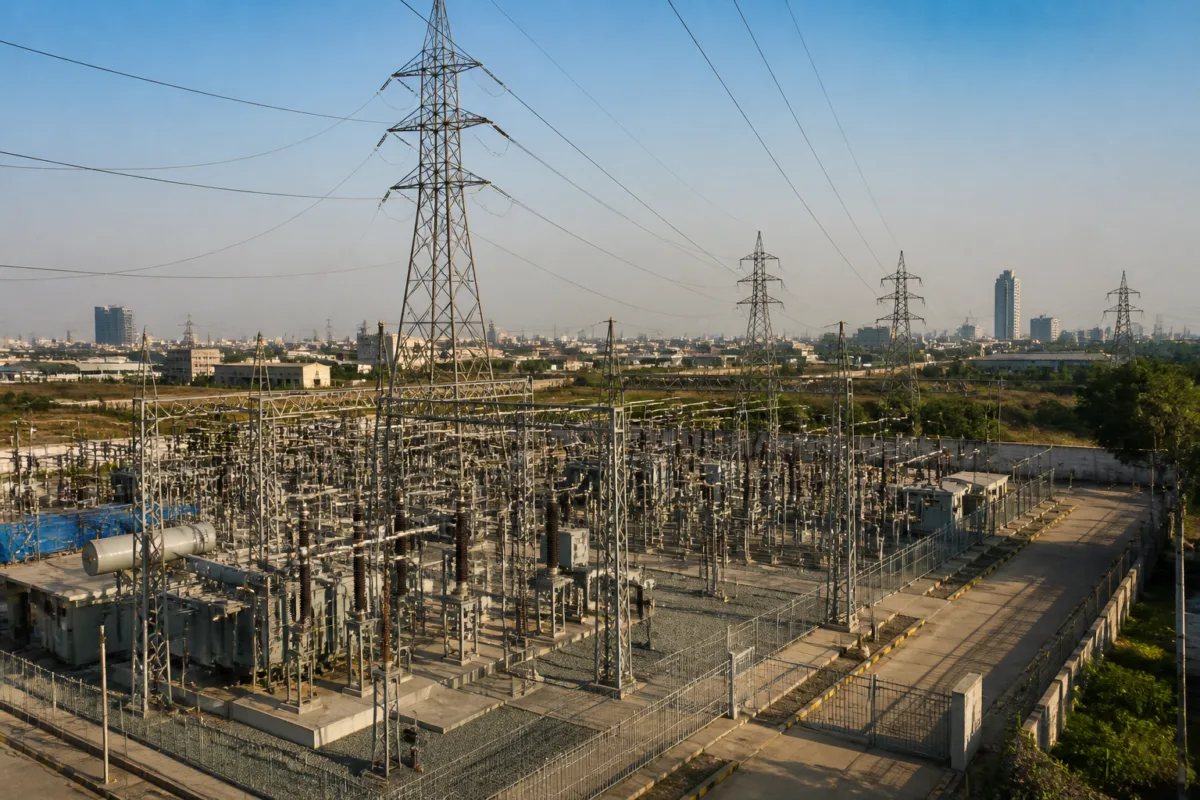
Rajesh Power Services’ 34% rise in net profit in the September quarter is more than a company earnings update. It offers a view into the infrastructure workload building beneath India’s power transition: substations, extra-high-voltage cables, transmission lines and distribution networks that must connect rising demand with new generation. The company’s reported performance also shows how contractors are positioned between policy ambition and the physical execution of electricity infrastructure.
The power transmission and distribution contractor reported net profit of ₹79 crore for the September quarter, compared with ₹59 crore in the corresponding period, according to The Hindu BusinessLine. Revenue rose to ₹929 crore from ₹638 crore. The company also reported an unexecuted order book of ₹3,647 crore at the end of September and said it had executed projects worth ₹929 crore in the first half of the fiscal year.
Those numbers matter because the transmission and distribution system is where broad energy goals become visible infrastructure. Renewable-energy targets, higher peak demand and the expansion of inter-state and intra-state networks require equipment and construction work at multiple levels. At the city and industrial-cluster level, that can include substations, underground cabling and distribution upgrades. At the regional level, it includes transmission lines and higher-capacity networks that move electricity from generating areas to demand centres.
The company’s results therefore sit within a wider investment cycle that its chairman and managing director, Kurang Panchal, described as a “once-in-a-generation investment cycle”. Panchal attributed the reported growth to on-time execution across GIS and AIS substations, EHV cable, transmission line and distribution projects. GIS refers to gas-insulated switchgear, while AIS refers to air-insulated switchgear; both are used in substation systems, although the source does not provide a project-wise breakdown of the company’s revenue or margins from these segments.
The distinction between an order book and executed work is important. The ₹3,647-crore unexecuted order book represents work that the company says remains to be delivered, while the ₹929 crore executed in the first half indicates the value of projects completed or carried out during that period. Together, the figures point to a significant pipeline, but they do not establish how quickly the remaining orders will convert into revenue, what their profitability will be, or whether execution will face delays. Those outcomes depend on project schedules, approvals, equipment availability, land and right-of-way conditions, utility coordination and payment cycles, none of which are detailed in the supplied report.
The urban infrastructure connection is clearest in distribution modernisation. Panchal said demand is being supported by the Revamped Distribution Sector Scheme, grid modernisation, underground cabling in cities, and the growth of data centres and industrial corridors. These are different forms of electricity demand and network pressure, but they converge on the need for more reliable and higher-capacity distribution assets.
Underground cabling is particularly significant in dense urban areas. It can reduce the exposure of power lines to weather and physical damage and can help manage constrained streetscapes, although the source does not quantify reliability improvements or compare underground and overhead systems. It is also a more coordination-intensive form of construction: utilities must work around roads, buildings and existing services, while municipal agencies and electricity distributors must manage access, traffic and reinstatement. The company’s reference to urban underground cabling indicates where distribution work intersects directly with the built environment, even though no city-specific project details were disclosed.
The same network requirements are emerging around data centres and industrial corridors. These facilities depend on dependable, high-capacity electricity connections, but the supplied report does not state the value of that market for Rajesh Power Services or identify specific customers. What can be established is that the company sees these segments as demand drivers for GIS substations and EHV cabling, areas in which it says it has domain expertise and an established track record.
The policy landscape described by the company combines national planning with distribution-level programmes. Panchal cited the National Electricity Plan and Green Energy Corridor Phase III as part of the expansion of inter-state and intra-state transmission networks. He also referred to the Revamped Distribution Sector Scheme and grid modernisation. These references place the contractor’s work within a layered institutional structure: transmission expansion operates across broader regional networks, while distribution upgrades are implemented closer to states, utilities, cities and consumers.
The source does not provide details on the specific contracts, tenders, funding allocations or utility agencies associated with the order book. It also does not specify how much of the reported revenue came from public-sector utilities, private customers, renewable projects, urban distribution or industrial users. That information would be necessary to assess the company’s exposure to individual states, customer groups or policy programmes more precisely.
The geographic spread cited by the company is nevertheless relevant. Rajesh Power Services said it has relationships with state utilities and a growing presence across Gujarat, Rajasthan, Uttarakhand, Maharashtra, Madhya Pradesh and Odisha. This spread covers states with different generation profiles, industrial bases, terrain and network requirements. It may reduce dependence on a single geography, but the supplied material does not provide a revenue split or order-book distribution by state, so the extent of that diversification cannot be measured.
The company’s first-half execution figure also provides a useful operational signal. Revenue of ₹929 crore in the first half is equal to the full value of the revenue figure reported for the September quarter only if the quarter and half-year figures are being described on the same basis, but the source wording is not sufficiently detailed to establish the exact comparison period or accounting presentation. The report clearly states that the company executed projects worth ₹929 crore in the first half and separately reports September-quarter revenue of ₹929 crore against ₹638 crore. These figures should therefore not be treated as interchangeable without the company’s financial filing or results statement.
What the results do establish is a combination of current execution and future committed work. Profit growth indicates that the company reported stronger earnings alongside higher revenue, while the order book provides visibility into projects yet to be executed. The critical institutional question is whether India’s planned power-system expansion can be delivered at the pace implied by demand growth, renewable integration and industrial development. Contractors are a key part of that delivery chain, but their performance is also dependent on the decisions and capacity of utilities, regulators, suppliers and local administrations.
For cities, the implications extend beyond the availability of electricity. Distribution infrastructure affects the functioning of housing, commercial buildings, transport systems, hospitals, data facilities and manufacturing areas. Network upgrades may require road excavation, substation land, cable corridors and coordination with other utilities. The source does not report the citizen-level effects of any specific Rajesh Power Services project, but its emphasis on urban cabling shows how power infrastructure increasingly forms part of everyday city construction and maintenance.
The company’s stated expansion plans are to enter new geographies, bid for larger projects and invest in people, technology and execution capability. Panchal said the company was confident of sustained profitable growth in FY27 and beyond, but that is a management outlook rather than an independently established outcome. The reported order book supports visibility, not a guarantee of future performance.
The broader evidence is therefore mixed but significant. Rajesh Power Services has reported stronger quarterly profit, higher revenue, first-half execution worth ₹929 crore and an unexecuted order book of ₹3,647 crore. Its own explanation links the performance to project execution and to demand from transmission expansion, distribution reform, urban cabling, data centres and industrial corridors. What remains unclear from the available information is the composition, duration and profitability of the order book, as well as the measurable impact of the company’s projects on urban reliability and service quality. Those details will determine whether the current construction pipeline becomes durable infrastructure capacity rather than only a temporary surge in contracting activity.

