


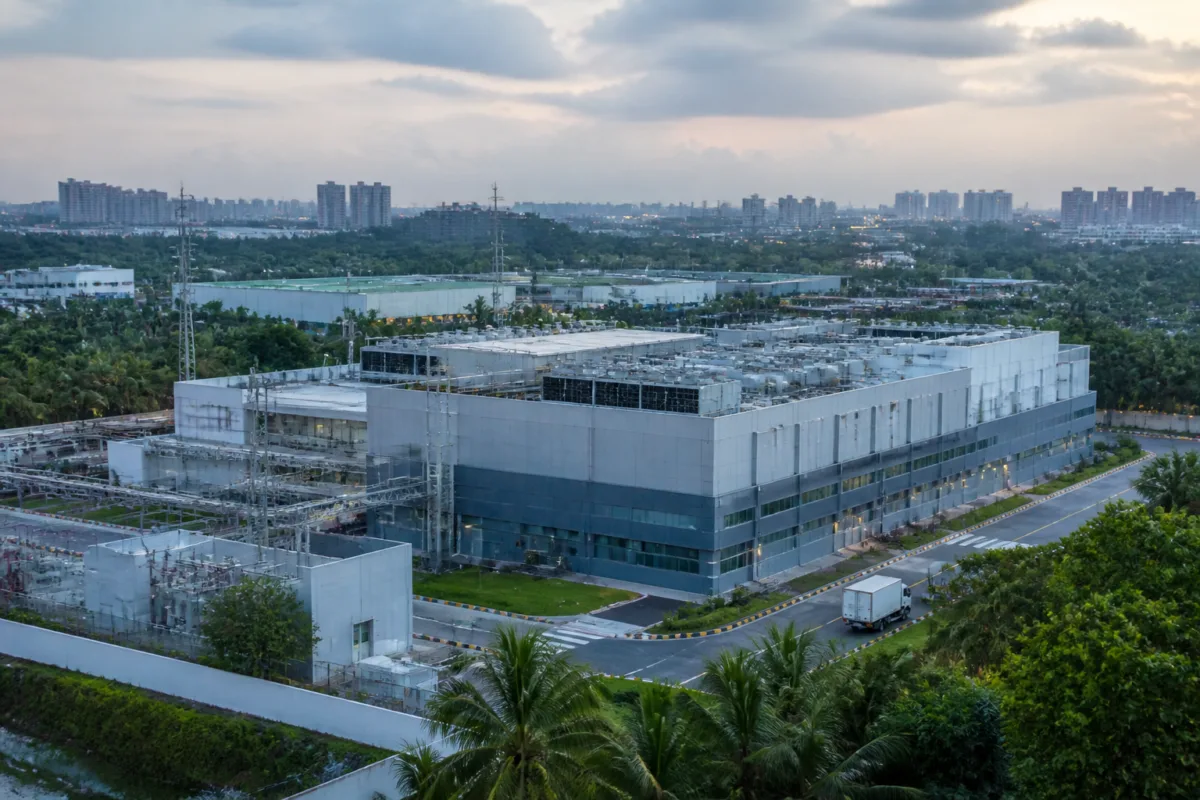
Vultr’s plan to build 1 GW of AI compute capacity in India by 2029 places Chennai at the starting point of a national data-centre expansion that could reshape how startups and enterprises access computing power. The US-based cloud infrastructure provider plans to operationalise a 20 MW AI cluster in a Chennai data centre by March 2027, then expand its Indian capacity to 600 MW by 2028 and 1 GW by 2029.
The scale is important because the company is not presenting the Chennai cluster as a standalone facility. It is the first stated stage of a multi-location capacity programme. Vultr is scouting and evaluating sites across India, according to Kevin Cochrane, the company’s chief marketing officer. That approach links the announcement to a wider infrastructure question: whether AI computing in India will be concentrated in a few established technology centres or distributed across multiple locations with access to suitable data-centre facilities and enterprise demand.
The information supplied by Vultr does not specify the other locations, the total investment, the power requirement, the data-centre operators involved or the delivery model for the planned capacity. Those omissions matter because a gigawatt-scale target is not simply a software expansion. It depends on physical facilities, high-density computing equipment, power availability, cooling systems, network connectivity and the ability to bring capacity online in stages. The company has disclosed the capacity milestones, but not the infrastructure arrangements behind them.
What is clear is the sequence. Chennai is expected to host a 20 MW cluster by March 2027. The company then aims to reach 600 MW across India by 2028, before adding capacity to reach 1 GW in 2029. The difference between the initial Chennai cluster and the later national target indicates that the proposed expansion will rely on more than one site. It also means that the first milestone will provide an early test of Vultr’s ability to secure facilities and serve AI workloads at the scale it has described.
Vultr says the capacity will serve enterprises and startups running training and inference workloads. Training involves developing or refining AI models, while inference refers to running those models for users and applications. The company’s stated customer base therefore covers both organisations building AI systems and those deploying them in operational settings. That distinction is relevant to infrastructure planning because demand is not limited to one kind of user or one phase of the AI development cycle.
Cochrane said demand is growing from enterprises, including global majors operating in India. He linked Vultr’s initial decision to invest in the country to the presence of a large share of global enterprise platform engineers, cloud-native architects and developers. He also described India as a primary centre for engineers building and deploying open-source AI models and agentic systems for global use.
These comments present India not merely as a market where cloud services are consumed, but as a location where AI systems are designed, built and deployed for users beyond the country. That distinction is central to the proposed infrastructure strategy. If engineering and development teams are based in India, cloud capacity located closer to them can become part of the working environment in which models and applications are created. However, the supplied report does not provide independent demand figures or a forecast of how much capacity Indian enterprises and startups currently require.
The company has also made an affordability claim. Piyush Gupta, Vultr’s vice-president for India, Asia-Pacific and the Middle East, said the provider offers cloud infrastructure at costs 50% to 90% lower than traditional hyperscalers. According to Gupta, the savings can allow startups and enterprises to redirect money towards hiring and expanding workloads. This is a company assertion rather than an independently documented comparison in the supplied material, so its relevance lies in the commercial proposition Vultr is putting forward: access to AI computing at a lower stated price.
That proposition connects infrastructure capacity with the economics of innovation. AI workloads can require substantial computing resources, and cloud pricing affects whether a startup can experiment, train models, move a product into operation or scale an existing service. Vultr’s plan is therefore aimed at both physical expansion and market positioning. The company is using capacity, location and pricing as linked arguments for why Indian enterprises and startups should use its infrastructure.
The agreement with StartupTN adds a state-level institutional dimension to the expansion. Vultr has signed a memorandum of understanding with the organisation to extend up to $45,000 worth of cloud computing credits and preferential pricing to eligible startups across Tamil Nadu. The arrangement is not described as a direct public subsidy or a construction commitment. It is an access mechanism intended to reduce the initial computing cost for selected startups.
The StartupTN agreement also gives the Chennai announcement a broader ecosystem angle. The proposed 20 MW cluster is the physical infrastructure component, while the cloud credits and preferential pricing are the user-access component. One determines where computing capacity is hosted; the other seeks to influence who can use it. The supplied information does not state how many startups will be eligible, how the credits will be allocated, how long the benefit will last or how outcomes will be measured.
That distinction is important for assessing the likely urban and institutional impact. A data-centre cluster can bring demand for power, connectivity, equipment and specialised operations, but the report does not provide employment projections, local procurement estimates or land-use details. Similarly, the StartupTN memorandum may widen access to cloud services, but the available information does not establish how many companies will receive support or whether the programme will translate into long-term capacity usage.
The announced milestones also reveal the difference between a headline target and an implementation pathway. Vultr has provided a date for the first Chennai cluster and year-based targets for the national expansion. It has not yet disclosed the sites that will host the later capacity, the construction or commissioning schedule for those sites, or the approvals required. The company is still scouting and evaluating locations, which means the 2028 and 2029 milestones remain dependent on future site decisions and execution.
For Chennai, the immediate significance is that the city is identified as the first location in the plan rather than simply one of several possible sites. The 20 MW cluster gives the city an early role in Vultr’s India strategy. At the same time, the size of the initial cluster compared with the eventual 1 GW target shows that Chennai alone is not being presented as the destination for the entire expansion. The city is a starting node in a proposed national network.
The larger urban question is how India will accommodate computing infrastructure whose physical footprint is less visible than roads, housing or transit but whose operations depend on the same urban systems. Vultr’s announcement identifies the capacity ambition and the first location, but it does not yet establish the power, water, land, connectivity or regulatory requirements associated with the programme. Those details will determine how the expansion interacts with cities and regions.
The evidence currently confirms a 20 MW Chennai cluster targeted for March 2027, a proposed 600 MW Indian capacity by 2028 and a 1 GW target by 2029. It also confirms a startup-access agreement with StartupTN and company claims about demand and pricing. What remains unsettled is where the later facilities will be built, how the capacity will be financed and powered, and how many enterprises and startups will ultimately use it. The next material milestones are the identification of additional sites and the operationalisation of the Chennai cluster.

