


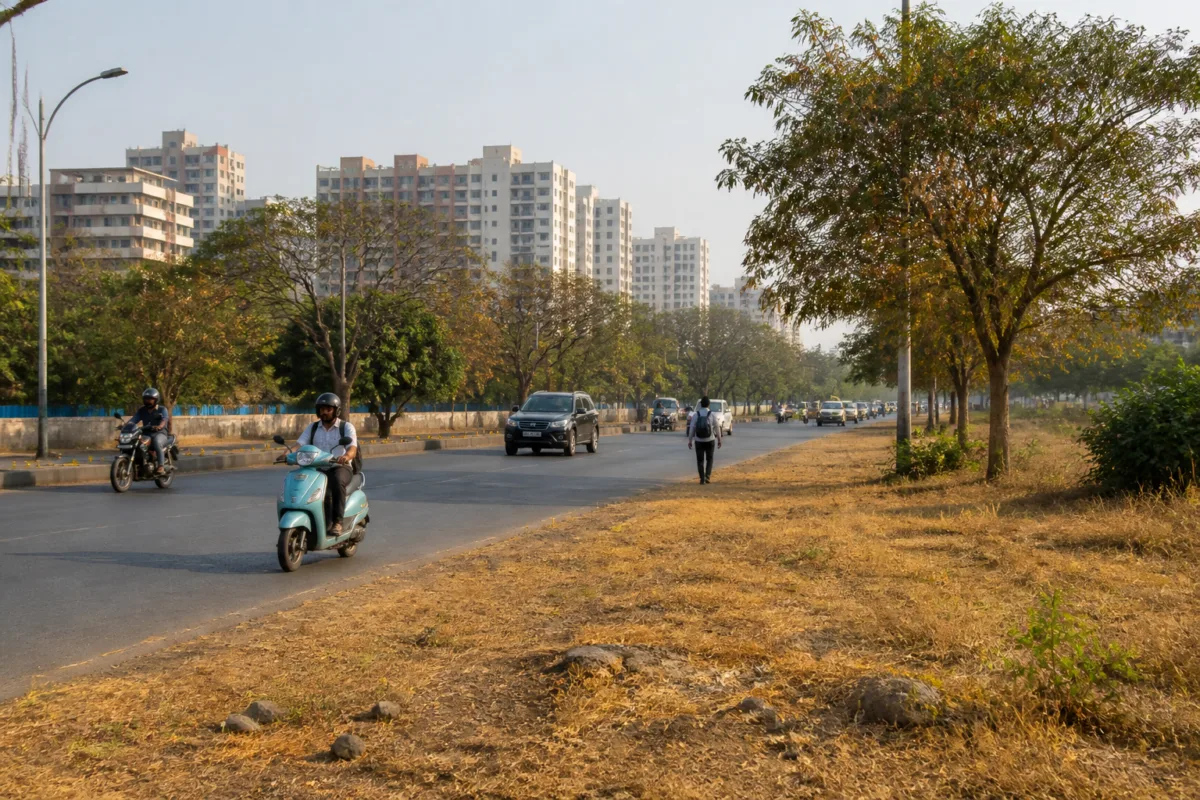
Pune weather took an unusually dry turn in October 2026, when the city recorded only 1.7 mm of rain at the Shivajinagar observatory. The figure was the lowest October rainfall recorded in the city in 11 years, according to data cited from the India Meteorological Department (IMD). The immediate result was a month dominated by dry conditions and rising temperatures, but the larger urban significance lies in what a weak retreating monsoon can mean for soil moisture, heat conditions and the way a growing city manages water between rainy seasons.
October is normally a transition month for Pune. The southwest monsoon has begun withdrawing, but the city can still receive light to moderate showers. In 2026, however, rain was recorded on only two days: 1.4 mm on October 1 and 0.3 mm on October 30. For the rest of the month, the city experienced no substantial rainfall, according to the report. This was not merely a day-to-day weather variation. It placed the month at the bottom of the available 11-year October record cited in the report.
The contrast with recent years is significant. Pune received 18.6 mm in October 2023, 61.2 mm in October 2024 and 67.3 mm in October 2025. Even the 2023 figure, previously described as the lowest in the 11-year comparison, was more than ten times the 2026 total. At the other end of the range, the city recorded 313.3 mm in October 2020 and 303.5 mm in October 2022. The sequence shows how sharply October rainfall can vary, but it also establishes the exceptional nature of the 2026 reading within the figures supplied by the report.
The longer series cited in the report begins with 76.7 mm in 2015 and 80.4 mm in 2016. Rainfall rose to 180.9 mm in 2017, declined to 36.1 mm in 2018 and then increased to 235 mm in 2019. The city recorded 313.3 mm in 2020, 140.2 mm in 2021 and 303.5 mm in 2022. Rainfall then fell to 18.6 mm in 2023 before reaching 61.2 mm in 2024, 67.3 mm in 2025 and 1.7 mm in 2026. There is no steady upward or downward trend in this short series. Instead, it points to a highly variable October rainfall regime, with very wet years and exceptionally dry years occurring within the same period.
That variability matters because urban systems are designed and operated around more than annual rainfall totals. The timing of rain affects soil moisture, local cooling, stormwater movement, groundwater recharge and the demand placed on piped water supplies. Rain that arrives in concentrated spells can create drainage pressure without necessarily providing evenly distributed moisture. Conversely, a dry October can leave the urban landscape hotter and drier after the main monsoon has ended. The supplied report does not establish how Pune’s reservoirs, groundwater levels or municipal water demand responded in 2026, but it does establish the weather condition that makes those questions important.
IMD Pune scientist S. D. Sanap attributed the dry conditions across much of the state to the retreating monsoon not occurring as expected. According to the statement quoted in the report, the absence of rain reduced moisture in the soil and contributed to maximum daytime and minimum nighttime temperatures being recorded above average. The statement also said that some parts of the Konkan coast experienced heatwave-like conditions. These observations connect Pune’s rainfall deficit with two linked urban concerns: declining moisture availability and increased thermal stress.
For residents, the effect of a dry October is experienced at street level rather than only in a rainfall table. Dry surfaces can increase dust, while higher daytime temperatures can make paved areas and buildings retain more heat. Reduced soil moisture can also affect trees, gardens and other planted spaces, particularly where they depend on rainfall rather than regular irrigation. The report does not provide measurements of dust levels, tree stress or neighbourhood-level temperatures, so those impacts cannot be quantified from the supplied evidence. What the data does show is that the atmospheric and ground conditions associated with those risks were present.
Pune’s institutional response to such a month is spread across several urban functions. Weather monitoring is provided by the IMD, while water supply, local roads, drainage, public spaces and municipal services fall within the responsibilities of urban authorities. The report identifies the IMD’s Shivajinagar observatory as the source of the city rainfall measurement and quotes an IMD scientist on the wider weather pattern. It does not report a new municipal water advisory, emergency measure or change in supply operations. That absence is important: the rainfall record describes a condition, but it does not by itself establish how city agencies acted or whether residents faced supply restrictions.
The figures also caution against treating one wet or dry month as a complete account of Pune’s water security. October rainfall is only one part of the annual hydrological picture. The supplied material does not include the year’s cumulative rainfall, reservoir storage, river flows, groundwater readings or water consumption. It therefore cannot establish whether Pune entered the post-monsoon period with a shortage, or whether earlier rainfall compensated for the October deficit. The available evidence supports a narrower but still consequential conclusion: the city experienced an unusually dry October, accompanied by warmer conditions and lower soil moisture.
The data’s strongest message is the gap between rainfall variability and the assumptions built into urban planning. In the 12-year table provided, October rainfall ranges from 1.7 mm to 313.3 mm. That is a difference of more than 300 mm between the driest and wettest entries. Such variation makes a single average less useful for understanding operational risk. A city that plans only for a typical October may be poorly prepared for both extremes: intense rain in a wet year and prolonged dryness in a year such as 2026.
This is especially relevant to the transition between monsoon management and summer preparedness. A wet October can prolong surface moisture and delay the onset of hotter, drier conditions. A dry October accelerates that transition. The report says temperatures increased as the rain stayed away and that both daytime maximum and nighttime minimum temperatures were above average. It does not provide the exact temperature readings or compare them with a defined long-term normal, so the scale of the increase cannot be assessed here. Nevertheless, the direction of the change has administrative implications for water planning, public-space maintenance and heat-risk monitoring.
The evidence also highlights the limits of citywide rainfall measurements. The 1.7 mm figure comes from the Shivajinagar observatory and is used to describe Pune’s rainfall. Rainfall can differ across an expanding metropolitan area, especially between built-up neighbourhoods and peripheral zones. The article supplies no additional station data, so it cannot show whether all parts of Pune received the same amount. For governance, that distinction matters because water demand, vegetation cover, construction activity and heat exposure are not evenly distributed across the city.
A dry month also raises a structural question about how Pune links weather information with urban decisions. The report provides the meteorological diagnosis but not the next administrative layer: whether authorities reviewed local water availability, adjusted irrigation of public landscapes, monitored heat impacts or communicated conservation measures. Those actions may or may not have occurred, but they are not documented in the supplied material. The gap does not weaken the rainfall finding; it shows that weather reporting and urban-service reporting often remain separate even when the consequences overlap.
Pune’s October record therefore deserves to be read as more than a seasonal curiosity. The city has moved from a month with rainfall measured in hundreds of millimetres in some recent years to just 1.7 mm in 2026. The supplied data does not prove a long-term climate trend, and it does not permit conclusions about the causes of year-to-year variation beyond the IMD explanation concerning the retreating monsoon. It does, however, demonstrate that urban systems must operate amid substantial rainfall uncertainty.
What is confirmed is clear: October 2026 was Pune’s driest October in the 11-year comparison cited, with rain limited to two recorded days; soil moisture declined; and temperatures rose, according to the IMD scientist quoted by the report. What remains unestablished in the available material is the effect on reservoirs, groundwater, municipal supply, agriculture around the city and neighbourhood-level heat exposure. Those indicators, along with rainfall in the months that follow, will determine whether the dry October remains an isolated weather event or becomes part of a wider water and heat-management challenge for Pune.

