


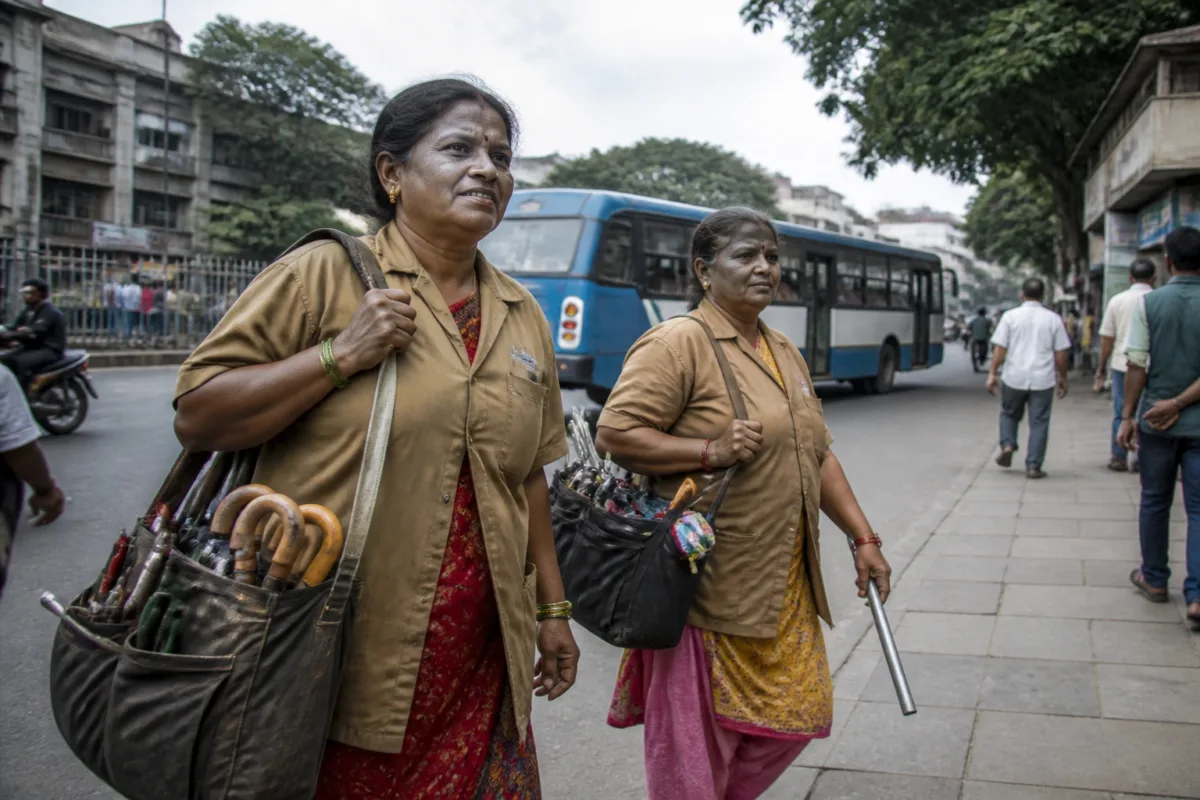
Umbrella repair in Bengaluru is being sustained by two sisters who travel across the city by bus, carrying tools, spare parts and a trade that is increasingly difficult to pass on. Their work offers more than a human-interest story: it shows how informal services help urban households extend the life of products, how family skills are transmitted, and why some forms of livelihood disappear even when customers still exist.
Selvi, 52, and Amaravathi, 60, leave their home in Jayanagar at 7am and travel towards areas including Shivajinagar, Koramangala and Ulsoor. They use BMTC buses, walk through neighbourhoods and advertise their services through a pre-recorded audio message. Their equipment includes pipes, handles and other spare parts, which they carry as they move through the city.
The sisters’ mobility is central to the business. They do not operate from a fixed shop described in the account. Instead, they take a specialised service to the streets and neighbourhoods where customers may need it. That arrangement reflects one of the less visible ways in which urban economies function: small operators reduce the distance between a service and the household that needs it, often without formal storefronts, large inventories or digital platforms.
Their work also demonstrates the practical value of repair in a city shaped by rising consumption. The sisters repair handles, pipes and ribs, replace fabric and fix patches and caps. These are relatively small interventions, but they determine whether an umbrella is discarded or used again. The account does not provide city-wide data on umbrella consumption or waste, so it cannot establish the overall environmental effect of the trade. It does, however, document a direct form of reuse that takes place at street level and depends on a skill-based service economy.
Selvi says customers who buy umbrellas for Rs 100-200 are more likely to discard them when they break, while those who spend Rs 500 on a folding umbrella are more inclined to have it repaired. That distinction connects repair decisions to household economics. The cost of fixing an item is weighed against the price of replacing it, and the calculation changes when the original product is expensive or has personal value.
The sisters also encounter objects whose value cannot be measured only in rupees. Selvi recalls a woman who brought six or seven umbrellas gifted by her late mother and grandmother. The customer wanted to preserve them as family memories. In that case, repair became a way of maintaining an emotional connection, not merely a method of saving money. The example shows why replacement and repair are not always interchangeable, even when a new product may be cheaper or easier to obtain.
The economics of the sisters’ work have changed over time. They currently earn between Rs 500-600 and Rs 1,000-1,500 a day, depending on business. Their daily expenses are around Rs 200-300. Every two months, they set aside Rs 10,000 to buy spare parts from KR Market. These figures indicate that the trade generates an income, but also that the business requires regular working-capital expenditure and depends on a steady flow of customers across different parts of the city.
Selvi compares the present with roughly 25 years ago, when the sisters worked from 6am to 9pm but earned less. Their daily expenses were then around Rs 25-30. Today, they work until 1pm or 2pm, earn more, and face substantially higher expenses. The comparison is not a formal measure of inflation or real income because the account does not provide comparable data on prices, purchasing power or annual earnings. It does show how a longer working day in the past did not necessarily translate into higher returns.
That tension is common to many informal urban occupations. Income is shaped not only by skill but also by travel time, customer density, material costs and the ability to reach the right neighbourhoods. For the sisters, the BMTC network enables movement between their home and working areas. Their earnings therefore depend partly on the city’s public transport system and on their ability to walk between bus routes and customer locations. The story does not establish whether they receive any formal support, licence or institutional assistance for this work.
The trade’s most serious vulnerability is not the absence of customers. Selvi says there are still plenty of people who want umbrellas repaired. Its vulnerability is the absence of a successor. The sisters’ son chose work in Kuwait rather than learning the family profession, and Selvi says she and Amaravathi are the only members of the wider family still carrying on the trade.
Her explanation of skill transmission is significant. She says umbrella repair is not something that can simply be taught and that a person has to develop the skill by observing others. This places the craft outside a straightforward training model. The knowledge involves repeated observation, manual adjustment and experience with different kinds of damage and parts. Once practitioners leave the occupation, the tools may remain available, but the accumulated judgement required to use them may not.
This is where the story moves beyond nostalgia. Traditional repair trades are often described as endangered because younger family members choose other occupations. But the account suggests a more complicated process. The sisters have customers, earn more than they did in the past and continue to value the profession. At the same time, the work has no visible succession plan, and the next generation may see greater opportunity elsewhere. Demand alone, therefore, may not be enough to preserve a trade.
The case also complicates the idea that a throwaway culture eliminates all repair markets. Low-cost umbrellas may be discarded, but higher-priced products and objects with sentimental value continue to generate demand. Repair survives in the space between replacement cost, product quality and emotional attachment. It is not a single consumer behaviour but a set of choices made differently by different households.
For Bengaluru, the sisters’ work highlights the relationship between informal livelihoods and the city’s everyday sustainability. Repair is performed close to consumers, uses existing products and creates income without requiring a new purchase for every failure. Yet the account does not prove that umbrella repair alone can materially change the city’s waste profile. Its importance lies instead in showing how circular practices can exist quietly within ordinary neighbourhood economies, without being branded as a formal sustainability programme.
It also raises an institutional question: what happens when an urban service is socially useful but too small and informal to fit easily into official planning categories? The sisters depend on movement through public streets and buses, but the supplied account does not say whether the city recognises, regulates or supports mobile repair workers. That gap is important because the survival of such trades may depend on access to public space, transport and customers as much as on technical skill.
The evidence confirms that umbrella repair remains economically viable for Selvi and Amaravathi, that their customers include people motivated by savings and sentiment, and that their work has changed alongside household expenses. It also confirms that the trade’s continuity is uncertain because the craft has not passed to the next generation. What remains unknown is the scale of umbrella repair across Bengaluru, the number of practitioners still working, and whether any public or private programme exists to document or support the skill.
The sisters’ daily journey therefore captures a wider urban transition. Bengaluru still has room for repair, reuse and specialised informal services, but the people who carry those practices may be ageing faster than the trades can be renewed. The question is not only whether customers will continue to bring broken umbrellas. It is whether the city will retain the skills, spaces and livelihoods that allow those umbrellas to be repaired at all.

