


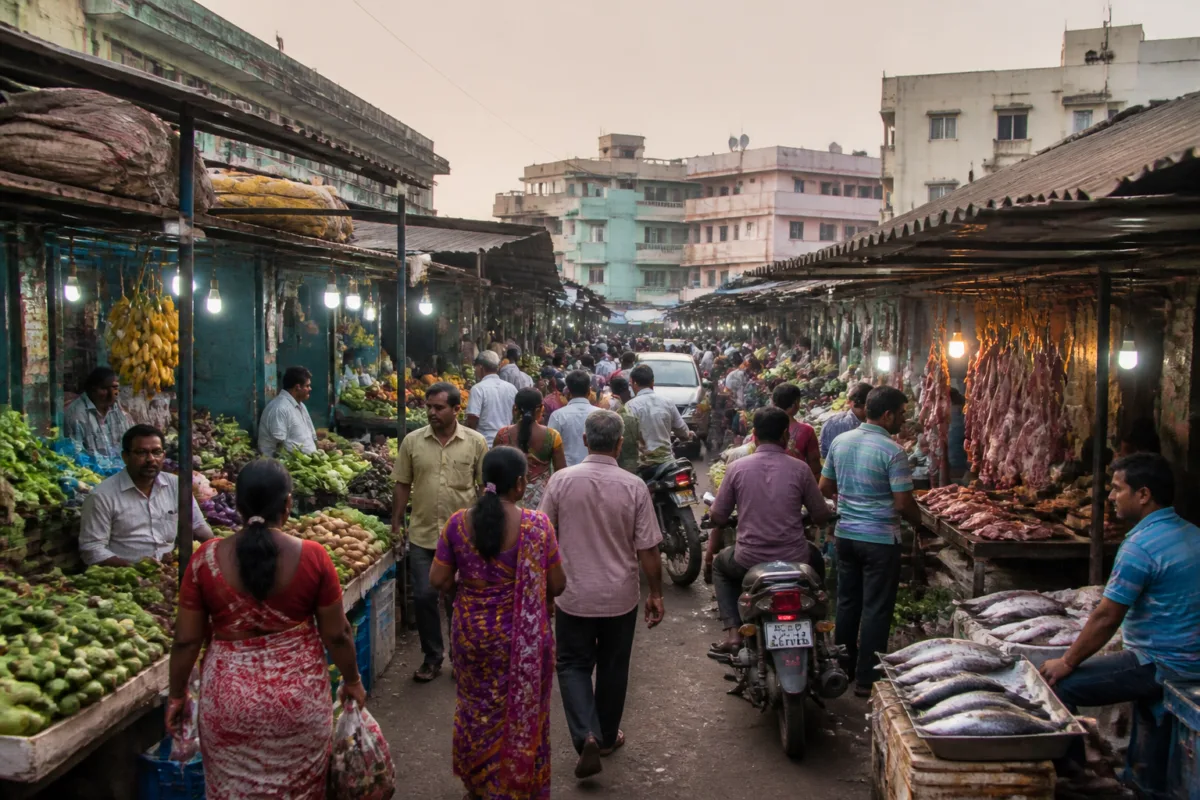
Bhubaneswar’s Unit-4 Market is not simply a place where vegetables, meat, groceries and household goods are bought and sold. Spread over nearly eight acres, the Bhoumanagar Haat supports around 1,200 traders and draws customers from several parts of the capital and nearby areas. Its reported shortage of toilets, waste management, lighting, parking, security and fire-safety arrangements shows how a market can become economically central while its public infrastructure remains inadequate.
The market was inaugurated on October 2, 1974, by then Chief Minister Nandini Satpathy. It was initially managed by the Department of Animal Husbandry before the Bhubaneswar Municipal Corporation took over in 1983. That administrative history matters because it places the market within the civic system rather than treating it only as a collection of private shops and vending spaces.
Over more than five decades, the market has developed into a commercial network with different types of formal and informal activity. The report identifies more than 300 vegetable shops, 38 grocery stores, 42 rice warehouses, 10 eateries, 39 wholesale non-vegetarian outlets and around 300 retail meat and fish shops. It also includes sellers of puja essentials, salons and other commodities. Traders operate from designated vending platforms, shop units and open spaces, creating a mixed marketplace whose requirements extend beyond those of a conventional enclosed retail complex.
That diversity is central to understanding the market’s infrastructure needs. A large vegetable and meat market requires regular waste collection, drainage, water access, washable surfaces, public toilets and clear movement routes. A wholesale component requires space for loading and unloading. Retail customers need safe pedestrian access, lighting and parking or managed vehicle movement. Security and fire protection become more important when many businesses operate close together and when cooking, electrical equipment and combustible materials are present.
According to the report, the market remains open daily from 6 am to around 10 pm, except on the last Tuesday of every month. Its operating hours cover the full daily cycle of a major urban market, from early procurement and trading to evening retail activity. This makes the reported absence of basic facilities a continuous public-management issue rather than a problem limited to occasional congestion.
The reported revenue structure also raises a clear governance question. When the BMC took over management, it initially collected a monthly tax of Rs 7 from each trader. The current charges are reported to be Rs 250 a month for vendors in designated vending spaces and open areas, and between Rs 1,500 and Rs 2,000 a month for shop owners. The report says the civic body collects lakhs of rupees in monthly revenue from the market, while traders allege that basic facilities have not kept pace with these collections.
The issue is not whether every rupee collected from a market must be spent within its boundary. Municipal bodies have wider responsibilities and revenue is generally pooled across services. But the market’s reported condition highlights the importance of a visible maintenance framework: who is responsible for toilets, cleaning, lighting, security, parking management and emergency preparedness; what service standards apply; and how complaints are tracked and closed.
The reported sanitation gap is particularly significant. The market is said to have no proper public toilet and only two urinals, which traders report are not cleaned regularly. Waste such as vegetable peels and other garbage is reportedly scattered across the premises. In a food market, organic waste is generated every day and can accumulate quickly if collection schedules, storage points and cleaning responsibilities are unclear. The report does not establish the precise volume of waste generated or the BMC’s current collection schedule, but it records a direct mismatch between the market’s scale and the facilities available to users.
The market’s layout and crowding create a second layer of difficulty. There is reportedly no designated parking area, leading customers to bring vehicles inside the premises. Congestion is said to be especially severe on busy days and in the non-vegetarian section. This is a familiar urban-market problem: when customer access, vendor activity, loading, parking and pedestrian movement are not separated, the internal circulation space becomes the default solution for every competing use.
The consequences are experienced by both traders and customers. A vehicle entering a crowded market can obstruct people carrying goods, slow deliveries and make it harder for emergency services to reach the premises. Yet the source does not provide a formal traffic assessment or an officially approved circulation plan. The evidence therefore supports a description of reported congestion, not a conclusion about the exact causes or the scale of operational risk.
Lighting, security and fire safety form another cluster of reported deficiencies. The market is said to lack adequate lighting, security guards and CCTV cameras, as well as proper fire-safety arrangements. These are not cosmetic additions. The long operating hours mean that parts of the market function in low-light conditions, while the concentration of shops and storage spaces makes emergency access and response relevant to everyday management.
The absence of reported fire-safety arrangements is especially important because the market combines dense commercial activity with eateries, warehouses and multiple retail units. However, the supplied report does not state whether the premises have undergone a fire audit, whether extinguishers are present, or whether any authority has issued a compliance notice. Those questions remain open and would need documentary confirmation before stronger conclusions could be drawn.
Encroachment is also identified as a problem, with some traders allegedly occupying more space than officially allotted. This points to a further institutional challenge: markets require not only physical infrastructure but also an enforceable system of allocation and renewal. If designated spaces are not clearly marked or periodically monitored, additional occupation can narrow walkways, intensify congestion and make service delivery more difficult. The report does not quantify the alleged encroachments or identify specific enforcement action.
The Bhouma Nagar Haat Traders’ Association has reportedly submitted written complaints and demands to the BMC seeking improvements in civic amenities. Traders claim that no concrete action has followed. This account is attributed to the association and the report does not include a response from the BMC. That missing response is important because the municipal corporation is the market’s managing authority and would be expected to clarify the status of complaints, maintenance contracts, proposed works and any budgetary or legal constraints.
The market’s role extends beyond its immediate premises. Traders come from Keshura, Nakhara, Athagarh and Cuttack, as well as different parts of Bhubaneswar. Customers reportedly travel from Shastri Nagar, Nayapalli, Acharya Vihar, Saheed Nagar, Unit-2, IRC Village and Laxmisagar. This catchment gives Unit-4 Market a citywide and peri-urban function. Its condition therefore affects not only individual shopkeepers but also food access, household shopping patterns and the movement of people and goods across the capital.
Its social and cultural role adds another layer. The market houses three Trinath temples as well as temples dedicated to Lord Hanuman, Lord Shani and Goddess Tarini. Ganesh Puja, a Makar Mela and temple foundation-day celebrations are held there. These activities mean that the market is also a recurring public gathering space. During festivals, the demands on sanitation, crowd management, lighting and access can increase, although the source does not provide attendance figures or details of special arrangements.
The market’s history also shows why urban management cannot be reduced to new construction. Unit-4 Market has evolved over 52 years through changes in administration, trading patterns and the growth of Bhubaneswar’s surrounding neighbourhoods. Its current mix of formal shops, vending platforms, open spaces, warehouses, eateries and places of worship reflects incremental urban development. Such places often remain functional because traders and customers adapt continuously, even when civic systems do not evolve at the same pace.
The central evidence from the report is therefore institutional rather than merely physical. Unit-4 Market has a defined managing authority, a traders’ association, a large revenue base and a substantial user population. Yet the reported problems concern the most basic functions of a public commercial space: cleanliness, sanitation, safe movement, lighting, security and emergency preparedness. The gap suggests that the question is not only whether the market needs redevelopment, but whether routine municipal management is being delivered and measured.
The supplied material does not establish whether the BMC has approved a modernisation plan, allocated funds, commissioned a safety audit or scheduled specific works. It also does not provide independent inspection findings, expenditure details or a formal municipal response. Those are the facts that would determine whether the reported deficiencies are temporary, chronic or already under remediation.
What is established is that Bhubaneswar’s Unit-4 Market remains a major urban livelihood and retail node while traders report that its civic infrastructure has not matched its scale. The next meaningful developments are likely to depend on the BMC’s response to the written complaints, its clarification of revenue and maintenance responsibilities, and any documented plan for sanitation, circulation, security and fire safety. Until those details emerge, the market stands as a visible example of how an economically successful urban institution can continue to operate with inadequate public facilities.

