


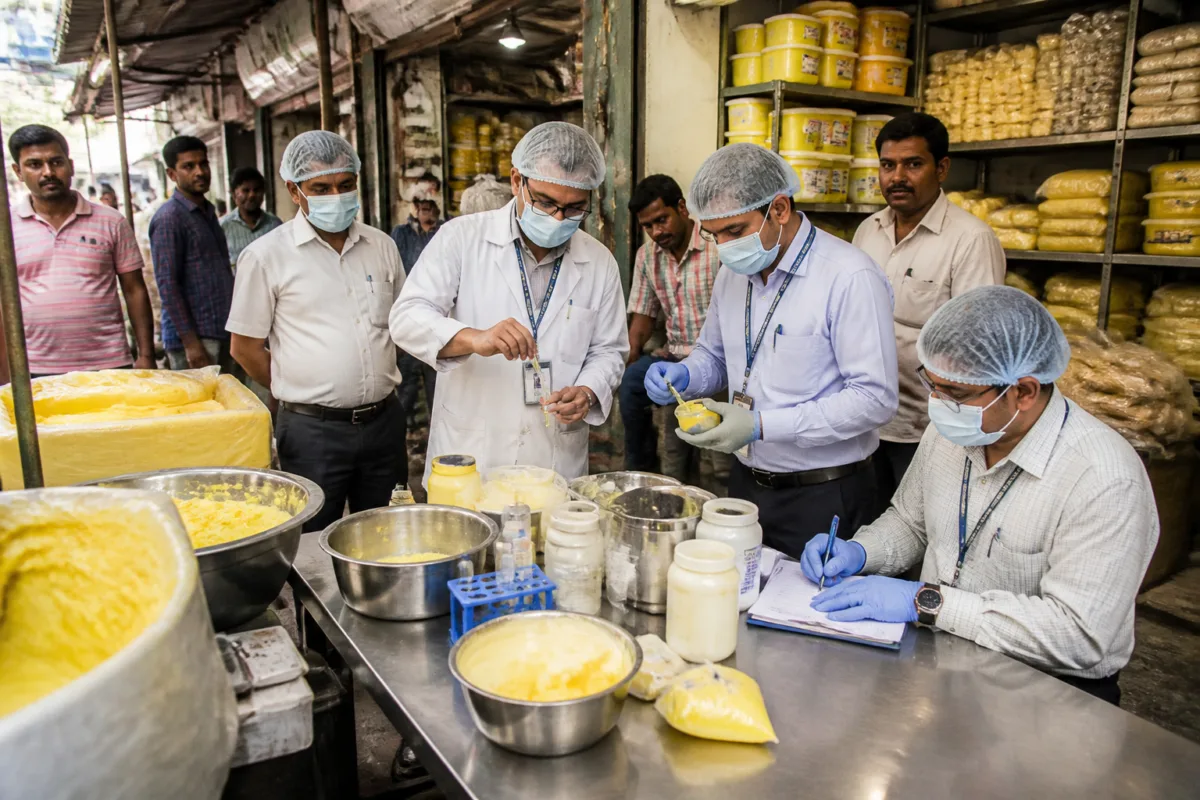
The Ahmedabad Municipal Corporation’s health and food department inspected ghee manufacturers and wholesale traders in Madhupura market ahead of the Diwali and New Year festivities, conducting preliminary rapid tests on around 25 brands and sending statutory samples for detailed laboratory analysis.
The inspections were carried out by multiple health department teams at Ahmedabad’s principal wholesale centre for edible oils and ghee. The civic action was aimed at checking the quality of products being sold during the festival period, when demand for ghee and other food items typically rises.
Food safety officers used a rapid testing method at the market to screen samples for possible adulteration. The test involved mixing ghee samples with hydrochloric acid and furfural solution as part of the Baudouin test. According to the report, a red colour change would indicate the possible presence of oil or vanaspati in the ghee.
No serious adulteration was detected in the preliminary on-the-spot tests conducted at the Madhupura establishments, and the initial samples were reported to have passed the screening. The inspection covered both packaged and loose quantities of cow and buffalo ghee across approximately 25 branded and local products.
However, the rapid test is only a preliminary screening tool and does not replace statutory laboratory testing. To avoid relying solely on the on-site results, the civic authorities collected separate statutory samples from the brands under the prescribed procedure.
These samples have been sent to the Public Health Laboratory for detailed microbiological and chemical analysis. The laboratory process is expected to establish whether the products comply with applicable food safety requirements beyond the limited adulteration indicators checked during the rapid screening.
The Madhupura inspection reflects the role of municipal food and health teams in monitoring high-volume wholesale markets during periods of increased festive consumption. Such markets connect manufacturers and bulk suppliers with retailers across the city, making their inspection important for tracing the quality of products entering the wider supply chain.
The civic department’s preliminary findings do not constitute a final clearance for all the products inspected. The statutory laboratory reports will determine whether any further action is required against specific manufacturers, brands or traders. The samples remain under examination at the Public Health Laboratory.

