


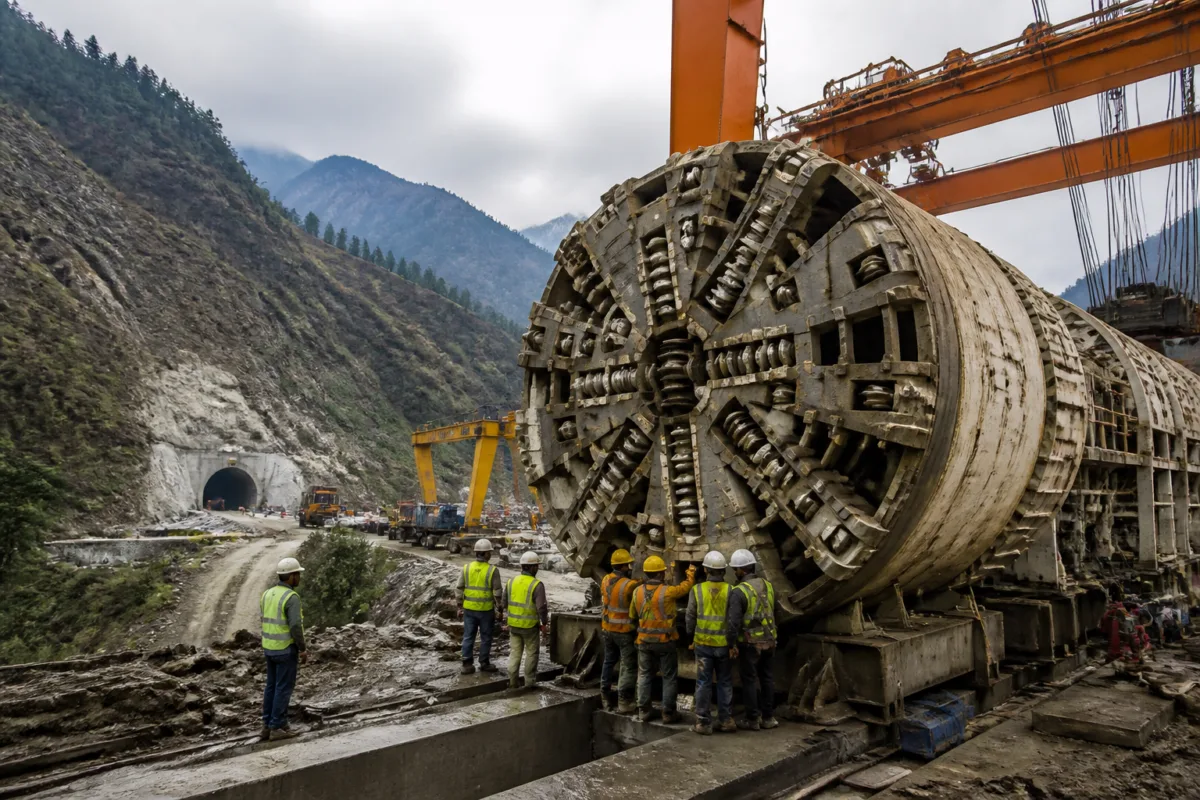
China’s decision to tighten export controls on tunnel-boring machines and related construction equipment has exposed a critical weakness in India’s infrastructure plans: the country wants to build more tunnels, roads, railways and metro systems, but still depends heavily on overseas manufacturers for some of the most specialised machines required to do so. The restrictions, due to take effect later this month, could affect both new procurement and the maintenance of equipment already operating on Indian projects.
The immediate concern is not simply whether India can buy another tunnel-boring machine. It is whether contractors can secure the complete industrial ecosystem behind one: specialised machinery, replacement parts, high-altitude concrete-spraying equipment, technical support and the components needed to keep large machines working in difficult terrain. That distinction matters because tunnel construction is a long-duration activity, and equipment failure can interrupt an entire project rather than merely delay a single purchase.
According to the Economic Times report, China’s new controls cover tunnel-boring machines and other construction equipment, including machines used to spray concrete at high altitudes. Beijing has cited the potential dual use of such equipment in civilian and military projects. It has also said that “sensitive countries and regions with disputes with China” will face stricter rules. The language has attracted particular attention in India because the two countries share a disputed Himalayan border and tensions in the region have flared repeatedly.
India is expanding roads and railway lines in the border region partly to reduce troop mobilisation times. Those projects require extensive tunnelling through difficult mountain terrain. The inclusion of high-altitude machinery therefore carries a significance beyond ordinary commercial trade. Sun Chenghao, a fellow at Tsinghua University’s Center for International Security and Strategy, told the report that the inclusion could indicate attention to strategically sensitive terrain. He said China’s concern was where Chinese engineering capabilities were being used and whether they could strengthen another country’s military infrastructure.
The restrictions also extend a pattern of supply-chain dependence that has already affected Indian infrastructure procurement. In 2024, China delayed efforts by Germany’s Herrenknecht AG, which manufactures some of its boring machines in China, to sell equipment to India for projects including the Ahmedabad-Mumbai bullet train and the Delhi Metro. A Herrenknecht spokesperson said the company was studying the latest restrictions.
This history shows why substitution is not straightforward. Tunnel-boring machines are not standard catalogue products that can be replaced instantly by shifting to another supplier. Their size, engineering specifications, geology, project design and operating conditions all matter. India may be able to move equipment from one site to another for a priority project, but that would redistribute capacity rather than solve the underlying shortage.
Ajay Srivastava, founder of the Global Trade Research Initiative, said India could shift equipment from other sites for priority projects. He also identified a more immediate vulnerability: the new controls apply to components. Tunnel-boring machines face heavy wear and tear, making regular access to parts essential. Restrictions could therefore affect the existing stock of machines in India, even where the original procurement has already been completed.
That component risk is significant for a country with a growing construction pipeline. A machine that cannot obtain critical replacement parts can become commercially unusable even if it remains physically available at a project site. The resulting disruption would not necessarily appear as a formal cancellation. It could emerge through slower excavation, longer maintenance cycles, rescheduled contracts and higher costs for contractors and public agencies.
China’s position in the sector makes the exposure difficult to ignore. Chinese state media has placed the country’s global share of the tunnel-boring equipment industry at around 70 per cent. China Railway Engineering Equipment Group, described in the report as the top producer, says its equipment is used in 36 countries, including Denmark and France. This is not a market in which India is the only dependent customer, but India’s infrastructure ambitions give the issue particular importance.
The alternative suppliers mentioned in the report include manufacturers in Germany, the United States and Japan. Their presence means China does not have an absolute monopoly. But alternative production is not the same as immediately available production. Existing manufacturers may need to add capacity, qualify equipment for different geological conditions and establish supply arrangements for parts and maintenance. Chetna Kumar, a geoeconomics analyst for South Asia, said foreign equipment makers had an incentive to add capacity in large markets such as India as Chinese controls encouraged customers to reduce their dependence on China.
That creates a potential opportunity for India, but not an instant solution. The country is trying to build domestic capability at a time when the scale gap with China remains substantial. Road Transport and Highways Minister Nitin Gadkari has said India aims to invest up to $9.6 billion in tunnelling over the next five years and has urged local industry to manufacture boring machines. The government is also reportedly considering a $1.2 billion incentive plan for construction-equipment manufacturers.
These figures indicate the size of the demand that policymakers expect, but demand alone does not create a competitive manufacturing industry. Tunnel-boring equipment combines heavy engineering, precision manufacturing, electronics, materials, software and after-sales service. It also requires operating experience across different ground conditions. A domestic producer must compete not only on the price of the machine but also on reliability, delivery schedules, maintenance and the availability of replacement parts.
R. Shankar Raman, president of Larsen & Toubro, said the Mumbai-based engineering company was building a prototype tunnel-borer. He added that if the experiment proved successful, the company might be able to source its own machinery and sell it to others. His comments illustrate both the opportunity and the distance still to be covered: one of India’s largest engineering companies is exploring domestic production, but the effort remains at the prototype stage.
Cost is another barrier. Raman said India was at an earlier phase of manufacturing while China produced equipment at scale. If buyers continued comparing Indian products with lower-priced Chinese imports and sought ways to continue importing from China, he said, India would remain at a disadvantage. This is the central policy tension. Strategic resilience may require domestic or diversified supply, but infrastructure agencies and contractors also face pressure to deliver projects within budgets and schedules.
The issue therefore extends beyond a narrow trade dispute. It brings together border infrastructure, public procurement, industrial policy and project execution. India’s roads, railways and metro systems are often discussed through the value of their civil works, but the machinery that creates those works can be just as strategically important. A tunnel project depends on a chain that runs from geological surveys and machine selection to excavation, lining, concrete spraying, component supply and maintenance.
China’s controls also demonstrate how commercial dominance can become geopolitical leverage. Kyle Chan, a fellow at the Brookings Institution, said Beijing increasingly viewed its position as a global construction-equipment producer in strategic terms. He said the situation increased dependency risks and encouraged other countries to reduce their exposure to China. For India, that risk is concentrated in a sector linked to both civilian connectivity and strategic access to the Himalayan border.
The evidence supplied in the report does not establish that any Indian project has been cancelled or stopped because of the new controls. It does establish a more immediate exposure: procurement may become harder, parts may be less predictable and contractors may have to manage equipment across sites more carefully. The short-term effect will depend on the scope of licences, the treatment of components and the implementation of the controls.
The longer-term question is whether India can turn supply-chain pressure into manufacturing capability without making infrastructure delivery slower or more expensive. Foreign manufacturers may see an opportunity to expand in India, while domestic companies may receive policy support to develop tunnel-boring machines and associated equipment. But the report also makes clear that building a credible alternative requires scale, technical depth and a dependable maintenance network, not only an incentive announcement.
India’s infrastructure programme is consequently facing a test that begins before construction reaches the ground. The country needs to secure the tools, parts and industrial capabilities behind its tunnel ambitions, especially where projects serve both economic connectivity and strategic access. What happens next will depend on how Beijing applies the controls, how Indian agencies manage existing equipment, and whether proposed domestic manufacturing efforts move beyond prototypes into dependable production.

