


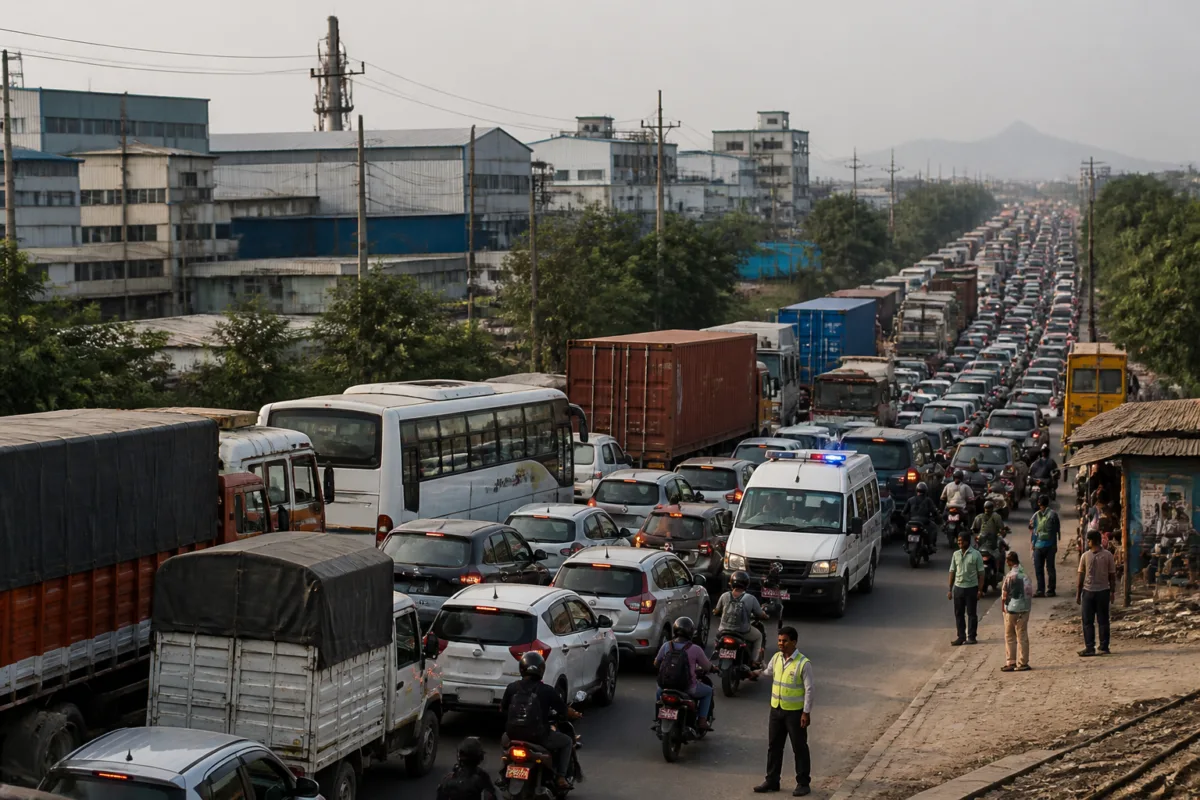
Traffic congestion in Chakan has stretched to seven to eight kilometres on routes linking Pune, Nashik, Talegaon and Shikrapur, disrupting workers, students, freight operators and emergency vehicles as industrial growth outpaces road capacity.
The congestion was reported from Friday night on the Pune-to-Nashik route, where vehicles moved slowly or remained stationary for hours. The affected network includes the Pune-Nashik highway and the Talegaon-Chakan-Shikrapur corridor, both of which carry heavy industrial and commuter traffic.
The Chakan industrial area has expanded alongside the Talegaon MIDC belt, while urbanisation and the movement of heavy vehicles have increased pressure on the roads. Thousands of trucks, containers, buses, private vehicles and two-wheelers use the corridors each day. The congestion is particularly severe during morning and evening industrial operating hours.
Traffic data cited in the report shows that daily traffic on National Highway 548D between Talegaon, Chakan and Shikrapur was around 12,000 to 15,000 passenger car units in 2016. Available 2026 figures place the daily volume between 39,197 and 40,839 passenger car units, indicating a substantial increase over the decade.
The Pune-Nashik highway has seen a similar rise. In 2016, the Bhosari-Moshi-Rajgurunagar stretch carried about 25,000 to 30,000 passenger car units a day, according to the report. In 2026, some sections between Nashik Phata and Chakan are reported to be carrying 75,000 to 85,000 passenger car units daily.
The queues have affected industrial workers travelling to and from factories, as well as schoolchildren, students and private transport users. Ambulances have also faced difficulty finding a clear passage, raising concerns about delays to emergency medical services.
Some encroachments have been removed in the Chakan area, but the road network has not been widened in line with the increase in traffic. Unauthorised auto-rickshaw stands and the growing number of rickshaws at Talegaon Chowk and Ambethan Chowk have also been identified as local obstructions. The report points to the need for regulated rickshaw stands, improved junction management and better traffic control.
Deputy Chief Minister Eknath Shinde and Industries Minister Uday Samant visited the area in August 2026 after concerns were raised about congestion, poor roads and the possible relocation of industrial units. The district administration had set 31 August as the deadline for filling potholes, carrying out temporary repairs and removing obstructions on highways and local roads.
The report states that pothole repairs and encroachment removal alone will not resolve the problem. Long-term measures identified include road widening, alternative routes, junction redesign, heavy-vehicle management and regulation of rickshaw stands. The next steps depend on how the relevant government agencies implement these measures across the industrial corridor.

